Help us get this right
Does this portrait look right for Qashqai?
One tap. It takes a second and it is recorded.
0 say it looks right, 1 says it looks off.
Qashqai Erotic
Fars Province (Iran)
Islam / Shia Islam
About Qashqai People
The Qashqai are a confederation of Turkic-speaking pastoralists whose annual rhythm has, for centuries, been organized around two journeys rather than one place. Their summer pastures sit in the high Zagros above Semirom; their winter quarters lie in the warmer lowlands toward the Persian Gulf. The migration between them — the kuch — is the spine of Qashqai identity, even now, when many families have settled in towns around Shiraz and only a fraction still move with the herds. The confederation is not a single tribe but an assembly of them: Amaleh, Darrehshuri, Kashkuli, Shesh Boluki, Farsi Madan, and Qarachahi, each with its own leadership and its own pasture rights, historically held together under the Ilkhani.
Their language, Qashqai, sits firmly in the Oghuz branch of Turkic — closer to Azerbaijani than to the Turkmen east, and quite distinct from the Persian spoken all around them. Most Qashqai are functionally bilingual in Persian, and the language has absorbed a heavy Persian vocabulary over generations of close contact, but the grammatical bones remain Turkic. It is overwhelmingly an oral language; literacy, where it exists, is in Persian. The group is Shia Muslim, like the Iranian majority, though religious practice in the camps tends to be lighter on clerical formality and heavier on seasonal observance and lineage tradition.
Politically, the Qashqai have a long memory of friction with the central state. Reza Shah's forced settlement campaigns in the 1930s broke up the migration routes by decree, and the confederation reasserted itself only after his abdication. They sided with Mosaddegh during the oil nationalization period, and the post-1953 settlement was unkind to their leadership; the Ilkhani structure was effectively dismantled, and several leading figures spent decades in exile. The 1979 revolution did not restore the old order. What survives today is cultural rather than political — a confederation in name, a network of families in practice.
The Qashqai are best known abroad for their weaving. Their gabbeh and kilim work is unusually unconcerned with the formal medallion-and-border conventions of city carpets; the designs are looser, more figurative, and woven from memory rather than from a cartoon. Camp life centers on the black goat-hair tent, the siah chador, and on a strict division of labor in which women handle the wool from shearing through to the finished rug. It is one of the few remaining pastoral economies in Iran where the textile is not a souvenir but a working object.
Related ethnic groups
Groups that share Qashqai's homeland, region, language, or religious tradition. These are likely candidates for comparative phenotype reference.
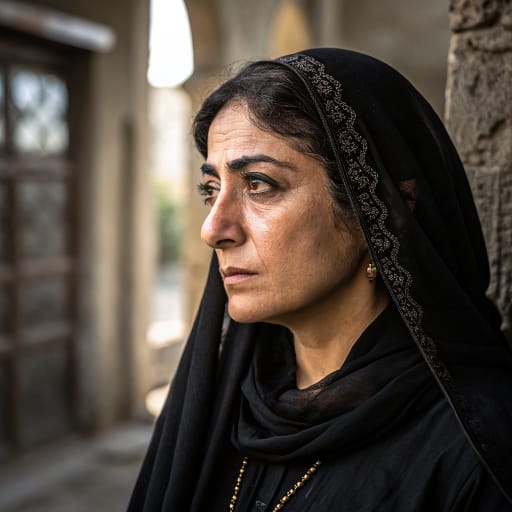
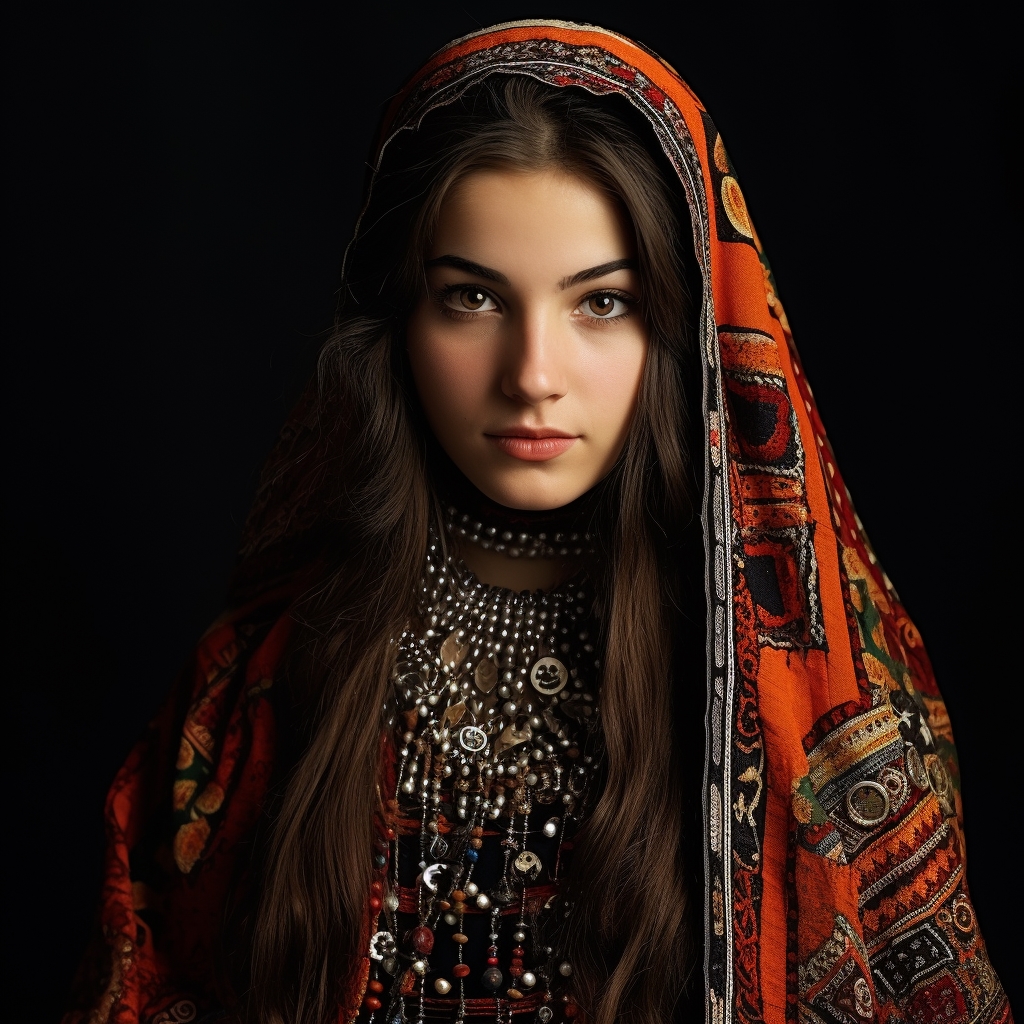
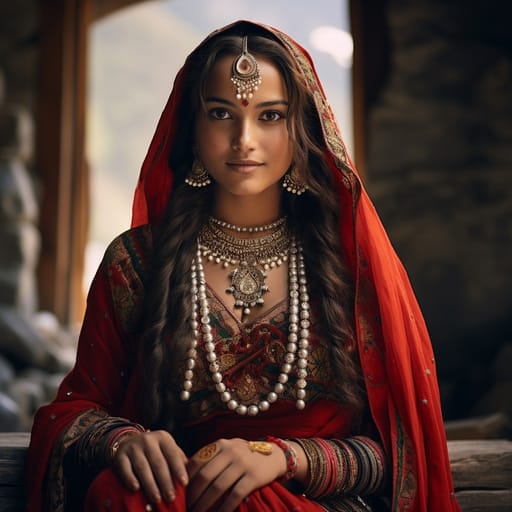
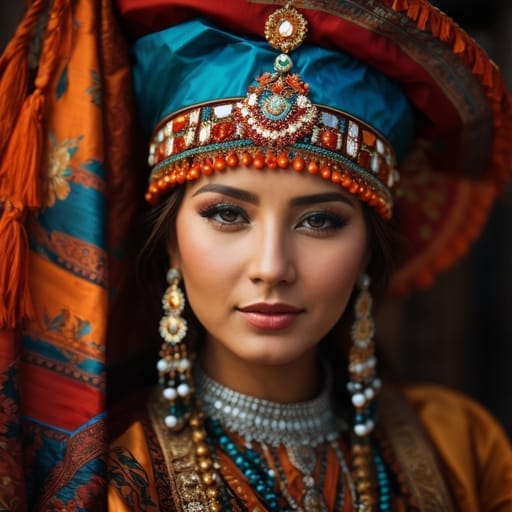
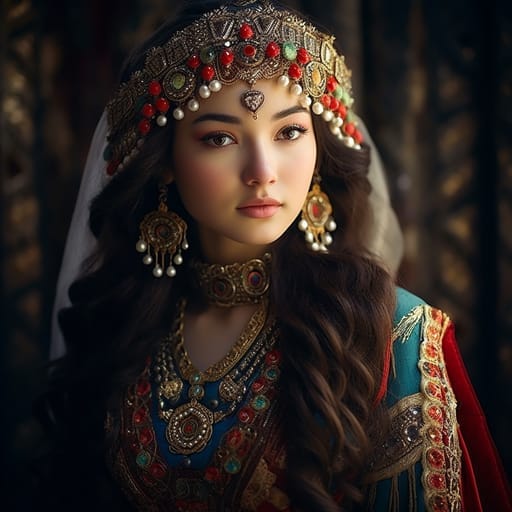
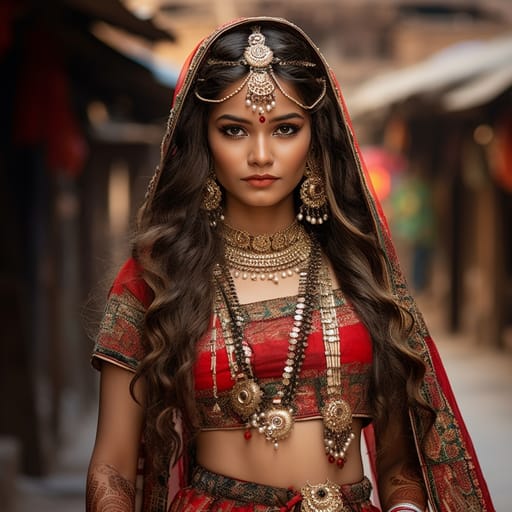
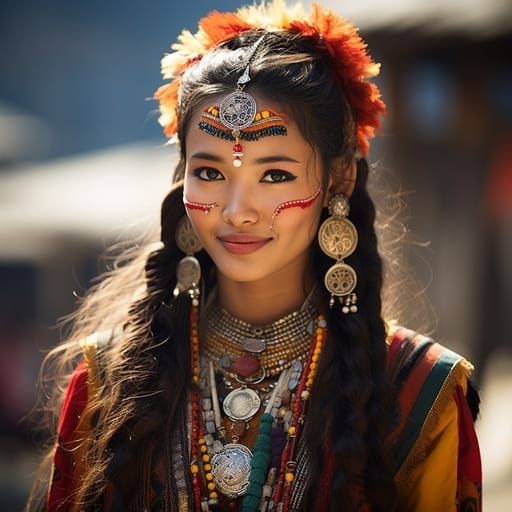
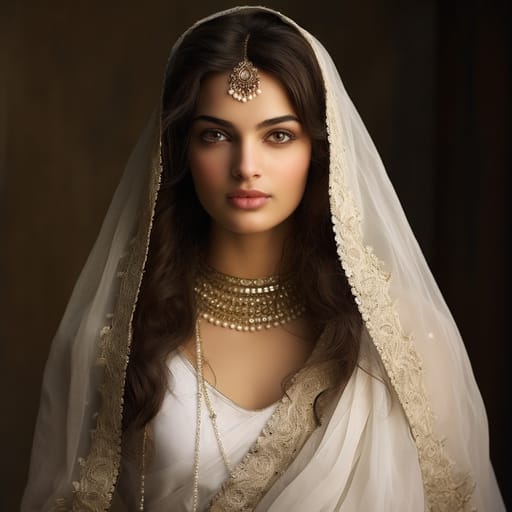
Geographic Distribution: Qashqai populations across 1 country
Each row is ranked by the group's share of that country's population, with the source citation drawn from published census and demographic surveys. Click through for the full per-country phenotype profile.
| Country | Share | Source |
|---|---|---|
| Iran | 1.0% | Estimates; Qashqai (~1%, ~1M+); concentrated in southwestern Iran (Fars, Khuzestan, Bushehr provinces). Turkic-language pastoral-nomadic confederation |
Typical Qashqai Phenotypes
Reference for AI generation: hair, eyes, skin, facial structure, build
The Qashqai are a Turkic-speaking nomadic confederation of Fars Province whose phenotype reflects centuries on the Zagros plateau as a Turkic population layered onto an Iranian substrate. The result reads as visibly Iranian with recurring Inner Asian markers — sharper cheekbones, a slightly broader midface, and occasional eye-fold traces you don't typically see in neighboring Persian or Lur populations.
Hair is overwhelmingly dark — coffee-brown to near-black — with a meaningful minority of medium chestnut and warm auburn shades, especially among women in the Amaleh and Darreshuri branches. Texture runs straight to loose-wave; tight curl is uncommon. Greying tends to come in early at the temples for men, and bone-white hair past sixty is almost a cultural marker in elder portraits. Eyes are most often dark brown, but hazel and grey-green appear at notably higher rates than in lowland Fars — a frequent giveaway of Qashqai background. Eyelids are typically Iranian in form, but a soft, partial epicanthic fold turns up often enough to be recognizable, especially in children and older women.
Skin sits in Fitzpatrick III–IV, with warm olive and golden-wheat undertones; the nomadic life produces a deep, weathered tan on exposed faces and forearms while torso skin stays markedly lighter. Noses are usually straight to slightly aquiline with a moderate bridge — less prominent than the classic Persian profile, less flat than Turkmen. Lips are medium full, mouths wide. Jawlines tend to be square in men and softly angular in women, with high, forward cheekbones that catch light strongly — a feature visible in figures like Milad Beigi.
Build is wiry and durable rather than tall: men commonly 168–175 cm, women 155–162 cm, with narrow hips, strong shoulders, and lean musculature shaped by horseback and migration on foot. The combined signature is Iranian coloring with quietly Turkic bone structure — recognizable across the Amaleh, Darreshuri, Kashkuli, Farsimadan, and Shesh Boluki sub-tribes despite minor local variation.
Data depth
46/100Coverage of image-grounded phenotype observations · drives AI generation diversity
- Sample size
- 6/40· 2 images
- Image quality
- 25/30· 50% high
- Confidence
- 15/20· mean 0.80
- Source diversity
- 0/10· wikipedia
- ·No image observations yet
- ·Wikipedia-only source, not population-representative
Explore phenotype categories
Structured taxonomy with peer-reviewed scales · 22 anatomical categories
Notable Qashqai People
3 reference figures, sourced from Wikipedia
- Milad Beigi, taekwondo practitioner
- Ismail Khan Qashqai, born 1257 AH / 1295 AH to 1931), tribal leader
- Mohammad Bahmanbeigi, 26 Bahman 1298 to 11 May 1389), writer and founder of nomadic education in Iran
Erotic Poses & Sex Positions
From the pose catalog: 219 named positions with reference skeletons
Frequently asked questions about Qashqai people
Where is the Qashqai homeland?
The Qashqai homeland is Fars Province (Iran) in Southern Asia.
What countries do Qashqai people live in?
Qashqai populations are documented across 1 country: Iran.
What language do Qashqai people speak?
Qashqai people primarily speak Turkic / Oghuz / Qashqai.
What religion do Qashqai people practice?
The predominant religion among Qashqai people is Islam / Shia Islam.






Make your own Qashqai images
Five a day, free, no credits to buy. The studio starts from this group's phenotype data, so you can set body type, pose and style and keep the traits accurate.
Start with Qashqai