Help us get this right
Does this portrait look right for Khomani San?
One tap. It takes a second and it is recorded.
1 says it looks right, 0 say it looks off.
Khomani San Erotic
Southern Kalahari, Northern Cape, South Africa
Nǁng (Nǀuu), Tuu family; also Nama and Afrikaans
Traditional San beliefs (with Christianity)
About Khomani San People
The ǂKhomani San (also written Khomani) are a San people of the southern Kalahari in South Africa's Northern Cape province, living in and around the Kgalagadi Transfrontier Park along the borders with Botswana and Namibia. They are descendants of the region's oldest inhabitants, hunter-gatherers whose presence in southern Africa reaches back many thousands of years. Their self-identifying membership today is generally counted in the low thousands.
Their ancestral language is Nǁng (also called Nǀuu), a member of the Tuu family and one of the world's most critically endangered languages, spoken fluently by only a handful of elderly people. Most ǂKhomani today speak Nama, Afrikaans, and other regional languages.
History and society
For generations the ǂKhomani foraged across the dunes and dry riverbeds of the Kalahari, hunting antelope and gathering tsamma melons, wild tubers, and bush foods adapted to an arid environment. The creation of the Kalahari Gemsbok Park in the 1930s dispossessed many families of their land, scattering the community and nearly erasing its distinct identity. In a landmark 1999 land claim, the post-apartheid South African government restored land and heritage rights to the ǂKhomani, an event that catalysed a cultural revival. The community now works to document its language, revive tracking and craft traditions, and pass ecological knowledge to younger generations. Social organisation was traditionally egalitarian and band-based, with sharing, consensus, and extended kinship at its core.
Appearance and adornment
In common with other San peoples, the ǂKhomani are typically of short to medium stature, with tawny to yellowish-brown skin, high cheekbones, epicanthic eye folds, and tightly curled hair. Traditional dress made use of softened animal hides: leather aprons and cloak-like karosses that doubled as blankets and carrying garments. Ornamentation featured ostrich-eggshell beads worked into necklaces, headbands, and bracelets, a craft still practised and now central to the community's cultural economy. Ritual life historically included the trance or healing dance, in which the community gathered around fire while healers entered altered states to draw out sickness, a practice widely shared among San peoples. Belief centred on a creator, ancestral spirits, and a close relationship with the animals and plants of the desert.
Related ethnic groups
Groups that share Khomani San's homeland, region, language, or religious tradition. These are likely candidates for comparative phenotype reference.
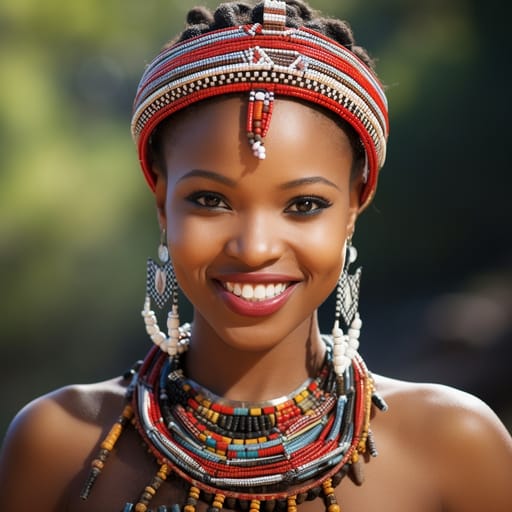
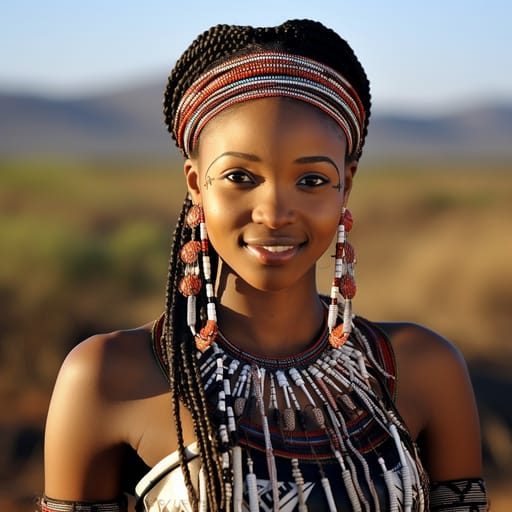
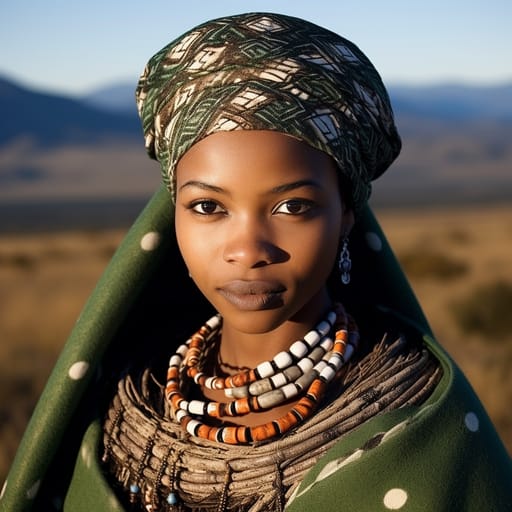
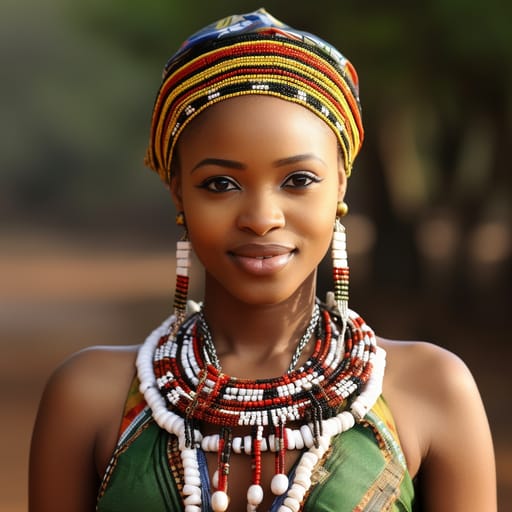
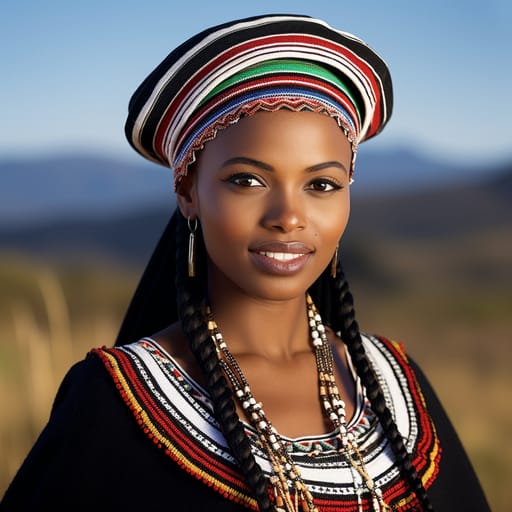

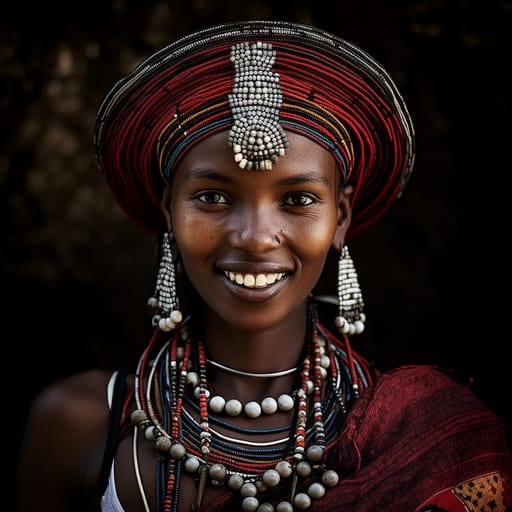
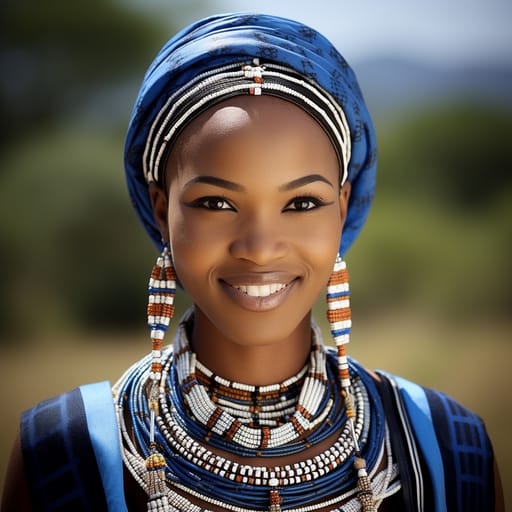
Typical Khomani San Phenotypes
Reference for AI generation: hair, eyes, skin, facial structure, build
Khomani San Body & Anatomy Reference
Per-feature anatomical profile for AI nude generation: Bantu / Khoisan Southern African phenotype
Khomani San Boobs & Breasts
The typical Khomani San bust is medium cup, full but moderate projection, in line with the wider Bantu / Khoisan Southern African pattern. Areolas usually fall in the 30-44mm range, with medium-brown to deep-brown areolar pigmentation. Compared with the heavier West African bust, Khomani San breasts sit forward and are generally moderately full; less projecting than West African norm. A faithful AI render of Khomani San tits keeps that shape and areola size.
Khomani San Ass & Hips
Butt shape among Khomani San women: the distinctive Khoisan-influenced steatopygic profile in some sub-populations (San, Khoekhoe); broader gluteal projection in Bantu-speaking groups, over wide iliac crests with notable lordosis in Khoisan-descended sub-populations. This follows Bantu / Khoisan Southern African ancestry and looks quite unlike the slim Cushitic East African profile. An accurate Khomani San ass in adult AI imagery keeps both the silhouette and the overall build (mesomorph; Khoisan-descended sub-populations show distinctive steatopygic fat deposition) instead of a generic average.
Khomani San Vagina & Pussy
Vulvar anatomy among Khomani San women: deep-brown labial pigmentation; the elongated labia minora documented in some Khoisan-descended populations. Pubic hair tends to be tightly-coiled coarse texture, in the usual inverted-triangle pattern. Both follow Bantu / Khoisan Southern African pigmentation, which is why Khomani San pussy renders should not fall back on a pale, sparse Western template.
Khomani San Dicks & Penis
The Khomani San cock profile, from Bantu / Khoisan Southern African anthropometric data: regional mean ~14cm erect; moderate-to-above-average girth; deep-brown shaft pigmentation. Pubic hair has a tightly-coiled coarse texture and forms the usual inverted-V pattern. Whether Khomani San men are circumcised follows religious and cultural practice rather than phenotype.
Khomani San Body, Curves & Build
Build and curves among Khomani San women follow the Bantu / Khoisan Southern African pattern: mesomorph; Khoisan-descended sub-populations show distinctive steatopygic fat deposition, mean adult female BMI 24-28. Proportions matter as much as skin tone, so Khomani San figures should keep their regional height and limb ratios.
Khomani San Skin Tone & Hair Texture
The Khomani San skin range is medium-brown to deep-brown (Fitzpatrick V-VI); lighter in Khoisan-descended populations, and hair tends to be tightly-coiled 4A-4C; the distinctive 'peppercorn' tight-spiral texture in Khoisan-descended populations. That combination marks the Bantu / Khoisan Southern African phenotype, and skin tone is the trait AI generators most often get wrong for Khomani San women.
Explore phenotype categories
Structured taxonomy with peer-reviewed scales · 22 anatomical categories
Erotic Poses & Sex Positions
From the pose catalog: 219 named positions with reference skeletons
Frequently asked questions about Khomani San people
Where is the Khomani San homeland?
The Khomani San homeland is Southern Kalahari, Northern Cape, South Africa in Southern Africa.
What language do Khomani San people speak?
Khomani San people primarily speak Nǁng (Nǀuu), Tuu family; also Nama and Afrikaans.
What religion do Khomani San people practice?
The predominant religion among Khomani San people is Traditional San beliefs (with Christianity).






Make your own Khomani San images
Five a day, free, no credits to buy. The studio starts from this group's phenotype data, so you can set body type, pose and style and keep the traits accurate.
Start with Khomani San