Help us get this right
Does this portrait look right for Houma?
Nobody has judged this one yet. You would be the first.
Houma Erotic
Coastal southeastern Louisiana, United States, chiefly Terrebonne, Lafourche, Jefferson, St. Mary, St. Bernard and Plaquemines parishes. Historically the east bank of the Mississippi near the Red River, in present-day Mississippi and northern Louisiana.
English and Louisiana French, including a distinct Houma French dialect (Indo-European, Romance). Historically a Western Muskogean language (Muskogean), no longer spoken.
Predominantly Roman Catholic, with Methodist and Baptist congregations in some communities. Traiteur folk healing persists alongside church practice.
Southeastern Woodlands peoples. The United Houma Nation is the largest body; the Pointe-au-Chien Indian Tribe and the Biloxi-Chitimacha Confederation bands, including Grand Caillou/Dulac, Isle de Jean Charles and Bayou Lafourche, are related communities t
About Houma People
The Houma are a bayou people by circumstance rather than by origin. When the French first wrote them down in the 1680s they were living well upriver, on the east bank of the Mississippi near the mouth of the Red River, in country that is now Mississippi and northeastern Louisiana. The name comes from the Western Muskogean word for red, and Iberville's journals record a red-painted boundary post marking the line between Houma and Bayogoula hunting grounds. That post is where Baton Rouge got its name. Within a century the Houma themselves had moved almost the whole length of the state, pushed down the Mississippi by war, disease and colonial settlement until they reached the marshes of Terrebonne and Lafourche, the last land anyone else wanted.
What they built there is the thing that defines them now. Houma families settled the ridges along the bayous, spoke French rather than English, married French, Acadian and other Native neighbors, and made a living from water: shrimping, oystering, crabbing, trapping muskrat and nutria, gathering and curing Spanish moss for mattress stuffing. Palmetto is still coiled into baskets and hats by a small number of makers using a half-hitch stitch that is theirs and not their neighbors'. The Muskogean language did not survive the move. A Louisiana French dialect took its place and held for two centuries, and English is only now finishing the job. Catholicism arrived with the French and stuck, though Methodist missions at Dulac and Grand Caillou drew congregations of their own, and the traiteur, the treater who prays over a burn or a sprain, still works in some communities alongside the parish priest.
Two things sit at the center of Houma life in the present. One is recognition. Louisiana recognized the United Houma Nation in 1972, and roughly 17,000 people are enrolled across six coastal parishes, but federal acknowledgment has been sought for decades without success, and several bands have separated to press their own claims. The other is the ground itself. Houma children were kept out of white public schools in Terrebonne and Lafourche until the 1960s, a segregation that cost a generation its schooling, and the land those same families held is now dissolving. Levees starve the marsh of sediment, oil company canals let salt water in, and hurricanes take what is left. Isle de Jean Charles has lost most of its land since the 1950s and became the subject of a federal resettlement program. Ida flattened much of the parish in 2021. People rebuilt anyway.
Related ethnic groups
Groups that share Houma's homeland, region, language, or religious tradition. These are likely candidates for comparative phenotype reference.


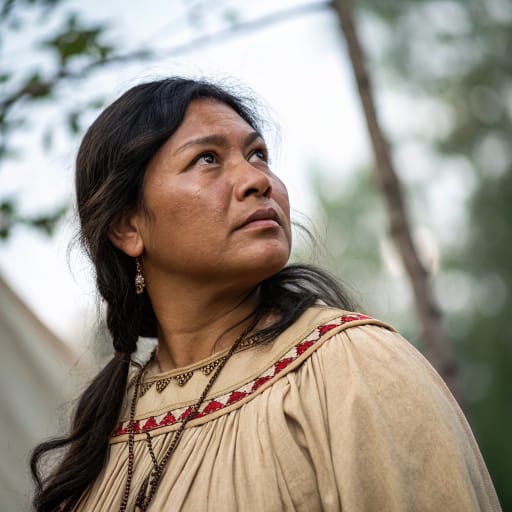
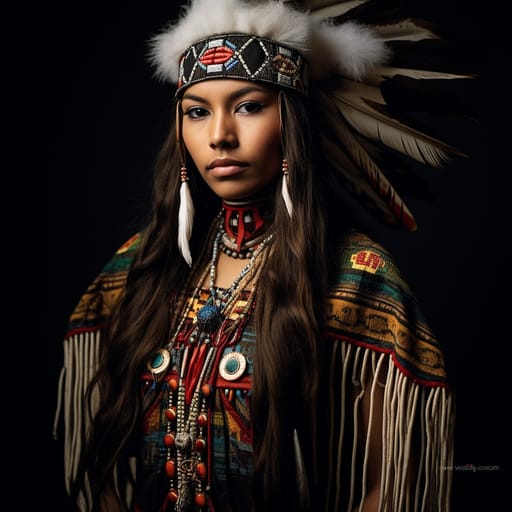
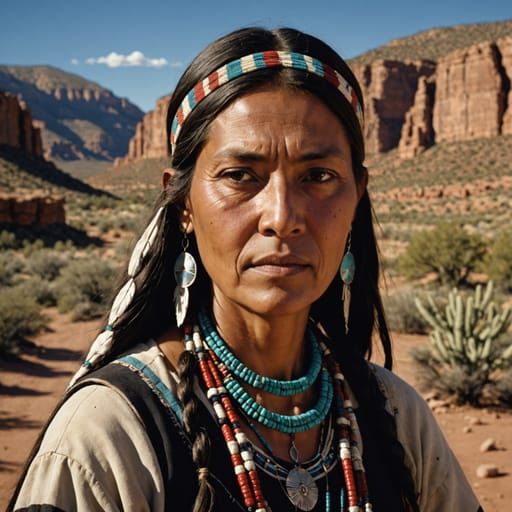
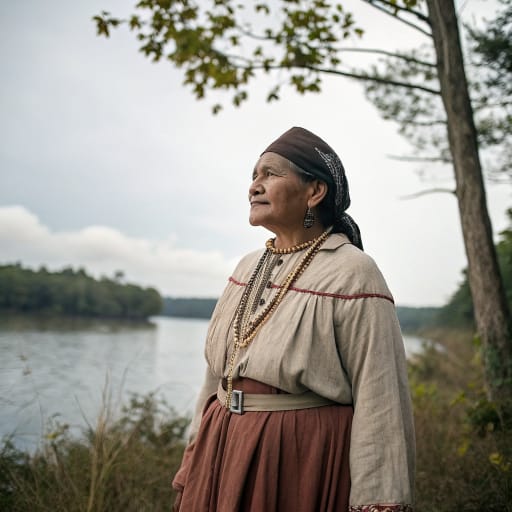
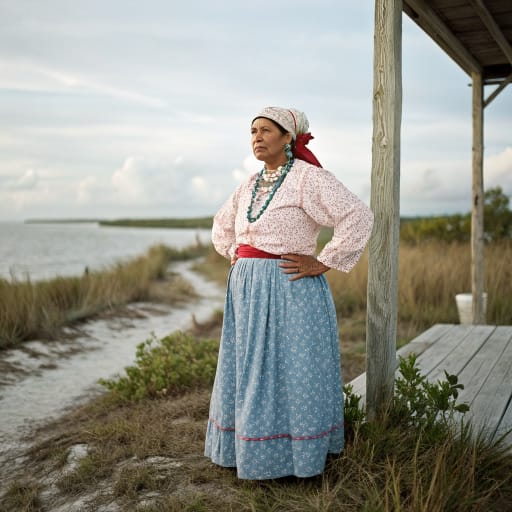
Typical Houma Phenotypes
Reference for AI generation: hair, eyes, skin, facial structure, build
Houma Body & Anatomy Reference
Per-feature anatomical profile for AI nude generation: Indigenous Northern American / Algonquian-Iroquoian phenotype
Houma Boobs & Breasts
Houma boobs follow the Indigenous Northern American / Algonquian-Iroquoian profile: medium cup, moderate projection. Areolar diameter is usually 30-44mm, and the coloring is medium-brown areolar pigmentation against the copper-to-medium-brown skin tone. Breast shape tracks body composition (mesomorph, broader frame in northern Indigenous populations, mean adult female BMI 25-28), so Houma breasts tend to be full and moderate projection. Expect a forward-set shape, not the smaller East Asian bust.
Houma Ass & Hips
Houma ass and hip morphology presents as medium, moderate-to-full projection, distinctly different from the slim East Asian narrow-hip profile. The Houma pelvic profile shows medium iliac crests, anchored in the Indigenous Northern American / Algonquian-Iroquoian skeletal pattern. Houma butt shots in adult AI imagery should render the medium, moderate-to-full projection silhouette with the overall build (mesomorph, broader frame in northern Indigenous populations) and the fat distribution typical of the Indigenous Northern American / Algonquian-Iroquoian phenotype.
Houma Vagina & Pussy
Houma pussy anatomy typically shows medium-brown labial pigmentation. Pubic hair is usually straight medium-coarse texture. In AI-generated Houma nudes, labial color should blend into the copper to medium-brown skin with a gradual transition, and the hair should keep its straight medium-coarse texture.
Houma Dicks & Penis
Penis reference for Houma men: regional mean ~13cm erect, moderate girth. Coloring: medium-brown shaft pigmentation. An accurate Houma cock in AI imagery matches the surrounding copper to medium-brown skin rather than a generic porn default. Circumcision depends on religion and custom, not ancestry.
Houma Body, Curves & Build
The Houma figure is generally mesomorph, broader frame in northern Indigenous populations, with mean adult female BMI 25-28, characteristic of Indigenous Northern American / Algonquian-Iroquoian ancestry. AI image tools tend to flatten regional body types into a few stock shapes; here the Houma build is kept as its own reference.
Houma Skin Tone & Hair Texture
Skin: copper to medium-brown (Fitzpatrick III-V). Hair: straight 1A, dark-brown to black, often thick and dense. Both are typical of Indigenous Northern American / Algonquian-Iroquoian ancestry. The most common mistake in AI nudes of Houma women is a body rendered lighter than the face.
Explore phenotype categories
Structured taxonomy with peer-reviewed scales · 22 anatomical categories
Erotic Poses & Sex Positions
From the pose catalog: 219 named positions with reference skeletons
Frequently asked questions about Houma people
Where is the Houma homeland?
The Houma homeland is Coastal southeastern Louisiana, United States, chiefly Terrebonne, Lafourche, Jefferson, St. Mary, St. Bernard and Plaquemines parishes. Historically the east bank of the Mississippi near the Red River, in present-day Mississippi and northern Louisiana. in North America.
What language do Houma people speak?
Houma people primarily speak English and Louisiana French, including a distinct Houma French dialect (Indo-European, Romance). Historically a Western Muskogean language (Muskogean), no longer spoken..
What religion do Houma people practice?
The predominant religion among Houma people is Predominantly Roman Catholic, with Methodist and Baptist congregations in some communities. Traiteur folk healing persists alongside church practice..






Make your own Houma images
Five a day, free, no credits to buy. The studio starts from this group's phenotype data, so you can set body type, pose and style and keep the traits accurate.
Start with Houma