No portrait yet
Gciriku Erotic
Along the Kavango (Okavango) River in Kavango East Region, northeastern Namibia, with a smaller population on the Angolan bank in Cuando Cubango Province
Rugciriku (Diriku), written together with Shambyu as Rumanyo (Bantu, Niger-Congo)
Mostly Christian, largely Roman Catholic, alongside continuing respect for ancestors and traditional authority
One of the five Kavango peoples, with the Kwangali, Mbunza, Shambyu and Mbukushu; closely tied to the Shambyu through the Rumanyo language
About Gciriku People
The Gciriku are a river people. Their homesteads follow the Kavango River across northeastern Namibia, and a smaller population lives on the Angolan bank. They are one of five Kavango kingdoms strung out along the river, with the Shambyu upstream and the Mbukushu downstream. Each kingdom keeps its own royal line and its own traditional authority. The river is also an international border, fixed by German and Portuguese colonial agreements in the late nineteenth century. That is why relatives and fields can sit in two countries, a short dugout crossing apart.
Their language, Rugciriku, is a Bantu language so close to Shambyu speech that Namibian schools, publishers and radio treat the two as one under the name Rumanyo. Its neighbors are related but not interchangeable: Kwangali further west, Mbukushu to the east. The spelling of the name holds a piece of history. The gc marks a click, a sound that Bantu languages in this part of the continent picked up through long contact with Khoe and San communities, whose descendants still live in the region.
Gciriku society is matrilineal, as it is across the Kavango kingdoms. Clan membership, and traditionally the right to rule, pass through the mother's line. The heir to a hompa, the title of the ruler, has customarily come from a sister's children rather than the ruler's own. The royal house still counts for something: it has a say in communal land, customary disputes and public occasions.
Christianity took hold in the early twentieth century, when Catholic missionaries opened a station at Nyangana. The mission, and later its school and hospital, became an anchor for the district. Most Gciriku today are Christian, many of them Catholic, and church life sits alongside older respect for the ancestors and for the royal line.
Daily life follows the river. Families grow mahangu, the pearl millet at the center of the regional diet, along with maize and sorghum. They keep cattle and fish the floodplains with nets and traps. Kavango woodcarving, sold from roadside stalls along the main highway, brings in visible income. The twentieth century brought harder turns: the apartheid-era Kavango homeland administration, a heavy South African military presence during Namibia's independence war, and spillover from Angola's civil war. Namibia became independent in 1990, and the old Kavango Region was split in 2013. Since then the Gciriku heartland has sat within Kavango East, where the kingdom and the modern state share authority.
Related ethnic groups
Groups that share Gciriku's homeland, region, language, or religious tradition. These are likely candidates for comparative phenotype reference.
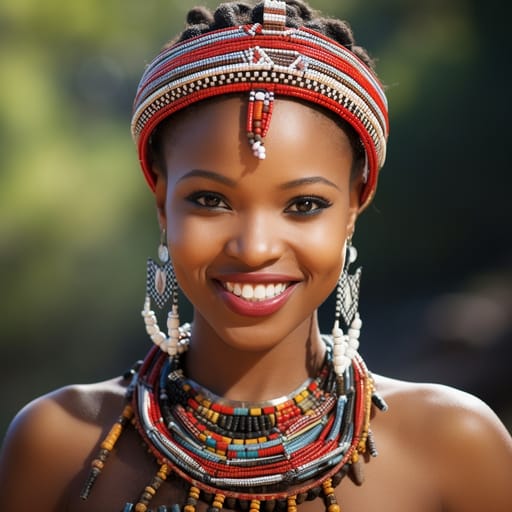
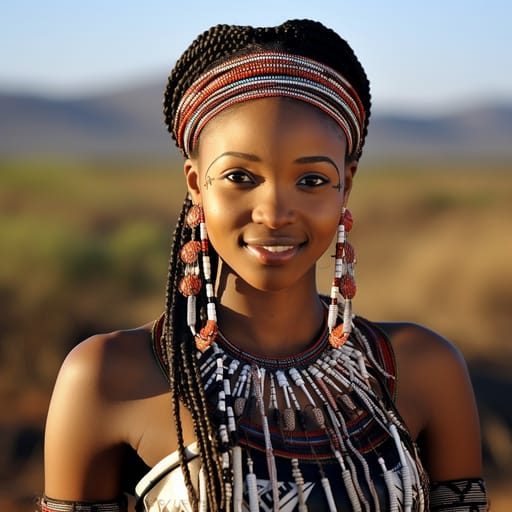
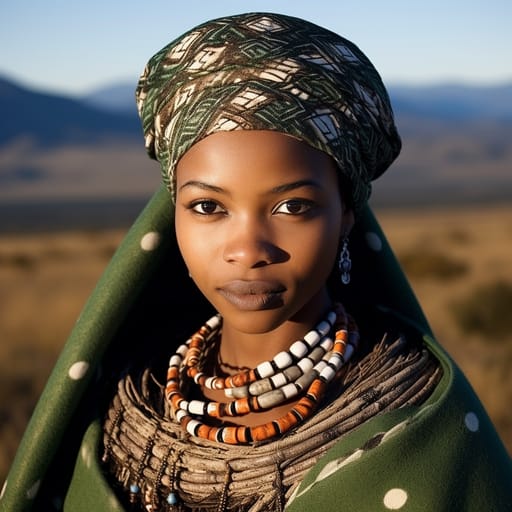
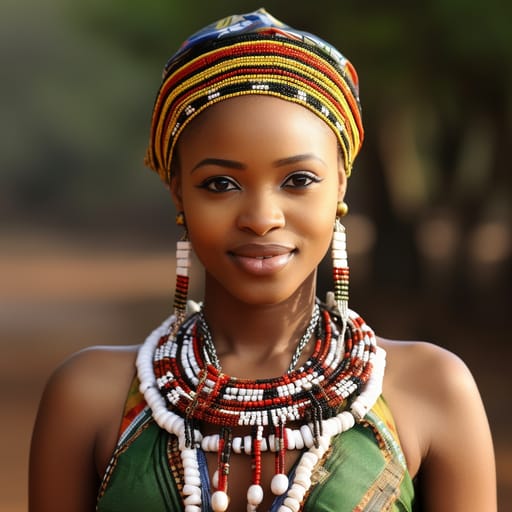
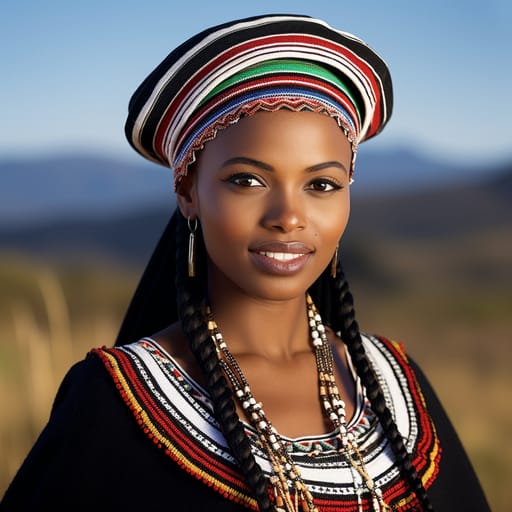

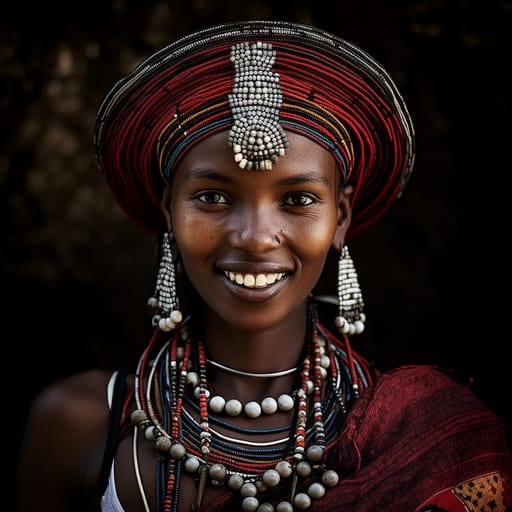
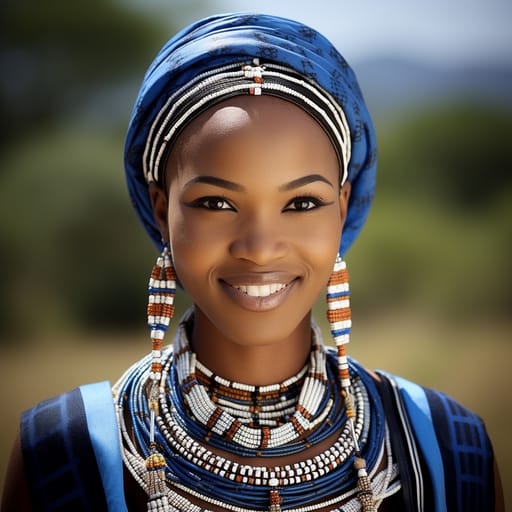
Typical Gciriku Phenotypes
Reference for AI generation: hair, eyes, skin, facial structure, build
Gciriku Body & Anatomy Reference
Anatomy by feature, Bantu / Khoisan Southern African phenotype
Gciriku Boobs & Breasts
Gciriku tits and boobs run medium cup, full but moderate projection, the classic Bantu / Khoisan Southern African bust profile. Gciriku nipples and areolas show medium-brown to deep-brown areolar pigmentation, with areolar diameter typically in the 30-44mm range and forward-set positioning rather than the heavier West African bust. Gciriku breasts trend moderately full; less projecting than West African norm, a function of the mesomorph; Khoisan-descended sub-populations show distinctive steatopygic fat deposition body habitus and the mean adult female BMI 24-28. For anatomically accurate AI-generated Gciriku nudes the render preserves the medium cup, full but moderate projection shape, 30-44mm areolas with medium-brown to deep-brown pigmentation, and the torso proportions of the Bantu / Khoisan Southern African phenotype.
Gciriku Ass & Hips
Gciriku hips and butt usually read as the distinctive Khoisan-influenced steatopygic profile in some sub-populations (San, Khoekhoe); broader gluteal projection in Bantu-speaking groups. The skeletal base is wide iliac crests with notable lordosis in Khoisan-descended sub-populations, the Bantu / Khoisan Southern African pattern. Set against the slim Cushitic East African profile, the difference is easy to see, and the hip-to-waist ratio is often what identifies Gciriku women in photos.
Gciriku Vagina & Pussy
Expect deep-brown labial pigmentation; the elongated labia minora documented in some Khoisan-descended populations on Gciriku women, in keeping with Bantu / Khoisan Southern African ancestry. The pubic hair is tightly-coiled coarse texture. Coloring should run evenly from the medium-brown to deep-brown skin of the thighs to the labia, and Gciriku nude imagery should keep the hair's tightly-coiled coarse texture.
Gciriku Dicks & Penis
Gciriku dick and penile anatomy in adult AI generation should anchor on the regional reference data: regional mean ~14cm erect, moderate-to-above-average girth, and deep-brown shaft pigmentation. The Gciriku cock profile reflects the Bantu / Khoisan Southern African population's anthropometric measurements. The shaft pigmentation should track the surrounding medium-brown to deep-brown skin tone, and the pubic hair should keep its tightly-coiled coarse texture in the typical inverted-V escutcheon.
Gciriku Body, Curves & Build
Gciriku body type: mesomorph; Khoisan-descended sub-populations show distinctive steatopygic fat deposition, with mean adult female BMI 24-28. This is the typical Bantu / Khoisan Southern African build. Height range, shoulder-to-hip ratio and fat distribution all follow from it, which is what an accurate Gciriku nude body should show.
Gciriku Skin Tone & Hair Texture
Gciriku skin tone falls in the medium-brown to deep-brown (Fitzpatrick V-VI); lighter in Khoisan-descended populations band, the surface signal most often miscalibrated by generic AI nude generators. Gciriku hair texture is typically tightly-coiled 4A-4C; the distinctive 'peppercorn' tight-spiral texture in Khoisan-descended populations, characteristic of the Bantu / Khoisan Southern African phenotype. In Gciriku nude renders the skin should hold that band consistently across the body.
Explore phenotype categories
Structured taxonomy with peer-reviewed scales · 22 anatomical categories
Erotic Poses & Sex Positions
From the pose catalog: 219 named positions with reference skeletons
Frequently asked questions about Gciriku people
Where is the Gciriku homeland?
The Gciriku homeland is Along the Kavango (Okavango) River in Kavango East Region, northeastern Namibia, with a smaller population on the Angolan bank in Cuando Cubango Province in Southern Africa.
What language do Gciriku people speak?
Gciriku people primarily speak Rugciriku (Diriku), written together with Shambyu as Rumanyo (Bantu, Niger-Congo).
What religion do Gciriku people practice?
The predominant religion among Gciriku people is Mostly Christian, largely Roman Catholic, alongside continuing respect for ancestors and traditional authority.






Make your own Gciriku images
Five a day, free, no credits to buy. The studio starts from this group's phenotype data, so you can set body type, pose and style and keep the traits accurate.
Start with Gciriku