Help us get this right
Does this portrait look right for Fon?
Nobody has judged this one yet. You would be the first.
Fon Erotic
Dahomey (Benin)
Christianity / Catholicism
Egun
About Fon People
The Fon are the people of the old Kingdom of Dahomey, the centralized state that ran the southern third of present-day Benin from the early seventeenth century until the French dismantled it in 1894. Their heartland is the plateau around Abomey, sloping down through Allada and Ouidah to the Atlantic coast — a stretch of palm groves, lagoons, and red-earth farmland rather than the dramatic geography people associate with West Africa. The Fon are the demographic core of Benin, and their language, also called Fon, belongs to the Gbe cluster of Kwa within Niger–Congo. Gbe is best understood as a chain of closely related tongues that shade into one another across the Benin–Togo–Nigeria border: Ewe to the west, Aja inland, Gen near the coast, with Fon as the eastern anchor. Speakers can usually follow neighboring varieties with effort, and the related Egun (Gun) of the Porto-Novo area are sometimes counted as a Fon sub-group, sometimes as kin rather than kin proper.
Dahomey is the historical fact that shapes everything about how the Fon present themselves. It was a militarized monarchy with a court bureaucracy, a standing army that famously included the women's regiment Europeans called the Amazons, and a deep, uncomfortable entanglement with the Atlantic slave trade through the port at Ouidah. That history is not a wound the Fon hide; the royal palaces at Abomey are a UNESCO site, the appliqué cloths of the court are a recognized art form, and the annual Vodun festival each January draws practitioners from across the Black Atlantic.
Catholicism took hold under French rule and remains the dominant institutional religion, but Fon religious life is rarely just one thing. Vodun — the indigenous system from which Haitian Vodou and Louisiana Voodoo descend — was never displaced, and most Fon households move between the two without much theological anxiety. A baptized Catholic may also keep a shrine to a family vodun, consult a bokonon diviner using the Fa system of sixteen signs, and observe obligations to ancestors at named festivals. The cuisine runs to maize and cassava porridges, palm-oil stews, and the fermented condiment afitin; agbo, the cloth-strip drumming and dance forms, and the praise-name traditions of the Abomey court all remain in active use rather than preserved as folklore.
Related ethnic groups
Groups that share Fon's homeland, region, language, or religious tradition. These are likely candidates for comparative phenotype reference.
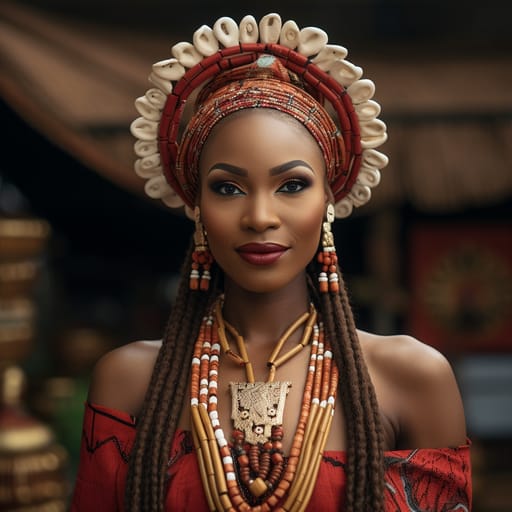
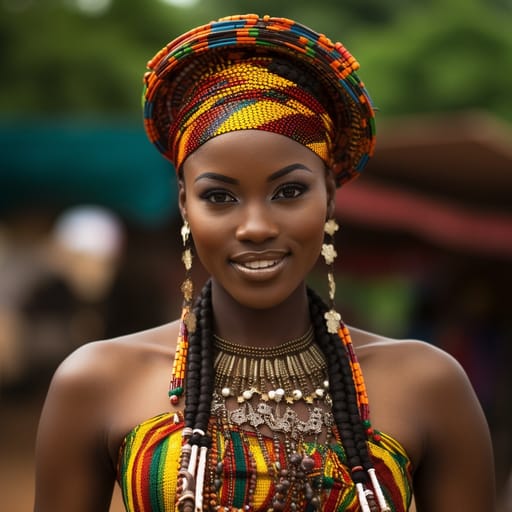
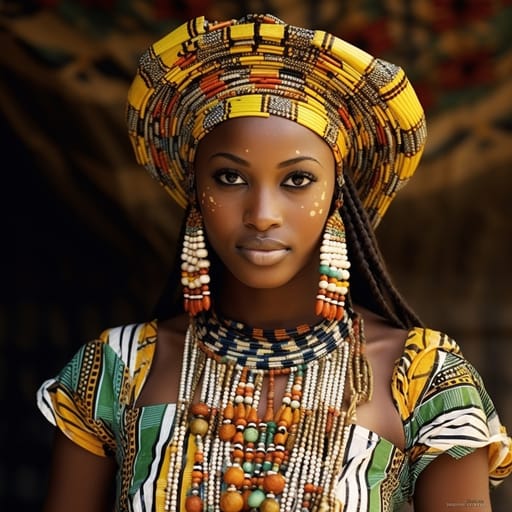
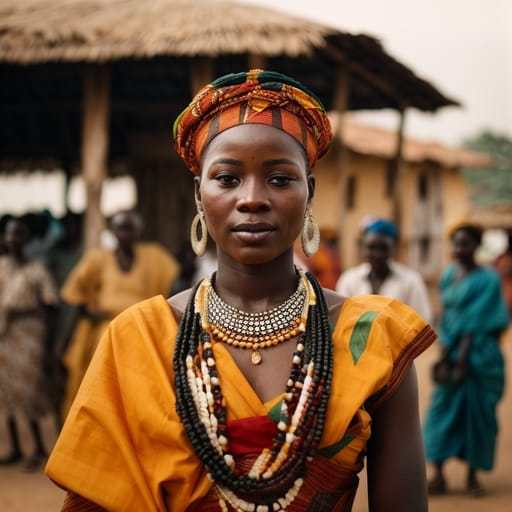
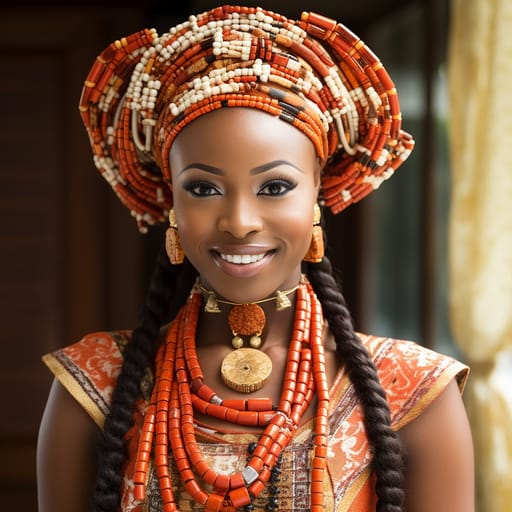
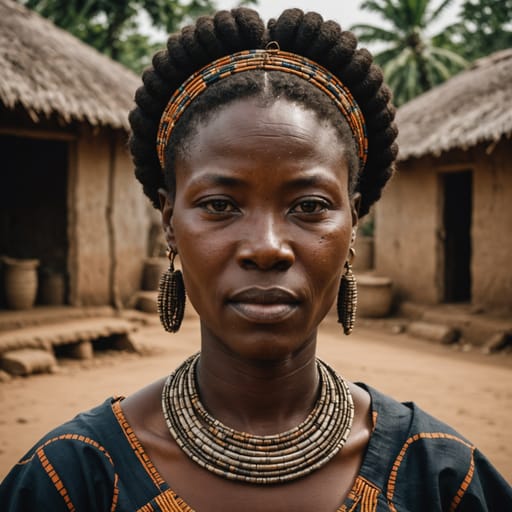
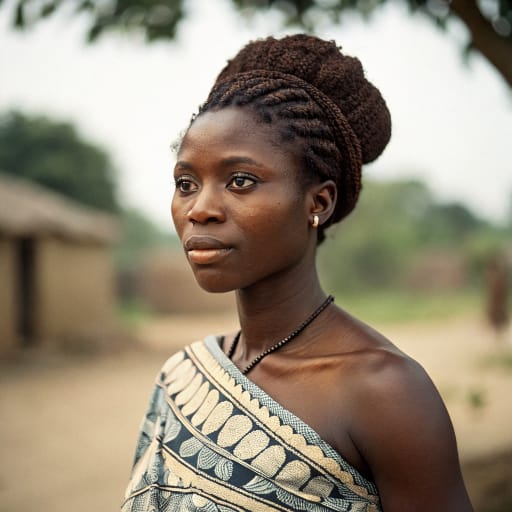
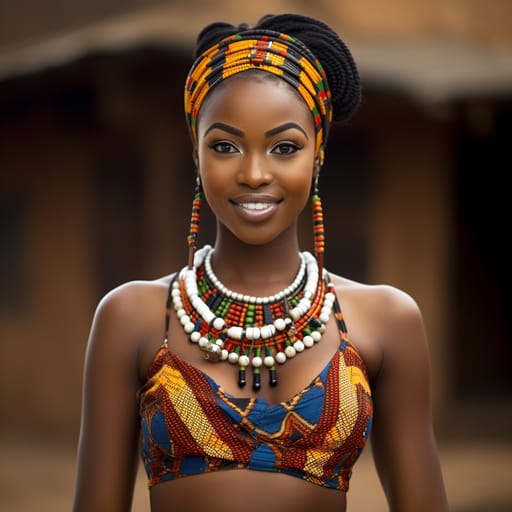
Geographic Distribution: Fon populations across 1 country
Each row is ranked by the group's share of that country's population, with the source citation drawn from published census and demographic surveys. Click through for the full per-country phenotype profile.
| Country | Share | Source |
|---|---|---|
| Benin | 38.5% | INSAE Benin 2013 Census; Fon (~38.5%, ~5.0M+); the largest ethnic group, concentrated in southern Benin (Cotonou, Porto-Novo, Abomey). Niger-Congo / Gbe language family. Founders of the Kingdom of Dahomey (1600-1904) |
Typical Fon Phenotypes
Reference for AI generation: hair, eyes, skin, facial structure, build
The Fon present one of West Africa's more uniformly dark-skinned phenotypes, with most individuals falling at Fitzpatrick VI — a deep, cool-toned brown to near-black with reddish or blue-black undertones rather than the warmer copper cast common further north in the Sahel. Lifelong equatorial sun maintains the depth; rare lighter-toned individuals usually trace to coastal Yoruba or European admixture from the Dahomey port era.
Hair is almost universally Type 4 — tightly coiled, with the springy 4B and densely zig-zagged 4C patterns predominating. Natural color is true black; reddish or auburn hairs appear only as scattered anomalies. The hairline is typically dense, with a defined frontal edge and high natural volume that supports the elaborate braided and threaded styles long traditional in Dahomey court culture.
Eyes are uniformly dark brown to near-black, set under straight or gently arched brows. The epicanthic fold is absent; eye shape tends toward almond with a clean, open upper lid — less hooded than is typical in East African populations. Sclera are bright, often with a faint bluish cast in younger people.
Facial structure is the most distinctive register. Fon noses are typically broad at the alar base with a low to medium bridge and rounded tip — the platyrrhine form characteristic of the Bight of Benin. Lips are full, with a pronounced vermilion border and often a defined cupid's bow. Cheekbones sit high and wide, the jaw is squared in men and softer-angled in women, and the overall facial plane reads as relatively flat in profile compared to the more prognathic structure found among some neighboring groups.
Build runs medium-statured — men averaging around 170 cm, women around 159 cm — with mesomorphic proportions: broad shoulders, muscular legs, and a tendency toward steatopygic fat distribution in women that is moderate rather than extreme. The closely related Egun of the coastal lagoons are visibly indistinguishable from mainland Fon, though sometimes slightly leaner in build owing to a fishing economy.
Fon Body & Anatomy Reference
Per-feature anatomical profile for AI nude generation: West African Niger-Congo phenotype
Fon Boobs & Breasts
Bust reference for Fon women: medium-to-large cup, full, projecting, which is typical of West African Niger-Congo ancestry. Areolas measure about 35-50mm across, with deep-brown to near-black pigmentation. Body type (mesomorph with strong gluteal-femoral fat distribution) shapes the bust as well, so Fon tits are usually fuller and more projecting than the East African norm. In AI imagery, keep the forward-set shape rather than drifting toward the smaller conical Cushitic East African profile.
Fon Ass & Hips
The Fon ass is typically wide-set, full, heavily projected glutes, which sets it apart from the slim narrow-hip Cushitic East African profile. Underneath, the pelvis shows wide iliac crests, broad gynoid pelvic pattern, high glute-to-waist ratio, part of the West African Niger-Congo skeletal pattern. For Fon butt pics and AI renders, match that silhouette and the overall build (mesomorph with strong gluteal-femoral fat distribution).
Fon Vagina & Pussy
Fon pussy and vulvar anatomy presents deep-brown to near-black labial pigmentation, fuller labia minora, consistent with the West African Niger-Congo phenotype's pigmentation pattern. Fon pubic hair is typically tightly-coiled coarse texture, densely distributed, in the inverted-triangle pattern. For anatomically accurate Fon pussy renders the labial coloration should match the surrounding medium-brown to deep-brown skin tone with a continuous gradient, and the hair should keep its tightly-coiled coarse texture.
Fon Dicks & Penis
Fon dicks follow the West African Niger-Congo reference data: regional mean ~14-15cm erect; above-average girth, ~13cm circumference; deep-brown-to-near-black shaft pigmentation. Shaft color should track the medium-brown to deep-brown skin tone with a smooth change toward the glans, and Fon pubic hair keeps its tightly-coiled coarse texture.
Fon Body, Curves & Build
Fon body type and overall build presents as mesomorph with strong gluteal-femoral fat distribution, with mean adult female BMI 24-27: the characteristic West African Niger-Congo habitus. Fon curves and proportions should keep the regional skeletal frame (height, shoulder-to-hip ratio, limb proportions) rather than a generic mesomorph default.
Fon Skin Tone & Hair Texture
Fon skin sits in the medium-brown to deep-brown (Fitzpatrick V-VI) band. Hair is typically tight 4A-4C coil, often worn natural, braided, or relaxed, in keeping with the West African Niger-Congo phenotype. In nude renders the skin should stay one even tone from face to body, and body, pubic and head hair should match.
Data depth
0/100Coverage of image-grounded phenotype observations · drives AI generation diversity
- Sample size
- 0/40· 0 images
- Image quality
- 0/30· 0% high
- Confidence
- 0/20
- Source diversity
- 0/10
- ·No image observations yet
Explore phenotype categories
Structured taxonomy with peer-reviewed scales · 22 anatomical categories
Erotic Poses & Sex Positions
From the pose catalog: 219 named positions with reference skeletons
Frequently asked questions about Fon people
Where is the Fon homeland?
The Fon homeland is Dahomey (Benin) in Western Africa.
What countries do Fon people live in?
Fon populations are documented across 1 country: Benin.
What language do Fon people speak?
Fon people primarily speak Niger-Congo / Kwa / Gbe / Fon.
What religion do Fon people practice?
The predominant religion among Fon people is Christianity / Catholicism.






Make your own Fon images
Five a day, free, no credits to buy. The studio starts from this group's phenotype data, so you can set body type, pose and style and keep the traits accurate.
Start with Fon