Help us get this right
Does this portrait look right for Ewondo?
Nobody has judged this one yet. You would be the first.
Ewondo Erotic
Centre Region of Cameroon, in and around Yaoundé and the surrounding forest country
Ewondo (Bantu, Niger-Congo), part of the Beti cluster with Bulu and Eton; French widely spoken
Predominantly Roman Catholic, with Protestant minorities and lasting ancestral and witchcraft beliefs such as evu
Beti branch of the Beti-Pahuin peoples, alongside Eton, Bane, Bulu and Fang; organized in patrilineal mvog clans such as Mvog-Ada and Mvog-Mbi
About Ewondo People
The Ewondo are the people on whose land Cameroon built its capital. When German officers founded a post in the forested hills of the Centre in 1889, they named it after the people they met there, and Jaunde became Yaoundé. Ewondo speakers still call the city Ongola, and several of its neighborhoods carry clan names: Mvog-Ada, Mvog-Mbi, Mvog-Betsi. Mvog means the descendants of a founding ancestor. These clans trace descent through fathers and traditionally marry outside their own clan. They still matter for marriage, land and burial in the home village, even for families who have lived in the city for generations.
The Ewondo belong to the Beti branch of the wider Beti-Pahuin family, which reaches south into Gabon and Equatorial Guinea and includes the Eton, Bane, Bulu and Fang. Oral tradition places their ancestors north of the Sanaga River and tells of a crossing made on the back of a giant serpent. Their language is a Bantu tongue close enough to Bulu and Eton that speakers follow one another with little effort. Missionaries gave it an unusually large role. After Pallottine priests opened the Catholic mission at Mvolyé in 1901, Ewondo became the language of catechism and hymns across the Centre, and a simplified form spread as a market language among people who were not Ewondo at all.
Catholicism is the main faith, but older ideas did not vanish. Before missionaries suppressed it, young men went through so, a long initiation built on ordeals and seclusion. Belief in evu, a force said to live in a person's belly and to explain unusual success or sudden harm, still comes up when people talk about witchcraft. Funerals are major public events that pull relatives from the city back to the village. The colonial era produced Charles Atangana, a mission-educated Ewondo who served as paramount chief under both the German and the French administrations. His career shows how both powers ruled through local chiefs they had chosen and shaped.
The best-known Ewondo export is sound. Bikutsi, roughly beating the ground, grew out of Beti songs and dances played on the xylophone. From the 1960s on, musicians reworked its rhythm for electric guitar until it became the music of Yaoundé bars and national radio. The mvet, a harp-zither that goes with long spoken epics, is shared with Bulu and Fang performers.
Related ethnic groups
Groups that share Ewondo's homeland, region, language, or religious tradition. These are likely candidates for comparative phenotype reference.
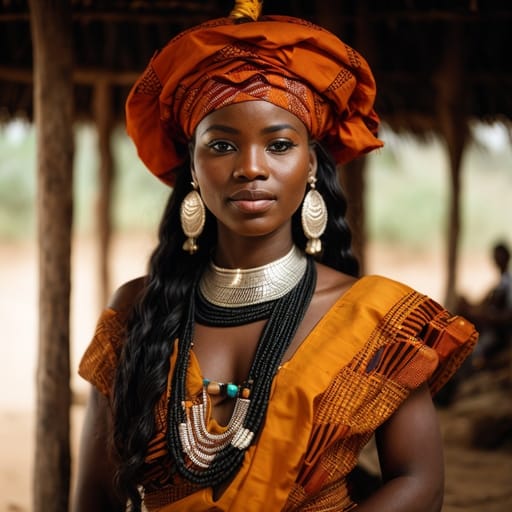
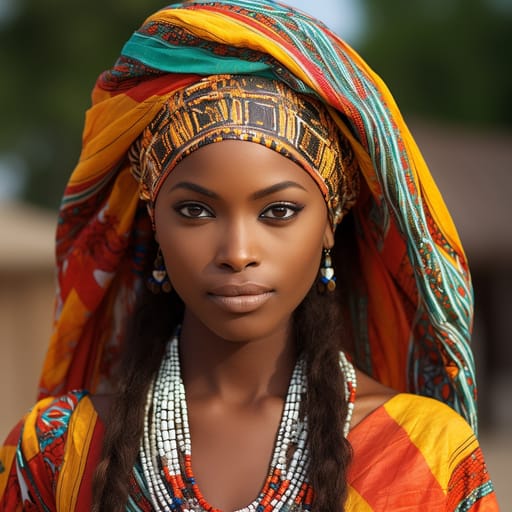
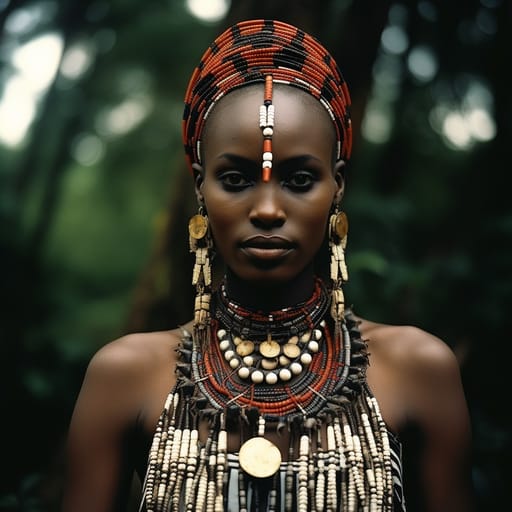
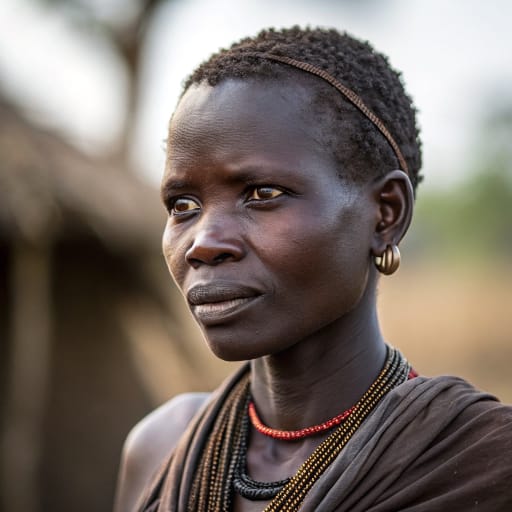
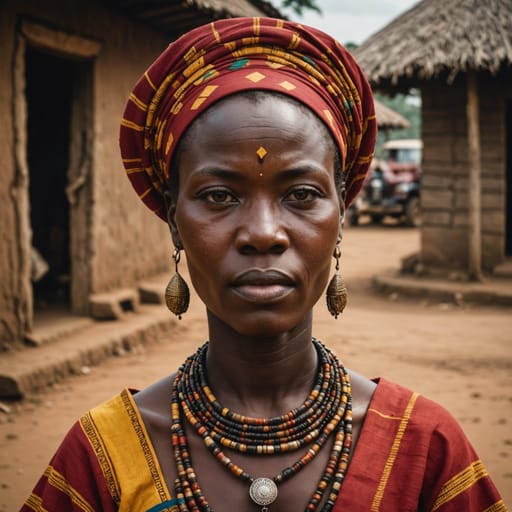
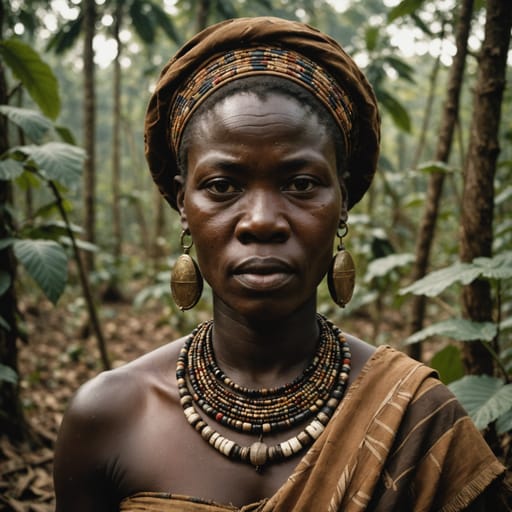
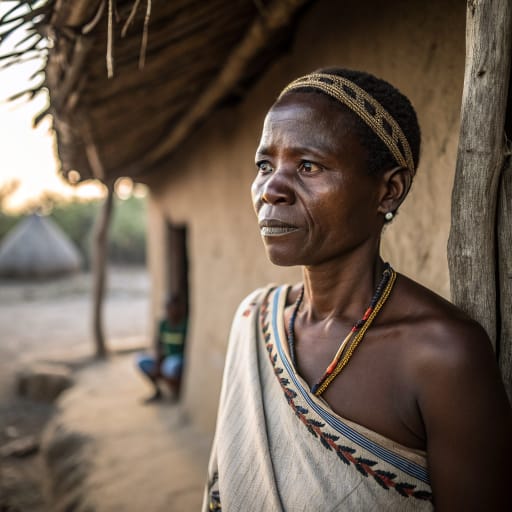
Typical Ewondo Phenotypes
Reference for AI generation: hair, eyes, skin, facial structure, build
Ewondo Body & Anatomy Reference
Bantu / Central African Niger-Congo phenotype: anatomy reference for AI nude generation
Ewondo Boobs & Breasts
Ewondo boobs follow the Bantu / Central African Niger-Congo profile: medium-to-large cup, full, projecting. Areolar diameter is usually 32-48mm, and the coloring is deep-brown areolar pigmentation against the deep-brown skin tone. Breast shape tracks body composition (mesomorph with strong gluteal-femoral fat deposition, mean adult female BMI 23-26), so Ewondo breasts tend to be fuller projection than East African; comparable to West African norm. Expect a forward-set shape, not the smaller East African conical profile.
Ewondo Ass & Hips
Ewondo ass and hip morphology presents as full, projected, wide-set glutes, distinctly different from the slim narrow-hip Cushitic East African profile. The Ewondo pelvic profile shows broad iliac crests, gynoid pelvic pattern, anchored in the Bantu / Central African Niger-Congo skeletal pattern. Ewondo butt shots in adult AI imagery should render the full, projected, wide-set glutes silhouette with the overall build (mesomorph with strong gluteal-femoral fat deposition) and the fat distribution typical of the Bantu / Central African Niger-Congo phenotype.
Ewondo Vagina & Pussy
Ewondo pussy anatomy typically shows deep-brown labial pigmentation, fuller labia minora. Pubic hair is usually tightly-coiled coarse texture, dense distribution. In AI-generated Ewondo nudes, labial color should blend into the deep-brown skin with a gradual transition, and the hair should keep its tightly-coiled coarse texture.
Ewondo Dicks & Penis
Penis reference for Ewondo men: regional mean ~14cm erect, above-average girth. Coloring: deep-brown shaft pigmentation. An accurate Ewondo cock in AI imagery matches the surrounding deep-brown skin rather than a generic porn default. Circumcision depends on religion and custom, not ancestry.
Ewondo Body, Curves & Build
The Ewondo figure is generally mesomorph with strong gluteal-femoral fat deposition, with mean adult female BMI 23-26, characteristic of Bantu / Central African Niger-Congo ancestry. AI image tools tend to flatten regional body types into a few stock shapes; here the Ewondo build is kept as its own reference.
Ewondo Skin Tone & Hair Texture
Skin: deep-brown (Fitzpatrick VI). Hair: tight 4A-4C coil. Both are typical of Bantu / Central African Niger-Congo ancestry. The most common mistake in AI nudes of Ewondo women is a body rendered lighter than the face.
Explore phenotype categories
Structured taxonomy with peer-reviewed scales · 22 anatomical categories
Erotic Poses & Sex Positions
From the pose catalog: 219 named positions with reference skeletons
Frequently asked questions about Ewondo people
Where is the Ewondo homeland?
The Ewondo homeland is Centre Region of Cameroon, in and around Yaoundé and the surrounding forest country in Central Africa.
What language do Ewondo people speak?
Ewondo people primarily speak Ewondo (Bantu, Niger-Congo), part of the Beti cluster with Bulu and Eton; French widely spoken.
What religion do Ewondo people practice?
The predominant religion among Ewondo people is Predominantly Roman Catholic, with Protestant minorities and lasting ancestral and witchcraft beliefs such as evu.






Make your own Ewondo images
Five a day, free, no credits to buy. The studio starts from this group's phenotype data, so you can set body type, pose and style and keep the traits accurate.
Start with Ewondo