Help us get this right
Does this portrait look right for Cayuse?
Nobody has judged this one yet. You would be the first.
Cayuse Erotic
Northeastern Oregon and southeastern Washington, United States, between the Columbia River and the Blue Mountains; today centered on the Umatilla Indian Reservation near Pendleton, Oregon.
Cayuse (language isolate, no longer spoken); English today, with Umatilla and Nez Perce (Sahaptian, Plateau Penutian) in ceremonial and revitalization use.
Washat, the Seven Drums longhouse religion, alongside Presbyterian and Catholic Christianity.
One of the three Confederated Tribes of the Umatilla Indian Reservation, with the Umatilla and Walla Walla; part of the wider Columbia Plateau cultural group.
About Cayuse People
Ask what a cayuse is anywhere west of the Rockies and you will hear tough little range horse before you hear people. That is the backhanded fame that comes from being very good at one thing very early. Horses reached the Columbia Plateau around 1730, and the Cayuse turned the grass country along the Umatilla, Walla Walla, and Grande Ronde rivers into breeding ground, running herds in the thousands and trading them the length of the interior Northwest. Wealth was counted in horses, and so was standing. Their homeland sat between the Columbia River and the Blue Mountains, in what is now northeastern Oregon and southeastern Washington, and the year moved with the food: salmon at the fisheries, cous and bitterroot dug on the uplands in spring, huckleberries in late summer, buffalo across the mountains once the horses made that trip possible. Their own language was an isolate, tied convincingly to nothing else, sitting like a stone in a region otherwise speaking Sahaptian. By the middle of the nineteenth century most Cayuse had shifted to Nez Perce, and the Cayuse language now survives in wordlists and nowhere else. Even the name is borrowed, from the French Canadian trappers' cailloux, meaning stones. The tribes write their own name as Weyiiletpuu.
Two dates set everything after. Marcus and Narcissa Whitman built a mission at Waiilatpu on Cayuse ground in 1836, and a decade on, measles came up the Oregon Trail with an emigrant train and killed a devastating share of the tribe while the white children under Whitman's care mostly lived. In a tradition where a healer answers personally for patients who die, that arithmetic read as intent. Cayuse men killed the Whitmans and eleven others, the Cayuse War followed, and in 1850 five men gave themselves up and were hanged at Oregon City after a trial in a court with no clear jurisdiction over them. At the Walla Walla council of 1855 the Cayuse ceded most of their country and were placed with the Umatilla and Walla Walla on one reservation near present day Pendleton, Oregon. They remain there as one of three tribes under a single confederated government, and those tribes now run water, fish, and land programs on a First Foods framework that ranks salmon, deer, cous, bitterroot, and huckleberry in the order they are served at the Root Feast each April. The horses are still there too, and the beaded parade regalia that goes on them.
Related ethnic groups
Groups that share Cayuse's homeland, region, language, or religious tradition. These are likely candidates for comparative phenotype reference.
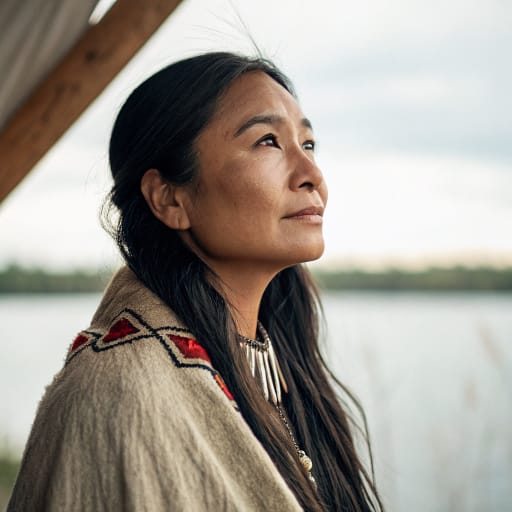
Cree
same region (North America)
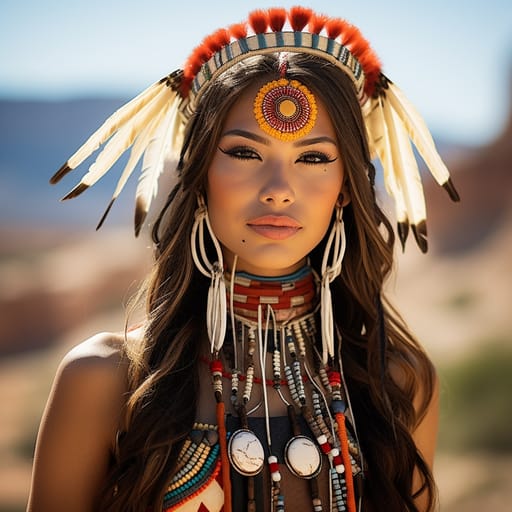
Navajo
same region (North America)
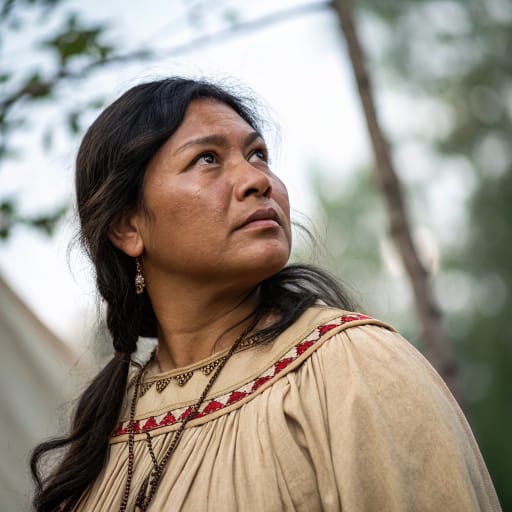
Miꞌkmaq
same region (North America)
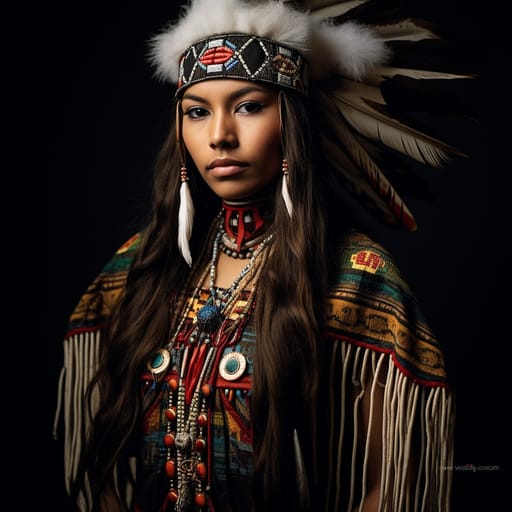
Sioux
same region (North America)
Mississaugas
same region (North America)
Chugach
same region (North America)
Central Alaskan Yup'ik
same region (North America)
Hispanos of New Mexico
same region (North America)
Typical Cayuse Phenotypes
Reference for AI generation: hair, eyes, skin, facial structure, build
Cayuse Body & Anatomy Reference
Per-feature anatomical profile for AI nude generation: Indigenous Northern American / Algonquian-Iroquoian phenotype
Cayuse Boobs & Breasts
Cayuse tits and boobs run medium cup, moderate projection, the classic Indigenous Northern American / Algonquian-Iroquoian bust profile. Cayuse nipples and areolas show medium-brown areolar pigmentation against the copper-to-medium-brown skin tone, with areolar diameter typically in the 30-44mm range and forward-set positioning rather than the smaller East Asian bust. Cayuse breasts trend full and moderate projection, a function of the mesomorph, broader frame in northern Indigenous populations body habitus and the mean adult female BMI 25-28. For anatomically accurate AI-generated Cayuse nudes the render preserves the medium cup, moderate projection shape, 30-44mm areolas with medium-brown pigmentation, and the torso proportions of the Indigenous Northern American / Algonquian-Iroquoian phenotype.
Cayuse Ass & Hips
Cayuse hips and butt usually read as medium, moderate-to-full projection. The skeletal base is medium iliac crests, the Indigenous Northern American / Algonquian-Iroquoian pattern. Set against the slim East Asian narrow-hip profile, the difference is easy to see, and the hip-to-waist ratio is often what identifies Cayuse women in photos.
Cayuse Vagina & Pussy
Expect medium-brown labial pigmentation on Cayuse women, in keeping with Indigenous Northern American / Algonquian-Iroquoian ancestry. The pubic hair is straight medium-coarse texture. Coloring should run evenly from the copper to medium-brown skin of the thighs to the labia, and Cayuse nude imagery should keep the hair's straight medium-coarse texture.
Cayuse Dicks & Penis
Cayuse dick and penile anatomy in adult AI generation should anchor on the regional reference data: regional mean ~13cm erect, moderate girth, and medium-brown shaft pigmentation. The Cayuse cock profile reflects the Indigenous Northern American / Algonquian-Iroquoian population's anthropometric measurements. The shaft pigmentation should track the surrounding copper to medium-brown skin tone, and the pubic hair should keep its straight medium-coarse texture in the typical inverted-V escutcheon.
Cayuse Body, Curves & Build
Cayuse body type: mesomorph, broader frame in northern Indigenous populations, with mean adult female BMI 25-28. This is the typical Indigenous Northern American / Algonquian-Iroquoian build. Height range, shoulder-to-hip ratio and fat distribution all follow from it, which is what an accurate Cayuse nude body should show.
Cayuse Skin Tone & Hair Texture
Cayuse skin tone falls in the copper to medium-brown (Fitzpatrick III-V) band, the surface signal most often miscalibrated by generic AI nude generators. Cayuse hair texture is typically straight 1A, dark-brown to black, often thick and dense, characteristic of the Indigenous Northern American / Algonquian-Iroquoian phenotype. In Cayuse nude renders the skin should hold that band consistently across the body.
Explore phenotype categories
Structured taxonomy with peer-reviewed scales · 22 anatomical categories
Erotic Poses & Sex Positions
From the pose catalog: 219 named positions with reference skeletons
Frequently asked questions about Cayuse people
Where is the Cayuse homeland?
The Cayuse homeland is Northeastern Oregon and southeastern Washington, United States, between the Columbia River and the Blue Mountains; today centered on the Umatilla Indian Reservation near Pendleton, Oregon. in North America.
What language do Cayuse people speak?
Cayuse people primarily speak Cayuse (language isolate, no longer spoken); English today, with Umatilla and Nez Perce (Sahaptian, Plateau Penutian) in ceremonial and revitalization use..
What religion do Cayuse people practice?
The predominant religion among Cayuse people is Washat, the Seven Drums longhouse religion, alongside Presbyterian and Catholic Christianity..






Make your own Cayuse images
Five a day, free, no credits to buy. The studio starts from this group's phenotype data, so you can set body type, pose and style and keep the traits accurate.
Start with Cayuse