Help us get this right
Does this portrait look right for Capinan?
One tap. It takes a second and it is recorded.
1 says it looks right, 0 say it looks off.
Capinan Erotic
Lower Pascagoula River near the Gulf Coast, in present-day southeastern Mississippi, United States
Unrecorded. Possibly Siouan like the neighboring Biloxi, or Muskogean; likely used Mobilian Jargon (Muskogean based pidgin) for trade
Indigenous Gulf Coast beliefs, not documented in detail
One of the French era petites nations of the Gulf Coast; closely associated with the Biloxi and Pascagoula, and possibly identical to the Moctobi
About Capinan People
The Capinan were a small Native American people of the Mississippi Gulf Coast, recorded by the French on the lower Pascagoula River around 1700 and gone from the written record within a few decades, most likely absorbed into their neighbors the Biloxi and Pascagoula. Almost everything known about them fits in a paragraph, and that scarcity is itself the story. They enter history because Pierre Le Moyne d'Iberville's expedition, planting the first French post on Biloxi Bay in 1699, took note of who lived nearby. The Capinan appear in those colonial papers as a name attached to two better documented peoples, sharing the same stretch of river in what is now southeastern Mississippi.
Who they were beyond that is an open question. Early twentieth century ethnologists noticed that the Capinan turn up in just the company where another obscure group, the Moctobi, had been listed, and proposed that the two names describe one people. Nobody has been able to prove it. No word list in their language survives. The Biloxi spoke a Siouan language, an outlier on a coast dominated by Muskogean speakers, and the Pascagoula language is itself unrecorded, so the Capinan could have belonged to either camp or to neither. Trade along this coast ran on Mobilian Jargon, a Muskogean based pidgin that let small nations with unrelated mother tongues live side by side, and the Capinan presumably used it like everyone around them.
Their setting explains both the closeness to neighbors and the disappearance. The French called communities like this the petites nations: towns that often numbered in the hundreds, growing corn along the rivers, fishing and gathering shellfish in the estuaries, hunting deer in the pine country behind. By the time Iberville arrived, disease had already emptied at least one village on the Pascagoula, and slave raids by groups armed by English traders in Carolina pushed survivors to cluster together for safety. Merging was how small nations survived. A shrinking town joined a friendly one, kept its own name for a while, and then the name dropped out of use.
That is the likeliest fate of the Capinan. The Biloxi and Pascagoula moved west into Louisiana in the later eighteenth century, and Biloxi descendants are today part of the Tunica-Biloxi Tribe at Marksville. Whatever Capinan families there were run somewhere through those lineages, unlabeled. The name itself survives only in French colonial documents and the reference works built on them, a reminder of how many Gulf Coast peoples were counted once by a passing officer and never asked anything more.
Related ethnic groups
Groups that share Capinan's homeland, region, language, or religious tradition. These are likely candidates for comparative phenotype reference.
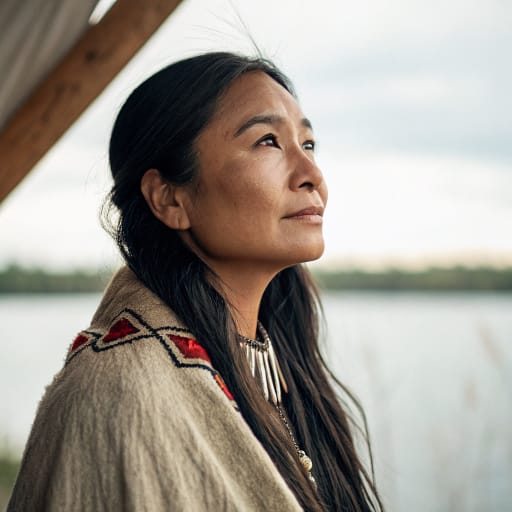
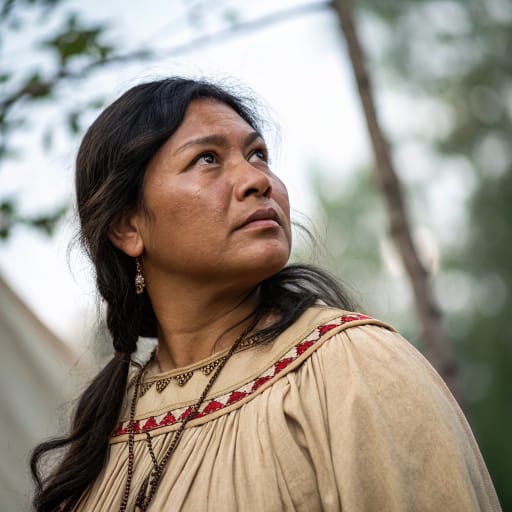
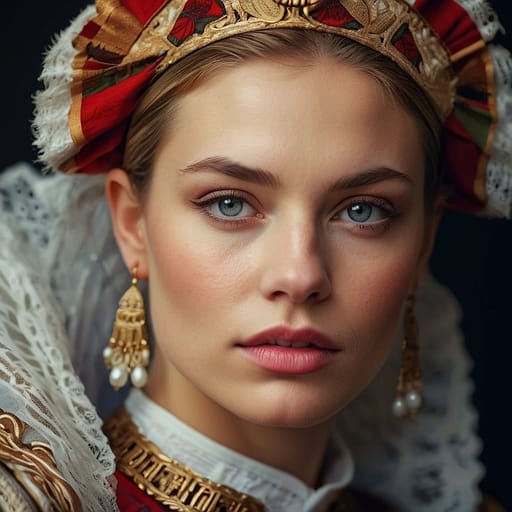
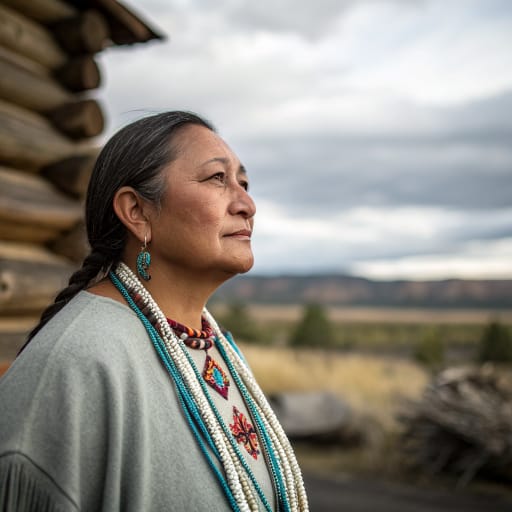
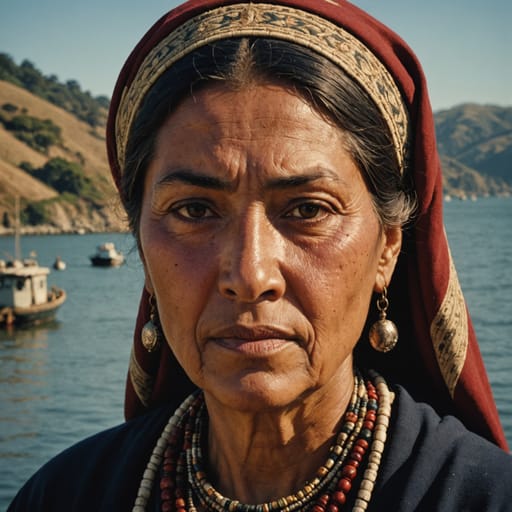
Typical Capinan Phenotypes
Reference for AI generation: hair, eyes, skin, facial structure, build
Capinan Body & Anatomy Reference
Per-feature anatomical profile for AI nude generation: Indigenous Northern American / Algonquian-Iroquoian phenotype
Capinan Boobs & Breasts
Capinan tits and boobs run medium cup, moderate projection, the classic Indigenous Northern American / Algonquian-Iroquoian bust profile. Capinan nipples and areolas show medium-brown areolar pigmentation against the copper-to-medium-brown skin tone, with areolar diameter typically in the 30-44mm range and forward-set positioning rather than the smaller East Asian bust. Capinan breasts trend full and moderate projection, a function of the mesomorph, broader frame in northern Indigenous populations body habitus and the mean adult female BMI 25-28. For anatomically accurate AI-generated Capinan nudes the render preserves the medium cup, moderate projection shape, 30-44mm areolas with medium-brown pigmentation, and the torso proportions of the Indigenous Northern American / Algonquian-Iroquoian phenotype.
Capinan Ass & Hips
Capinan hips and butt usually read as medium, moderate-to-full projection. The skeletal base is medium iliac crests, the Indigenous Northern American / Algonquian-Iroquoian pattern. Set against the slim East Asian narrow-hip profile, the difference is easy to see, and the hip-to-waist ratio is often what identifies Capinan women in photos.
Capinan Vagina & Pussy
Expect medium-brown labial pigmentation on Capinan women, in keeping with Indigenous Northern American / Algonquian-Iroquoian ancestry. The pubic hair is straight medium-coarse texture. Coloring should run evenly from the copper to medium-brown skin of the thighs to the labia, and Capinan nude imagery should keep the hair's straight medium-coarse texture.
Capinan Dicks & Penis
Capinan dick and penile anatomy in adult AI generation should anchor on the regional reference data: regional mean ~13cm erect, moderate girth, and medium-brown shaft pigmentation. The Capinan cock profile reflects the Indigenous Northern American / Algonquian-Iroquoian population's anthropometric measurements. The shaft pigmentation should track the surrounding copper to medium-brown skin tone, and the pubic hair should keep its straight medium-coarse texture in the typical inverted-V escutcheon.
Capinan Body, Curves & Build
Capinan body type: mesomorph, broader frame in northern Indigenous populations, with mean adult female BMI 25-28. This is the typical Indigenous Northern American / Algonquian-Iroquoian build. Height range, shoulder-to-hip ratio and fat distribution all follow from it, which is what an accurate Capinan nude body should show.
Capinan Skin Tone & Hair Texture
Capinan skin tone falls in the copper to medium-brown (Fitzpatrick III-V) band, the surface signal most often miscalibrated by generic AI nude generators. Capinan hair texture is typically straight 1A, dark-brown to black, often thick and dense, characteristic of the Indigenous Northern American / Algonquian-Iroquoian phenotype. In Capinan nude renders the skin should hold that band consistently across the body.
Explore phenotype categories
Structured taxonomy with peer-reviewed scales · 22 anatomical categories
Erotic Poses & Sex Positions
From the pose catalog: 219 named positions with reference skeletons
Frequently asked questions about Capinan people
Where is the Capinan homeland?
The Capinan homeland is Lower Pascagoula River near the Gulf Coast, in present-day southeastern Mississippi, United States in North America.
What language do Capinan people speak?
Capinan people primarily speak Unrecorded. Possibly Siouan like the neighboring Biloxi, or Muskogean; likely used Mobilian Jargon (Muskogean based pidgin) for trade.
What religion do Capinan people practice?
The predominant religion among Capinan people is Indigenous Gulf Coast beliefs, not documented in detail.






Make your own Capinan images
Five a day, free, no credits to buy. The studio starts from this group's phenotype data, so you can set body type, pose and style and keep the traits accurate.
Start with Capinan