Help us get this right
Does this portrait look right for Bainuk?
Nobody has judged this one yet. You would be the first.
Bainuk Erotic
Lower Casamance in southern Senegal, especially around Ziguinchor, with communities in northern Guinea-Bissau and The Gambia
Bainouk, in the Gunyuño, Gunyaamolo and Samik varieties (Atlantic, Niger-Congo); many also speak Jola, Mandinka, Wolof or Kriol
Mostly Sunni Islam, with Christian minorities and surviving ancestral shrine practice in some communities
Gunyuño speakers in Guinea-Bissau, Gunyaamolo and Samik speakers in Senegal; linguistically related to the Kasanga and Kobiana peoples
About Bainuk People
The Bainuk are, by the reckoning of most of their neighbors, the people who were in lower Casamance first. Mandinka power later spread west from Kaabu, and Jola rice farmers spread through the mangrove country. Before either, Bainuk villages held much of the land along the Casamance River and south into what is now Guinea-Bissau. Being the first people on the land is still central to Bainuk identity. The region's name is usually traced to the Kasa mansa, the title early Portuguese visitors recorded for the ruler of Kasa, a Bainuk kingdom on the river.
In the sixteenth and seventeenth centuries the Bainuk were central to trade in the region. Their markets on the Casamance and Cacheu rivers linked inland producers with Portuguese and Luso-African traders on the coast. That position did not last. Over the next centuries, Mandinka, Jola and Balanta expansion pushed Bainuk communities into smaller pockets. Many families were absorbed into neighboring groups, taking on their languages through marriage and daily life.
Bainouk, as the language is usually spelled, belongs to the Atlantic branch of Niger-Congo. It sits in a small cluster with Kasanga and Kobiana, languages that are themselves close to disappearing. Its varieties, Gunyuño in Guinea-Bissau and Gunyaamolo and Samik in Senegal, differ enough that linguists often treat them as separate languages. Bainouk is well known in linguistics for its noun classes: a borrowed word can be placed in a class just because of how it begins, a kind of alliteration built into the grammar. Today many people who call themselves Bainuk grow up speaking Jola, Mandinka, Wolof or Kriol, and the ancestral language survives mainly in rural villages.
Most Bainuk are Muslim. Islam came largely through their Mandinka neighbors, and there are Christian families as well. Conversion did not wipe out older practice everywhere, and ancestral shrines still matter in some communities. The Bainuk now live in and around Ziguinchor and in villages across southern Senegal, northern Guinea-Bissau and parts of The Gambia. They are a small people with a longer history than their current numbers suggest.
Related ethnic groups
Groups that share Bainuk's homeland, region, language, or religious tradition. These are likely candidates for comparative phenotype reference.
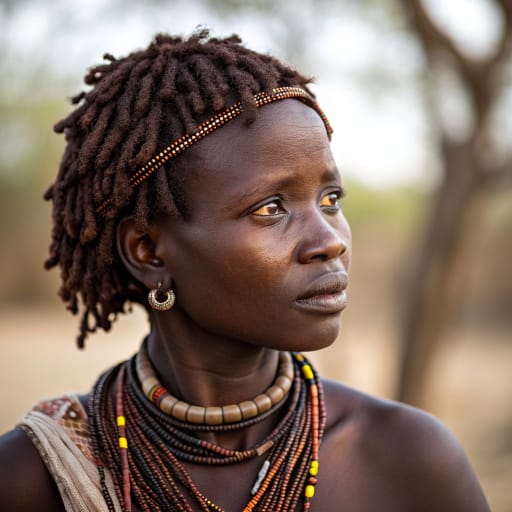
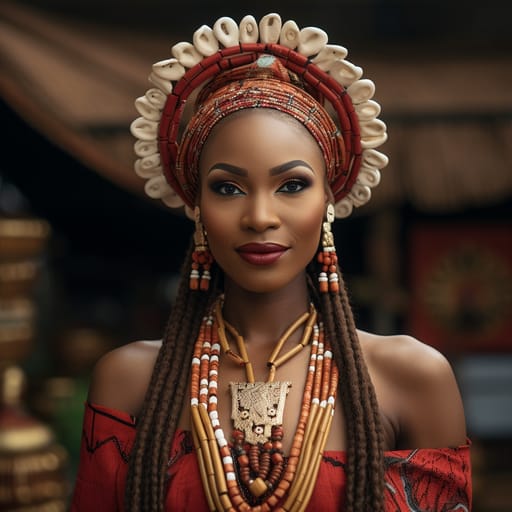
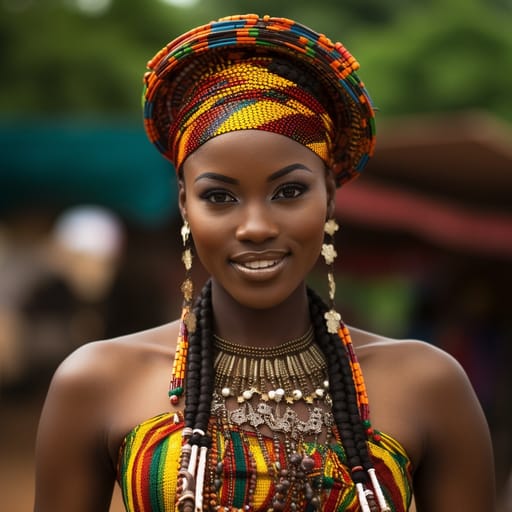
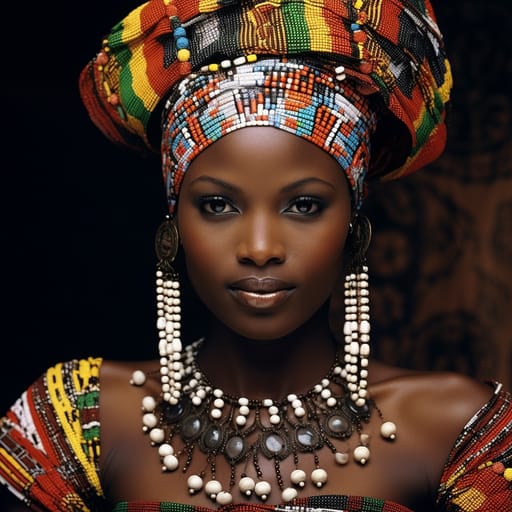
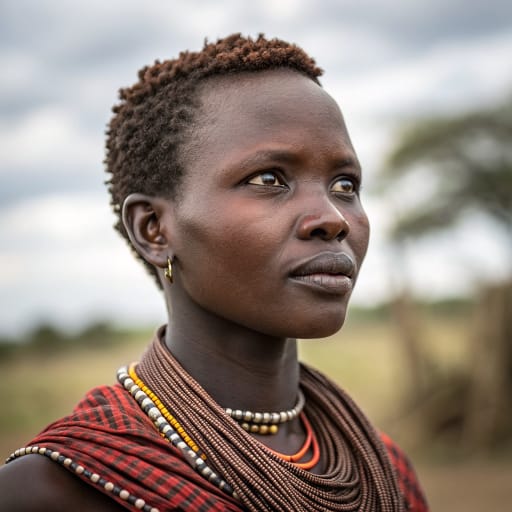
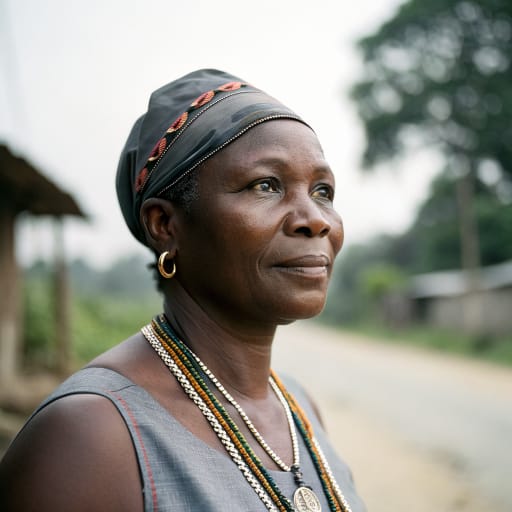
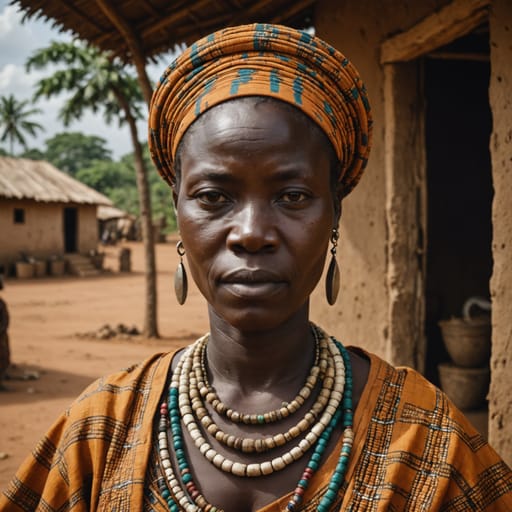
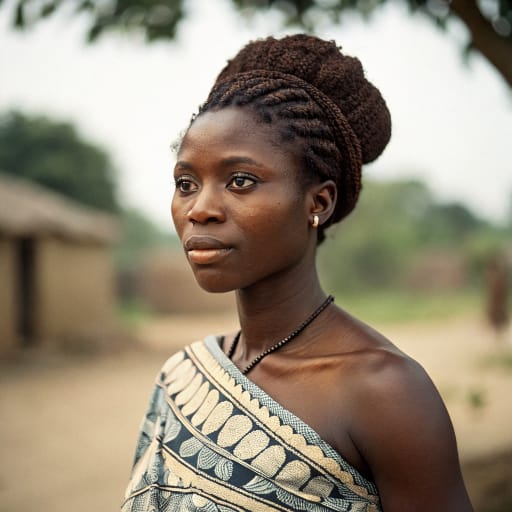
Typical Bainuk Phenotypes
Reference for AI generation: hair, eyes, skin, facial structure, build
Bainuk Body & Anatomy Reference
Per-feature anatomical profile for AI nude generation: West African Niger-Congo phenotype
Bainuk Boobs & Breasts
Bainuk tits and boobs run medium-to-large cup, full, projecting, the classic West African Niger-Congo bust profile. Bainuk nipples and areolas show deep-brown to near-black areolar pigmentation against the medium-to-deep-brown skin tone, with areolar diameter typically in the 35-50mm range and forward-set positioning rather than the smaller conical Cushitic East African profile. Bainuk breasts trend fuller and more projecting than the East African norm, a function of the mesomorph with strong gluteal-femoral fat distribution body habitus and the mean adult female BMI 24-27. For anatomically accurate AI-generated Bainuk nudes the render preserves the medium-to-large cup, full, projecting shape, 35-50mm areolas with deep-brown to near-black pigmentation, and the torso proportions of the West African Niger-Congo phenotype.
Bainuk Ass & Hips
Bainuk hips and butt usually read as wide-set, full, heavily projected glutes. The skeletal base is wide iliac crests, broad gynoid pelvic pattern, high glute-to-waist ratio, the West African Niger-Congo pattern. Set against the slim narrow-hip Cushitic East African profile, the difference is easy to see, and the hip-to-waist ratio is often what identifies Bainuk women in photos.
Bainuk Vagina & Pussy
Expect deep-brown to near-black labial pigmentation, fuller labia minora on Bainuk women, in keeping with West African Niger-Congo ancestry. The pubic hair is tightly-coiled coarse texture, densely distributed. Coloring should run evenly from the medium-brown to deep-brown skin of the thighs to the labia, and Bainuk nude imagery should keep the hair's tightly-coiled coarse texture.
Bainuk Dicks & Penis
Bainuk dick and penile anatomy in adult AI generation should anchor on the regional reference data: regional mean ~14-15cm erect, above-average girth, ~13cm circumference, and deep-brown-to-near-black shaft pigmentation. The Bainuk cock profile reflects the West African Niger-Congo population's anthropometric measurements. The shaft pigmentation should track the surrounding medium-brown to deep-brown skin tone, and the pubic hair should keep its tightly-coiled coarse texture in the typical inverted-V escutcheon.
Bainuk Body, Curves & Build
Bainuk body type: mesomorph with strong gluteal-femoral fat distribution, with mean adult female BMI 24-27. This is the typical West African Niger-Congo build. Height range, shoulder-to-hip ratio and fat distribution all follow from it, which is what an accurate Bainuk nude body should show.
Bainuk Skin Tone & Hair Texture
Bainuk skin tone falls in the medium-brown to deep-brown (Fitzpatrick V-VI) band, the surface signal most often miscalibrated by generic AI nude generators. Bainuk hair texture is typically tight 4A-4C coil, often worn natural, braided, or relaxed, characteristic of the West African Niger-Congo phenotype. In Bainuk nude renders the skin should hold that band consistently across the body.
Explore phenotype categories
Structured taxonomy with peer-reviewed scales · 22 anatomical categories
Erotic Poses & Sex Positions
From the pose catalog: 219 named positions with reference skeletons
Frequently asked questions about Bainuk people
Where is the Bainuk homeland?
The Bainuk homeland is Lower Casamance in southern Senegal, especially around Ziguinchor, with communities in northern Guinea-Bissau and The Gambia in Western Africa.
What language do Bainuk people speak?
Bainuk people primarily speak Bainouk, in the Gunyuño, Gunyaamolo and Samik varieties (Atlantic, Niger-Congo); many also speak Jola, Mandinka, Wolof or Kriol.
What religion do Bainuk people practice?
The predominant religion among Bainuk people is Mostly Sunni Islam, with Christian minorities and surviving ancestral shrine practice in some communities.






Make your own Bainuk images
Five a day, free, no credits to buy. The studio starts from this group's phenotype data, so you can set body type, pose and style and keep the traits accurate.
Start with Bainuk