Help us get this right
Does this portrait look right for Anuak?
One tap. It takes a second and it is recorded.
2 say it looks right, 1 says it looks off.
Anuak Erotic
Anuakia (Ethiopia), Boma (South Sudan)
Nilo-Saharan / Nilotic / Luo / Anuak
Christianity
About Anuak People
The Anuak are a riverine Nilotic people of the Gambela lowlands in western Ethiopia and the adjacent Boma plateau region of South Sudan, settled in tight clusters along the Baro, Akobo, Gilo, and Pibor rivers. Unlike most of their Luo-speaking cousins to the south and west — the Acholi, Luo proper, Shilluk — the Anuak gave up the long-distance cattle pastoralism that defines that branch of Nilotic life. The land they live on floods half the year and bakes the other half, so they fish, hunt, and farm sorghum and maize on the levees instead, and their economy and social rhythms are shaped by water rather than herds. Their language, Dha-Anywaa, is mutually a near-relative of Päri and Shilluk, but anyone who has spent time across the region will tell you the Anuak hold themselves apart culturally as well as linguistically.
Politically they are unusual among Nilotic peoples for having developed something close to hereditary kingship. Villages are led by kwaaro nobles, and a sacred royal lineage — the holders of the royal emblems, including a famous set of beads — moves between villages as the institution rotates. Power is real but contested, and a king who loses the emblems loses the office; this is not ceremonial monarchy. Wealth is traditionally counted in those bead strings rather than livestock, which again sets them apart from the cattle-counting cultures around them.
Most Anuak today are Christian, predominantly Protestant through a long mission presence, though older practices around river spirits and ancestor veneration sit beneath the surface and surface in mourning, naming, and harvest customs. The community has been bruised by the modern era. The 2003 Gambela massacre, in which several hundred Anuak men were killed in a few days of targeted violence around Gambela town, remains the defining recent trauma and pushed a substantial diaspora into Kenya, the United States, and Australia. Inside Ethiopia, conflict with neighboring Nuer pastoralists pressing east, and friction with highland resettlers and large agricultural concessions on Anuak land, continue to shape the politics of the region. The Anuak have a strong sense of being a distinct people in a contested place — small in number, rooted to specific rivers, and unusually self-aware about both.
Related ethnic groups
Groups that share Anuak's homeland, region, language, or religious tradition. These are likely candidates for comparative phenotype reference.
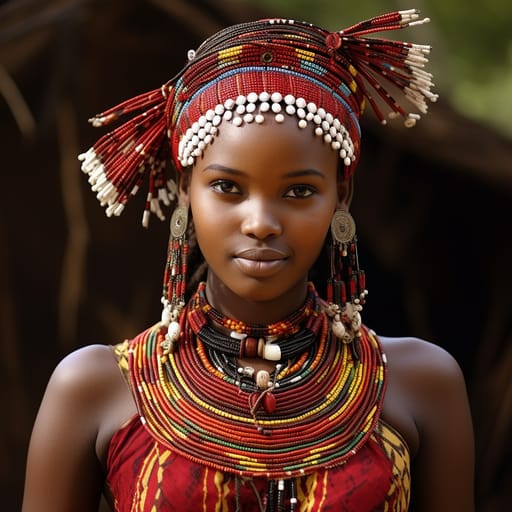
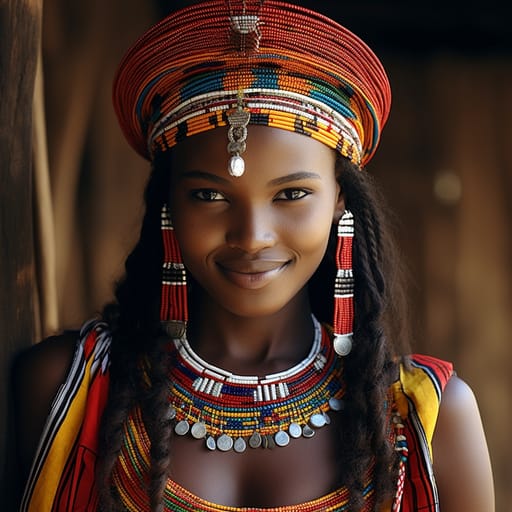
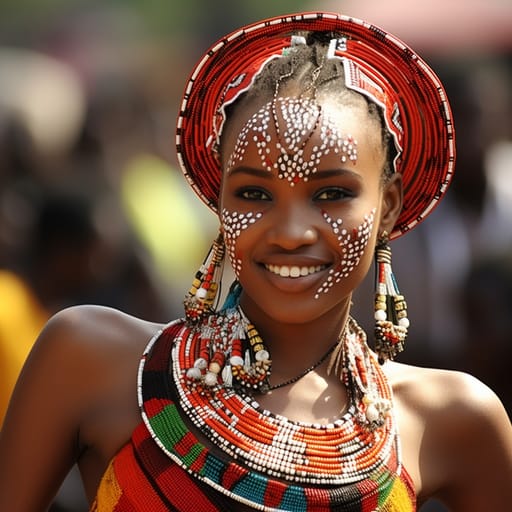
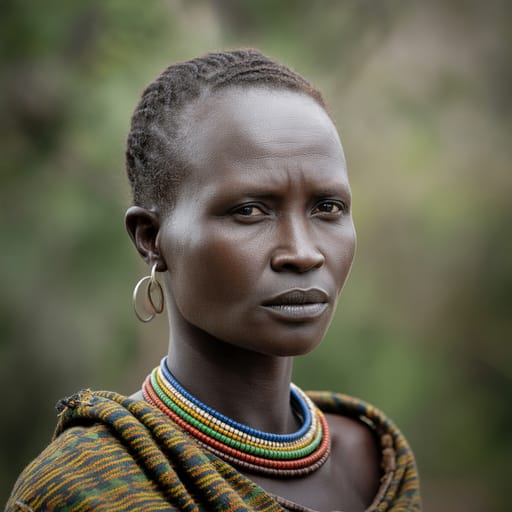
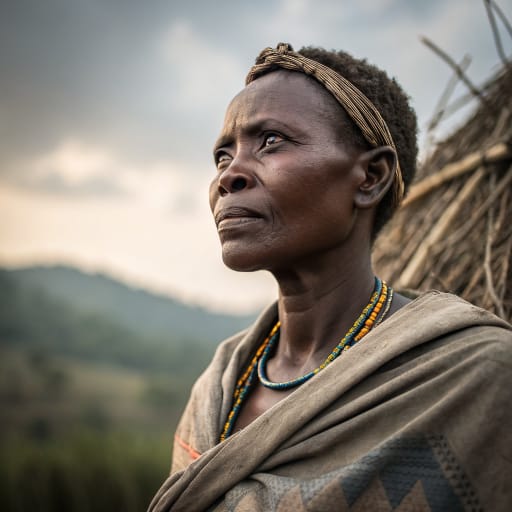
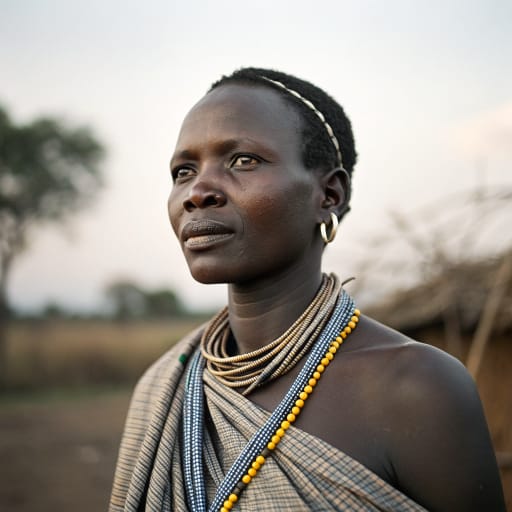
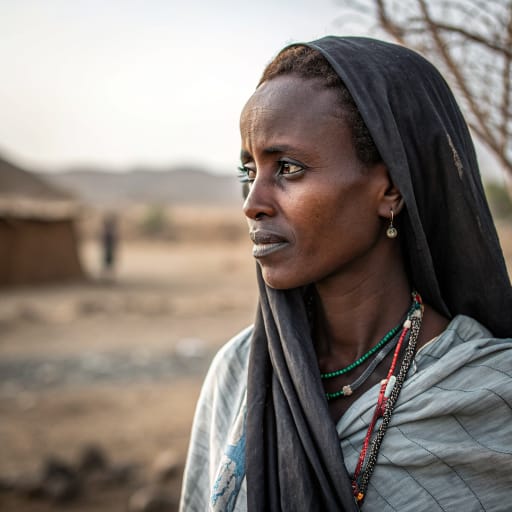
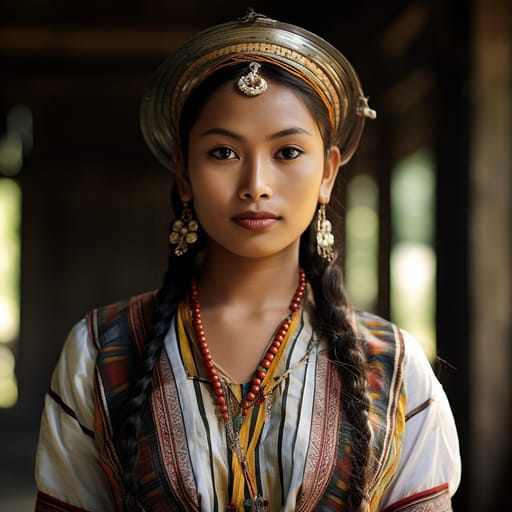
Typical Anuak Phenotypes
Reference for AI generation: hair, eyes, skin, facial structure, build
The Anuak sit firmly within the Nilotic phenotype spectrum, sharing the structural template of their Luo-speaking relatives along the upper Nile — tall, lean, and very dark — but with their own regional inflections shaped by the highland-edge zones of Gambela and the Boma plateau. The most immediately distinctive feature is skin tone: among the deepest in the world, typically Fitzpatrick VI with strong blue-black undertones rather than the warmer red-brown registers seen in some neighbouring Cushitic populations. Sun exposure intensifies rather than diversifies this — there's relatively little tonal range across the group.
Hair is densely coiled Type 4C, worn short by most men and historically in close-cropped or beaded styles by women. Color is uniformly black, with greying the only common variation; natural lightening is essentially absent. Eyes are dark brown to near-black, almond-shaped, set under straight or slightly arched brows with no epicanthic fold and unremarkable lid morphology — the classic open Nilotic eye.
Facial structure leans long and narrow. Noses tend toward a moderate bridge with a broader alar base than East African Cushitic neighbors but narrower than Bantu averages further south — a middle-Nilotic profile. Lips are full, often with a pronounced vermilion border. Cheekbones are high but not flared; the jaw is defined, the chin often pointed, giving the face a tapered ovoid shape rather than a square or round one.
Build is where the Anuak are most anthropometrically distinctive. Like the Dinka, Nuer, and other South Sudanese Nilotes they share borders with, they are among the tallest populations on earth — adult men commonly 183–190 cm, women proportionally tall — with elongated limbs, narrow hips and shoulders, slim torsos, and notably long lower legs. Body composition runs ectomorphic by default, with low natural fat distribution and visible musculature in agricultural and fishing communities along the Baro and Akobo rivers. Cross-border Anuak in Boma show the same template; subgroup variation within the ethnicity is minimal.
Anuak Body & Anatomy Reference
Per-feature anatomical profile for AI nude generation: Cushitic / Nilo-Cushitic East African phenotype
Anuak Boobs & Breasts
Anuak boobs follow the Cushitic / Nilo-Cushitic East African profile: small-to-medium-cup, high-set, conical. Areolar diameter is usually 28-38mm, and the coloring is moderate-to-high areolar pigmentation against the brown-to-deep-brown skin tone. Breast shape tracks body composition (lean ectomorph-to-mesomorph, mean adult female BMI 19-22), so Anuak breasts tend to be firmer and less projecting than the African-American or West African norm. Expect a forward-set shape, not the lateral spread of the West African phenotype.
Anuak Ass & Hips
Anuak ass and hip morphology presents as small-to-medium, high-set, rounded, distinctly different from the wide-set heavy-projection West African or African-American norm. The Anuak pelvic profile shows narrow-to-medium iliac crests, longer torso-to-leg ratio, anchored in the Cushitic / Nilo-Cushitic East African skeletal pattern. Anuak butt shots in adult AI imagery should render the small-to-medium, high-set, rounded silhouette with the overall build (lean ectomorph-to-mesomorph) and the fat distribution typical of the Cushitic / Nilo-Cushitic East African phenotype.
Anuak Vagina & Pussy
Anuak pussy anatomy typically shows brown-to-deep-brown labial pigmentation, narrow-to-medium labia minora projection. Pubic hair is usually tightly-coiled coarse texture, densely distributed. In AI-generated Anuak nudes, labial color should blend into the brown to deep brown skin with a gradual transition, and the hair should keep its tightly-coiled coarse texture.
Anuak Dicks & Penis
Penis reference for Anuak men: regional mean ~13.5cm erect, moderate girth, ~12cm circumference. Coloring: deeper-pigmented than the West African norm. An accurate Anuak cock in AI imagery matches the surrounding brown to deep brown skin rather than a generic porn default. Circumcision depends on religion and custom, not ancestry.
Anuak Body, Curves & Build
The Anuak figure is generally lean ectomorph-to-mesomorph, with mean adult female BMI 19-22, characteristic of Cushitic / Nilo-Cushitic East African ancestry. AI image tools tend to flatten regional body types into a few stock shapes; here the Anuak build is kept as its own reference.
Anuak Skin Tone & Hair Texture
Skin: brown to deep brown (Fitzpatrick V-VI). Hair: tight 4A-4C coil, often worn natural or in braided/twisted protective styles. Both are typical of Cushitic / Nilo-Cushitic East African ancestry. The most common mistake in AI nudes of Anuak women is a body rendered lighter than the face.
Data depth
0/100Coverage of image-grounded phenotype observations · drives AI generation diversity
- Sample size
- 0/40· 0 images
- Image quality
- 0/30· 0% high
- Confidence
- 0/20
- Source diversity
- 0/10
- ·No image observations yet
Explore phenotype categories
Structured taxonomy with peer-reviewed scales · 22 anatomical categories
Erotic Poses & Sex Positions
From the pose catalog: 219 named positions with reference skeletons
Frequently asked questions about Anuak people
Where is the Anuak homeland?
The Anuak homeland is Anuakia (Ethiopia), Boma (South Sudan) in Eastern Africa.
What language do Anuak people speak?
Anuak people primarily speak Nilo-Saharan / Nilotic / Luo / Anuak.
What religion do Anuak people practice?
The predominant religion among Anuak people is Christianity.






Make your own Anuak images
Five a day, free, no credits to buy. The studio starts from this group's phenotype data, so you can set body type, pose and style and keep the traits accurate.
Start with Anuak