Help us get this right
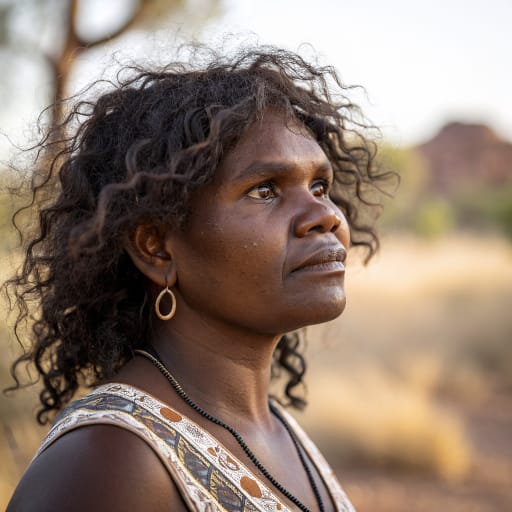
Does this portrait look right for Anmatyerre?
Nobody has judged this one yet. You would be the first.
Anmatyerre Erotic
Central Australia north of Alice Springs, around Ti Tree, Laramba, Yuelamu and the Utopia homelands, Northern Territory, Australia
Anmatyerr, in eastern and western varieties (Arandic, Pama-Nyungan); English, with many also speaking Warlpiri or Alyawarr
Altyerr (Dreaming) law and ceremony, alongside Christianity
Eastern and Western Anmatyerr; one of the Arandic peoples, with Arrernte, Alyawarr and Kaytetye
About Anmatyerre People
The Anmatyerre are the people whose country straddles the Stuart Highway north of Alice Springs. It is a stretch of mulga, spinifex and sandy creek beds that most drivers cross without asking whose land it is. To Anmatyerre families it is a close-packed map of named places. Each place is tied to Altyerr, the Dreaming, and to the people responsible for its songs and designs. Their home communities include Ti Tree, Laramba and Yuelamu, along with the Utopia homelands they share with Alyawarr neighbors. Their language, Anmatyerr, belongs to the Arandic branch of the Pama-Nyungan family. It is close kin to Arrernte to the south and Alyawarr to the east, and more distant from Kaytetye to the north. It has eastern and western varieties. On the western side many people move between Anmatyerr and Warlpiri without a second thought, the result of generations of intermarriage and shared ceremony. Kinship does much of the organizing. A system of eight skin names places everyone in relation to everyone else and shapes who marries whom, who speaks to whom and who does what at a ceremony. Rights in country pass through the father's line, while people connected through the mother act as managers who make sure things are done correctly. Women still hold awelye, their own ceremony of song and ochre designs painted onto the body. It is taken as serious business and not put on as a show.
Lasting contact came with the Overland Telegraph Line in the 1870s and the cattle stations that followed it. In 1928 a dingo trapper was killed, and the police reprisals now known as the Coniston massacre killed dozens of Warlpiri, Anmatyerre and Kaytetye people. For much of the twentieth century Anmatyerre men and women worked on stations such as Napperby and Utopia, on land they never stopped treating as their own. Utopia eventually went back to its Anmatyerre and Alyawarr owners through an early Northern Territory land claim. Families there spread out onto small outstations instead of gathering in one town, which kept people close to their own country. Most of the wider world knows the Anmatyerre through their painting. Clifford Possum Tjapaltjarri and Tim Leura Tjapaltjarri were central figures in the Papunya painting movement of the 1970s. At Utopia, women who had started with batik moved to canvas in the late 1980s. Emily Kame Kngwarreye took up canvas in her late seventies and became one of the most celebrated Australian artists of her time. She painted from the yam country and ceremonial designs she had known all her life.
Related ethnic groups
Groups that share Anmatyerre's homeland, region, language, or religious tradition. These are likely candidates for comparative phenotype reference.
Arrernte
same region (Australia / New Zealand)
Noongar
same region (Australia / New Zealand)
Yolngu
same region (Australia / New Zealand)
Tiwi
same region (Australia / New Zealand)
Pitjantjatjara
same region (Australia / New Zealand)
Te Roroa
same region (Australia / New Zealand)
Ngaanyatjarra
same region (Australia / New Zealand)
Warlpiri
same region (Australia / New Zealand)
Typical Anmatyerre Phenotypes
Reference for AI generation: hair, eyes, skin, facial structure, build
Anmatyerre Body & Anatomy Reference
Per-feature anatomical profile for AI nude generation: Aboriginal Australian phenotype
Anmatyerre Boobs & Breasts
Anmatyerre boobs follow the Aboriginal Australian profile: small-to-medium cup, modest-to-moderate projection. Areolar diameter is usually 28-42mm, and the coloring is deep-brown to near-black areolar pigmentation against the deep-brown skin tone. Breast shape tracks body composition (ectomorph-to-mesomorph, lean elongated frame adapted to arid environment, mean adult female BMI 23-26), so Anmatyerre breasts tend to be modest projection, firm. Expect a forward-set shape, not the fuller Polynesian or West African bust.
Anmatyerre Ass & Hips
Anmatyerre ass and hip morphology presents as small-to-medium, modest projection, narrower hip profile, distinctly different from the very full Polynesian gluteal projection. The Anmatyerre pelvic profile shows narrow-to-medium iliac crests, longer torso and limb proportions, anchored in the Aboriginal Australian skeletal pattern. Anmatyerre butt shots in adult AI imagery should render the small-to-medium, modest projection, narrower hip profile silhouette with the overall build (ectomorph-to-mesomorph, lean elongated frame adapted to arid environment) and the fat distribution typical of the Aboriginal Australian phenotype.
Anmatyerre Vagina & Pussy
Anmatyerre pussy anatomy typically shows deep-brown labial pigmentation. Pubic hair is usually wavy-to-coiled coarse texture. In AI-generated Anmatyerre nudes, labial color should blend into the deep-brown skin with a gradual transition, and the hair should keep its wavy-to-coiled coarse texture.
Anmatyerre Dicks & Penis
Penis reference for Anmatyerre men: regional mean ~13cm erect, moderate girth. Coloring: deep-brown shaft pigmentation. An accurate Anmatyerre cock in AI imagery matches the surrounding deep-brown skin rather than a generic porn default. Circumcision depends on religion and custom, not ancestry.
Anmatyerre Body, Curves & Build
The Anmatyerre figure is generally ectomorph-to-mesomorph, lean elongated frame adapted to arid environment, with mean adult female BMI 23-26, characteristic of Aboriginal Australian ancestry. AI image tools tend to flatten regional body types into a few stock shapes; here the Anmatyerre build is kept as its own reference.
Anmatyerre Skin Tone & Hair Texture
Skin: deep-brown (Fitzpatrick V-VI). Hair: wavy-to-curly 2C-3B, dark-brown to black; the distinctive blond-haired Aboriginal sub-population in Central Australia is documented and pigmentation-independent. Both are typical of Aboriginal Australian ancestry. The most common mistake in AI nudes of Anmatyerre women is a body rendered lighter than the face.
Explore phenotype categories
Structured taxonomy with peer-reviewed scales · 22 anatomical categories
Erotic Poses & Sex Positions
From the pose catalog: 219 named positions with reference skeletons
Frequently asked questions about Anmatyerre people
Where is the Anmatyerre homeland?
The Anmatyerre homeland is Central Australia north of Alice Springs, around Ti Tree, Laramba, Yuelamu and the Utopia homelands, Northern Territory, Australia in Australia / New Zealand.
What language do Anmatyerre people speak?
Anmatyerre people primarily speak Anmatyerr, in eastern and western varieties (Arandic, Pama-Nyungan); English, with many also speaking Warlpiri or Alyawarr.
What religion do Anmatyerre people practice?
The predominant religion among Anmatyerre people is Altyerr (Dreaming) law and ceremony, alongside Christianity.






Make your own Anmatyerre images
Five a day, free, no credits to buy. The studio starts from this group's phenotype data, so you can set body type, pose and style and keep the traits accurate.
Start with Anmatyerre