Help us get this right
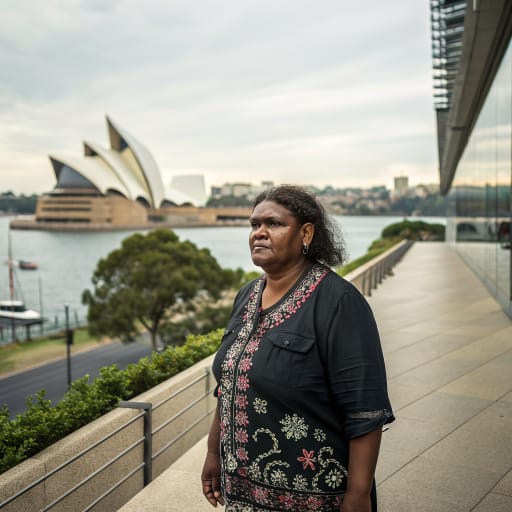
Does this portrait look right for Airiman?
Nobody has judged this one yet. You would be the first.
Airiman Erotic
Northern Territory, Australia. Listed in Norman Tindale's 1974 tribal catalog; the exact extent of their country is thinly documented.
Traditional Aboriginal religion grounded in the Dreaming and obligations to country; Christianity is widespread in Territory communities today.
Aboriginal Australians; one of the many Northern Territory peoples recorded in Tindale's catalog.
About Airiman People
The Airiman are one of the Aboriginal peoples of Australia's Northern Territory, and the honest place to start is how little the written record says about them. Their name survives chiefly because the anthropologist Norman Tindale entered it in his 1974 catalog of Aboriginal tribes, his attempt to put every group on the continent onto a single map. For a people like the Airiman, that entry is close to the whole paper trail: a name, a rough territory, and whatever variant spellings earlier visitors had jotted down.
That thinness says more about the recorders than the recorded. Tindale drew hard boundaries around groups whose own sense of belonging ran through country: specific tracts of land held by descent groups and tied together by kinship, marriage rules, shared ceremony and the Dreaming stories that account for every waterhole and ridge. A tribe on his map was often a language name, or a neighbor's label, stretched over several land-holding families. Later researchers have redrawn, merged or questioned many of his entries, and a name as lightly attested as Airiman should be read with that in mind. It marks real people and a real place, but the edges are an outsider's estimate.
What can be said with confidence is the larger story the Airiman lived inside. From the late nineteenth century the Territory was carved into pastoral leases, mining fields and mission stations. Small groups lost free access to their land, took work on cattle stations for rations, or were drawn into settlements where several peoples lived side by side. In that setting smaller identities were often folded into bigger neighboring ones, in government paperwork and in everyday speech alike, which is one reason some names fade from the record while the families behind them carry on.
Carry on they do. Since the Aboriginal Land Rights (Northern Territory) Act of 1976, roughly half of the Territory's land has returned to Aboriginal ownership, and the claims process has pushed communities to document descent lines and sacred sites in far more detail than Tindale ever managed. Descendants of people he listed under rare or variant names often identify today through a language group, a community or a land trust. Religious life blends older law with the Christianity the missions brought, and ceremony, funerals and obligations to kin still set the calendar in remote communities.
So treat this entry as a marker rather than a portrait. The Airiman belong on any complete list of the Territory's first peoples. A fuller account of who they are waits on sources, and on voices, that the published record has not yet supplied.
Related ethnic groups
Groups that share Airiman's homeland, region, language, or religious tradition. These are likely candidates for comparative phenotype reference.
Arrernte
same region (Australia / New Zealand)
Noongar
same region (Australia / New Zealand)
Yolngu
same region (Australia / New Zealand)
Tiwi
same region (Australia / New Zealand)
Gunaikurnai
same region (Australia / New Zealand)
Adnyamathanha
same region (Australia / New Zealand)
Kunwinjku
same region (Australia / New Zealand)
Bidjigal
same region (Australia / New Zealand)
Typical Airiman Phenotypes
Reference for AI generation: hair, eyes, skin, facial structure, build
Airiman Body & Anatomy Reference
Per-feature anatomical profile for AI nude generation: Aboriginal Australian phenotype
Airiman Boobs & Breasts
The typical Airiman bust is small-to-medium cup, modest-to-moderate projection, in line with the wider Aboriginal Australian pattern. Areolas usually fall in the 28-42mm range, with deep-brown to near-black areolar pigmentation against the deep-brown skin tone. Compared with the fuller Polynesian or West African bust, Airiman breasts sit forward and are generally modest projection, firm. A faithful AI render of Airiman tits keeps that shape and areola size.
Airiman Ass & Hips
Butt shape among Airiman women: small-to-medium, modest projection, narrower hip profile, over narrow-to-medium iliac crests, longer torso and limb proportions. This follows Aboriginal Australian ancestry and looks quite unlike the very full Polynesian gluteal projection. An accurate Airiman ass in adult AI imagery keeps both the silhouette and the overall build (ectomorph-to-mesomorph, lean elongated frame adapted to arid environment) instead of a generic average.
Airiman Vagina & Pussy
Vulvar anatomy among Airiman women: deep-brown labial pigmentation. Pubic hair tends to be wavy-to-coiled coarse texture, in the usual inverted-triangle pattern. Both follow Aboriginal Australian pigmentation, which is why Airiman pussy renders should not fall back on a pale, sparse Western template.
Airiman Dicks & Penis
The Airiman cock profile, from Aboriginal Australian anthropometric data: regional mean ~13cm erect; moderate girth; deep-brown shaft pigmentation. Pubic hair has a wavy-to-coiled coarse texture and forms the usual inverted-V pattern. Whether Airiman men are circumcised follows religious and cultural practice rather than phenotype.
Airiman Body, Curves & Build
Build and curves among Airiman women follow the Aboriginal Australian pattern: ectomorph-to-mesomorph, lean elongated frame adapted to arid environment, mean adult female BMI 23-26. Proportions matter as much as skin tone, so Airiman figures should keep their regional height and limb ratios.
Airiman Skin Tone & Hair Texture
The Airiman skin range is deep-brown (Fitzpatrick V-VI), and hair tends to be wavy-to-curly 2C-3B, dark-brown to black; the distinctive blond-haired Aboriginal sub-population in Central Australia is documented and pigmentation-independent. That combination marks the Aboriginal Australian phenotype, and skin tone is the trait AI generators most often get wrong for Airiman women.
Explore phenotype categories
Structured taxonomy with peer-reviewed scales · 22 anatomical categories
Erotic Poses & Sex Positions
From the pose catalog: 219 named positions with reference skeletons
Frequently asked questions about Airiman people
Where is the Airiman homeland?
The Airiman homeland is Northern Territory, Australia. Listed in Norman Tindale's 1974 tribal catalog; the exact extent of their country is thinly documented. in Australia / New Zealand.
What religion do Airiman people practice?
The predominant religion among Airiman people is Traditional Aboriginal religion grounded in the Dreaming and obligations to country; Christianity is widespread in Territory communities today..






Make your own Airiman images
Five a day, free, no credits to buy. The studio starts from this group's phenotype data, so you can set body type, pose and style and keep the traits accurate.
Start with Airiman