Help us get this right
Does this portrait look right for Adnyamathanha?
Nobody has judged this one yet. You would be the first.
Adnyamathanha Erotic
Northern Flinders Ranges between Lake Torrens and Lake Frome, South Australia, Australia; communities at Nepabunna, Port Augusta and Adelaide
Adnyamathanha, also called Yura Ngawarla (Thura-Yura, Pama-Nyungan), endangered; English is the everyday language for most
Christianity, much of it rooted in the United Aborigines Mission at Nepabunna, alongside Dreaming law tied to country
A collective of Wailpi, Kuyani, Jadliaura and Pilatapa groups; part of the Thura-Yura language bloc with Barngarla, Nukunu and Kaurna; society divided into Arruru and Mathari moieties
About Adnyamathanha People
The Adnyamathanha are the hills people of the northern Flinders Ranges in South Australia, and the name says as much: adnya means rock. Their country is red ridges, creek beds lined with gum trees, and gorges running between Lake Torrens and Lake Frome. The name covers more than one group. It brings together several older groups, among them the Wailpi, Kuyani, Jadliaura and Pilatapa. Pastoral settlement and mission life pushed their families together, and over time they came to speak of themselves as one people. In their own language they are Yura, simply people, and the language is Yura Ngawarla.
That language belongs to the Thura-Yura branch of the Pama-Nyungan family. These related languages were once spoken from the ranges across Eyre Peninsula and south to the Adelaide Plains. Linguists still point to one feature of it: the pronoun a speaker uses for we two depends on how the two people are related. Kinship is part of the grammar because it is part of everything else. Adnyamathanha society divides the world into two moieties, Arruru and Mathari, and people, animals, plants and places all belong to one or the other. Marriage traditionally crossed that line, and moiety is still part of how families work out who is related to whom.
The land holds the record of the Dreaming. Akurra, the great serpent, carved gorges and waterholes on its travels. The walls of Ikara, the basin better known on maps as Wilpena Pound, are said to be the bodies of Akurra serpents. Near Parachilna, people dug red ochre at Pukardu for generations and traded it far beyond the ranges. Christianity came with the United Aborigines Mission, which settled families at Nepabunna in 1931. In many households, church and Dreaming law now sit side by side.
The pastoral era hit hard. From the 1850s sheep runs took over the permanent waters and copper mines opened at places like Blinman. Adnyamathanha men became the stockmen and station hands who kept those stations and mines running. Families later spread to towns such as Port Augusta and Adelaide, but Nepabunna is still an Adnyamathanha community. The people have since won back legal recognition on their country. Native title was recognized over much of the ranges in 2009, and they co-manage the Ikara-Flinders Ranges and Vulkathunha-Gammon Ranges national parks. Cultural tourism at Iga Warta and steady work to revive the language pass the old knowledge on to a generation that mostly grew up speaking English.
Related ethnic groups
Groups that share Adnyamathanha's homeland, region, language, or religious tradition. These are likely candidates for comparative phenotype reference.
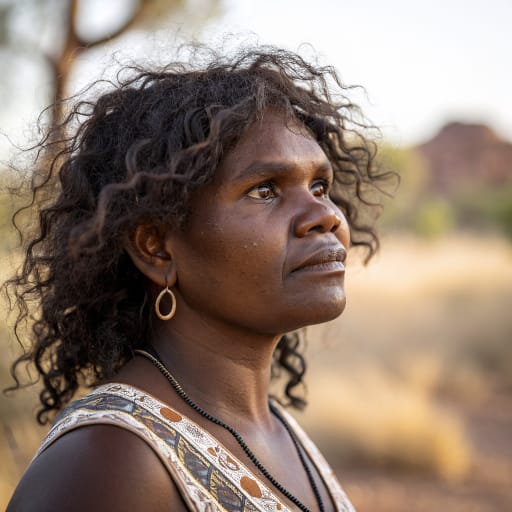
Arrernte
same region (Australia / New Zealand)
Noongar
same region (Australia / New Zealand)
Yolngu
same region (Australia / New Zealand)
Tiwi
same region (Australia / New Zealand)
Kaurna
same region (Australia / New Zealand)
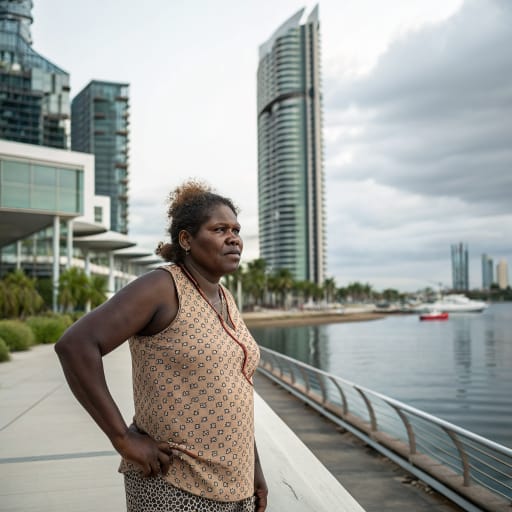
Darumbal
same region (Australia / New Zealand)
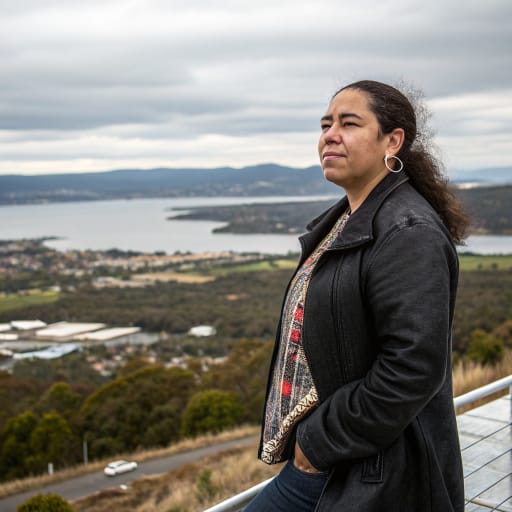
Gunaikurnai
same region (Australia / New Zealand)
Spinifex
same region (Australia / New Zealand)
Typical Adnyamathanha Phenotypes
Reference for AI generation: hair, eyes, skin, facial structure, build
Adnyamathanha Body & Anatomy Reference
Per-feature anatomical profile for AI nude generation: Aboriginal Australian phenotype
Adnyamathanha Boobs & Breasts
The typical Adnyamathanha bust is small-to-medium cup, modest-to-moderate projection, in line with the wider Aboriginal Australian pattern. Areolas usually fall in the 28-42mm range, with deep-brown to near-black areolar pigmentation against the deep-brown skin tone. Compared with the fuller Polynesian or West African bust, Adnyamathanha breasts sit forward and are generally modest projection, firm. A faithful AI render of Adnyamathanha tits keeps that shape and areola size.
Adnyamathanha Ass & Hips
Butt shape among Adnyamathanha women: small-to-medium, modest projection, narrower hip profile, over narrow-to-medium iliac crests, longer torso and limb proportions. This follows Aboriginal Australian ancestry and looks quite unlike the very full Polynesian gluteal projection. An accurate Adnyamathanha ass in adult AI imagery keeps both the silhouette and the overall build (ectomorph-to-mesomorph, lean elongated frame adapted to arid environment) instead of a generic average.
Adnyamathanha Vagina & Pussy
Vulvar anatomy among Adnyamathanha women: deep-brown labial pigmentation. Pubic hair tends to be wavy-to-coiled coarse texture, in the usual inverted-triangle pattern. Both follow Aboriginal Australian pigmentation, which is why Adnyamathanha pussy renders should not fall back on a pale, sparse Western template.
Adnyamathanha Dicks & Penis
The Adnyamathanha cock profile, from Aboriginal Australian anthropometric data: regional mean ~13cm erect; moderate girth; deep-brown shaft pigmentation. Pubic hair has a wavy-to-coiled coarse texture and forms the usual inverted-V pattern. Whether Adnyamathanha men are circumcised follows religious and cultural practice rather than phenotype.
Adnyamathanha Body, Curves & Build
Build and curves among Adnyamathanha women follow the Aboriginal Australian pattern: ectomorph-to-mesomorph, lean elongated frame adapted to arid environment, mean adult female BMI 23-26. Proportions matter as much as skin tone, so Adnyamathanha figures should keep their regional height and limb ratios.
Adnyamathanha Skin Tone & Hair Texture
The Adnyamathanha skin range is deep-brown (Fitzpatrick V-VI), and hair tends to be wavy-to-curly 2C-3B, dark-brown to black; the distinctive blond-haired Aboriginal sub-population in Central Australia is documented and pigmentation-independent. That combination marks the Aboriginal Australian phenotype, and skin tone is the trait AI generators most often get wrong for Adnyamathanha women.
Explore phenotype categories
Structured taxonomy with peer-reviewed scales · 22 anatomical categories
Erotic Poses & Sex Positions
From the pose catalog: 219 named positions with reference skeletons
Frequently asked questions about Adnyamathanha people
Where is the Adnyamathanha homeland?
The Adnyamathanha homeland is Northern Flinders Ranges between Lake Torrens and Lake Frome, South Australia, Australia; communities at Nepabunna, Port Augusta and Adelaide in Australia / New Zealand.
What language do Adnyamathanha people speak?
Adnyamathanha people primarily speak Adnyamathanha, also called Yura Ngawarla (Thura-Yura, Pama-Nyungan), endangered; English is the everyday language for most.
What religion do Adnyamathanha people practice?
The predominant religion among Adnyamathanha people is Christianity, much of it rooted in the United Aborigines Mission at Nepabunna, alongside Dreaming law tied to country.






Make your own Adnyamathanha images
Five a day, free, no credits to buy. The studio starts from this group's phenotype data, so you can set body type, pose and style and keep the traits accurate.
Start with Adnyamathanha