Help us get this right
Does this portrait look right for Alawa?
Nobody has judged this one yet. You would be the first.
Alawa Erotic
South of the Roper River along the Hodgson River, inland from the southwestern Gulf of Carpentaria, Northern Territory, Australia. Main communities today are Minyerri (former Hodgson Downs) and Ngukurr.
Alawa (Marran, non-Pama-Nyungan), now spoken fully by only a few elders; Kriol (English-based creole) is the everyday language, alongside English.
Ancestral Dreaming law and regional ceremony, alongside Christianity, mainly Anglican through the former Roper River Mission.
One of the Roper River peoples, neighbors of the Marra, Warndarang, Ngalakgan and Mangarrayi. Organized internally into four patrilineal semi-moieties: Mambali, Murrungun, Guyal and Budal.
About Alawa People
The Alawa are an Aboriginal people of the Northern Territory's Gulf country. Their land lies south of the Roper River, along the Hodgson River and its tributaries, inland from the southwestern corner of the Gulf of Carpentaria. It is savanna and sandstone country, flooded and cut off in the wet season and hard and dry for the rest of the year. Most Alawa now live at Minyerri, on the former Hodgson Downs cattle station, and at Ngukurr, the old Roper River Mission, with family in Katherine and Darwin.
Alawa is a Marran language, closest to Marra and the now silent Warndarang. It belongs to the non-Pama-Nyungan languages of the Top End, structurally far from the family that covers most of the continent, and it sorts nouns into masculine and feminine. Only a handful of elders still speak it fully. The everyday language is Kriol, the English-based creole that took shape at the Roper River Mission in the early twentieth century, when children from many language groups were raised together in its dormitories. The linguist Margaret Sharpe worked with Alawa speakers from the 1960s, and an Alawa, Kriol and English dictionary came out of that work.
The mission exists because of what came before it. Cattle reached the Roper in the 1870s and 1880s, and the violence that followed was severe. In the early 1900s a pastoral company with enormous leases paid armed gangs to clear Aboriginal people off the country. The Anglican mission opened in 1908 and became a refuge for survivors from the Alawa and their neighbors. Alawa men and women then spent generations as the poorly paid or unpaid workforce of stations built on their own land. Hodgson Downs was eventually returned as Aboriginal freehold and is now held by an Alawa land trust.
Alawa society runs on a framework shared across the Roper region. Everyone belongs to one of four semi-moieties, Mambali, Murrungun, Guyal and Budal, inherited through the father, which tie people to particular tracts of country, Dreaming tracks and ceremonies. Rights come in pairs. You own your father's country, and you act as junggayi, a manager or guardian, for your mother's. Owners cannot properly run a ceremony or decide the fate of a site without their junggayi present, a check that shapes land council meetings and mining negotiations as much as ritual. Christianity, mostly Anglican, sits beside ceremony rather than replacing it.
Outside the region the name travels in two ways: as a northern suburb of Darwin, and through I, the Aboriginal, Douglas Lockwood's 1962 account of the life of Phillip Roberts, Waipuldanya, an Alawa man who trained as a medical assistant.
Related ethnic groups
Groups that share Alawa's homeland, region, language, or religious tradition. These are likely candidates for comparative phenotype reference.
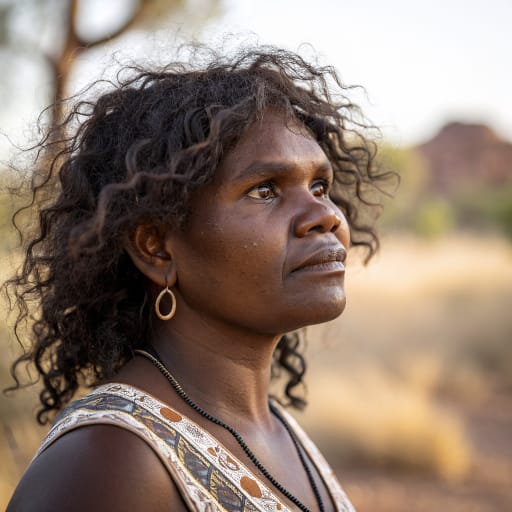
Arrernte
same region (Australia / New Zealand)
Noongar
same region (Australia / New Zealand)
Yolngu
same region (Australia / New Zealand)
Tiwi
same region (Australia / New Zealand)
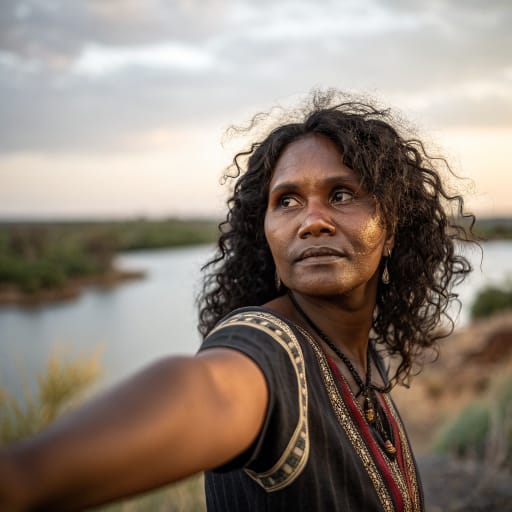
Alyawarre
same region (Australia / New Zealand)
Kaurna
same region (Australia / New Zealand)
Murrinh-Patha
same region (Australia / New Zealand)
Ngarrindjeri
same region (Australia / New Zealand)
Typical Alawa Phenotypes
Reference for AI generation: hair, eyes, skin, facial structure, build
Alawa Body & Anatomy Reference
Aboriginal Australian phenotype: anatomy reference for AI nude generation
Alawa Boobs & Breasts
Alawa tits and boobs run small-to-medium cup, modest-to-moderate projection, the classic Aboriginal Australian bust profile. Alawa nipples and areolas show deep-brown to near-black areolar pigmentation against the deep-brown skin tone, with areolar diameter typically in the 28-42mm range and forward-set positioning rather than the fuller Polynesian or West African bust. Alawa breasts trend modest projection, firm, a function of the ectomorph-to-mesomorph, lean elongated frame adapted to arid environment body habitus and the mean adult female BMI 23-26. For anatomically accurate AI-generated Alawa nudes the render preserves the small-to-medium cup, modest-to-moderate projection shape, 28-42mm areolas with deep-brown to near-black pigmentation, and the torso proportions of the Aboriginal Australian phenotype.
Alawa Ass & Hips
Alawa hips and butt usually read as small-to-medium, modest projection, narrower hip profile. The skeletal base is narrow-to-medium iliac crests, longer torso and limb proportions, the Aboriginal Australian pattern. Set against the very full Polynesian gluteal projection, the difference is easy to see, and the hip-to-waist ratio is often what identifies Alawa women in photos.
Alawa Vagina & Pussy
Expect deep-brown labial pigmentation on Alawa women, in keeping with Aboriginal Australian ancestry. The pubic hair is wavy-to-coiled coarse texture. Coloring should run evenly from the deep-brown skin of the thighs to the labia, and Alawa nude imagery should keep the hair's wavy-to-coiled coarse texture.
Alawa Dicks & Penis
Alawa dick and penile anatomy in adult AI generation should anchor on the regional reference data: regional mean ~13cm erect, moderate girth, and deep-brown shaft pigmentation. The Alawa cock profile reflects the Aboriginal Australian population's anthropometric measurements. The shaft pigmentation should track the surrounding deep-brown skin tone, and the pubic hair should keep its wavy-to-coiled coarse texture in the typical inverted-V escutcheon.
Alawa Body, Curves & Build
Alawa body type: ectomorph-to-mesomorph, lean elongated frame adapted to arid environment, with mean adult female BMI 23-26. This is the typical Aboriginal Australian build. Height range, shoulder-to-hip ratio and fat distribution all follow from it, which is what an accurate Alawa nude body should show.
Alawa Skin Tone & Hair Texture
Alawa skin tone falls in the deep-brown (Fitzpatrick V-VI) band, the surface signal most often miscalibrated by generic AI nude generators. Alawa hair texture is typically wavy-to-curly 2C-3B, dark-brown to black; the distinctive blond-haired Aboriginal sub-population in Central Australia is documented and pigmentation-independent, characteristic of the Aboriginal Australian phenotype. In Alawa nude renders the skin should hold that band consistently across the body.
Explore phenotype categories
Structured taxonomy with peer-reviewed scales · 22 anatomical categories
Erotic Poses & Sex Positions
From the pose catalog: 219 named positions with reference skeletons
Frequently asked questions about Alawa people
Where is the Alawa homeland?
The Alawa homeland is South of the Roper River along the Hodgson River, inland from the southwestern Gulf of Carpentaria, Northern Territory, Australia. Main communities today are Minyerri (former Hodgson Downs) and Ngukurr. in Australia / New Zealand.
What language do Alawa people speak?
Alawa people primarily speak Alawa (Marran, non-Pama-Nyungan), now spoken fully by only a few elders; Kriol (English-based creole) is the everyday language, alongside English..
What religion do Alawa people practice?
The predominant religion among Alawa people is Ancestral Dreaming law and regional ceremony, alongside Christianity, mainly Anglican through the former Roper River Mission..






Make your own Alawa images
Five a day, free, no credits to buy. The studio starts from this group's phenotype data, so you can set body type, pose and style and keep the traits accurate.
Start with Alawa