Help us get this right
Does this portrait look right for Bardi?
Nobody has judged this one yet. You would be the first.
Bardi Erotic
Northern tip of the Dampier Peninsula and nearby islands of King Sound, Kimberley region, Western Australia; main communities at One Arm Point (Ardyaloon), Djarindjin and Lombadina.
Bardi (Nyulnyulan, non-Pama-Nyungan), now critically endangered; Aboriginal English and Kriol in daily use.
Christianity (Catholic at Lombadina and Djarindjin, Protestant mission heritage at One Arm Point) alongside continuing Aboriginal Law and ceremony.
Aboriginal Australians of the West Kimberley; allied with the Jawi as Bardi Jawi; one of the Nyulnyulan-speaking peoples with the Nyul Nyul, Jabirr Jabirr and Yawuru. Country is held in family estates called buru.
About Bardi People
The Bardi are saltwater people, and nearly everything that marks them as a group comes from reading the sea. Their country is the northern tip of the Dampier Peninsula in Western Australia's Kimberley, north of Broome, where red cliffs meet white sand and the tides of King Sound can move through ten meters or more. Knowing when a reef will lie bare, which current runs to the next island, and when the turtles are fat is the core of Bardi knowledge. Their closest kin are the Jawi of Sunday Island and the Buccaneer Archipelago, and the two are now so intermarried that they usually act as one body, Bardi Jawi. Most live in three communities: One Arm Point (Ardyaloon), Djarindjin and Lombadina.
Bardi belongs to the small Nyulnyulan family, one of the Kimberley's non-Pama-Nyungan groups, with no demonstrable link to the languages that cover most of the continent. Jawi is close enough to count as a sister dialect. Only a handful of elders still speak Bardi fluently. Daily talk runs in Aboriginal English and Kriol, threaded with Bardi words for fish, tides, kin and seasons. The calendar itself is Bardi: six seasons rather than four, among them Lalin, the hot build-up before the rains, when turtles mate and hunters go out after them.
Outsiders arrived by boat. From the 1880s pearling luggers took Bardi men and women as divers and crew, often by force. Missions followed: a Protestant one on Sunday Island in 1899, a Catholic one at Lombadina in the 1910s. When the Sunday Island mission closed in the early 1960s its people were moved to Derby, a town on tidal mudflats far from their reefs. In 1972 they went home and built One Arm Point themselves. The Federal Court recognized Bardi Jawi native title in 2005 and widened it on appeal in 2010.
Most Bardi are Christian, and most also keep Law. Boys still go through initiation, and ilma, public song and dance cycles performed with handheld emblems of wood and colored thread, are still composed, often from songs said to arrive in dreams. Two older technologies deserve to be better known. The galwa is a raft of pegged mangrove logs, ridden on tidal currents between islands rather than paddled against them. Riji are pearl shells engraved with interlocking lines and rubbed with red ochre, worn by initiated men and once traded deep into the desert interior. Today Bardi Jawi rangers monitor turtle and dugong across an Indigenous Protected Area declared in 2013.
Related ethnic groups
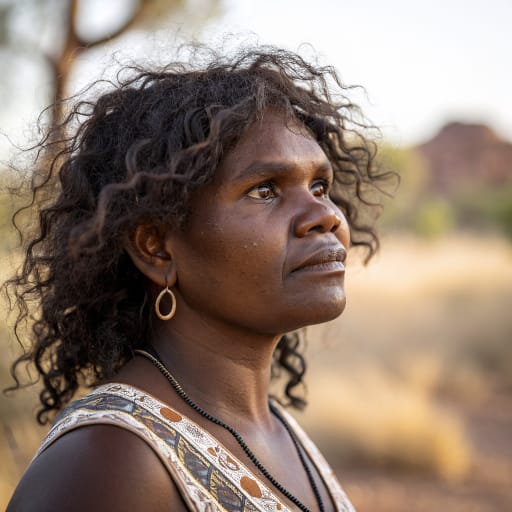
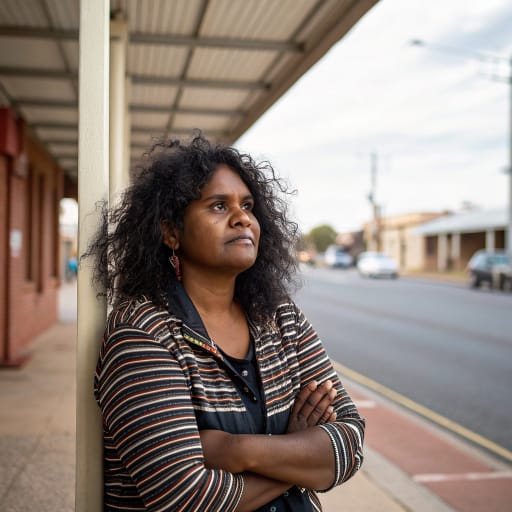
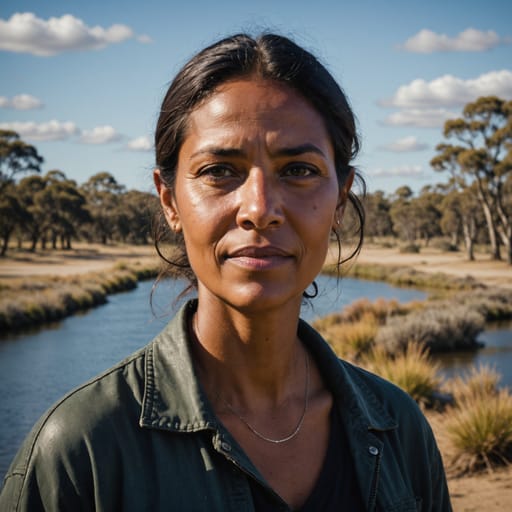
Groups that share Bardi's homeland, region, language, or religious tradition. These are likely candidates for comparative phenotype reference.
Arrernte
same region (Australia / New Zealand)
Noongar
same region (Australia / New Zealand)
Yolngu
same region (Australia / New Zealand)
Tiwi
same region (Australia / New Zealand)
Adnyamathanha
same region (Australia / New Zealand)
Murrinh-Patha
same region (Australia / New Zealand)
Wodiwodi
same region (Australia / New Zealand)
Beeliar
same region (Australia / New Zealand)
Typical Bardi Phenotypes
Reference for AI generation: hair, eyes, skin, facial structure, build
Bardi Body & Anatomy Reference
Anatomy by feature, Aboriginal Australian phenotype
Bardi Boobs & Breasts
Bardi boobs follow the Aboriginal Australian profile: small-to-medium cup, modest-to-moderate projection. Areolar diameter is usually 28-42mm, and the coloring is deep-brown to near-black areolar pigmentation against the deep-brown skin tone. Breast shape tracks body composition (ectomorph-to-mesomorph, lean elongated frame adapted to arid environment, mean adult female BMI 23-26), so Bardi breasts tend to be modest projection, firm. Expect a forward-set shape, not the fuller Polynesian or West African bust.
Bardi Ass & Hips
Bardi ass and hip morphology presents as small-to-medium, modest projection, narrower hip profile, distinctly different from the very full Polynesian gluteal projection. The Bardi pelvic profile shows narrow-to-medium iliac crests, longer torso and limb proportions, anchored in the Aboriginal Australian skeletal pattern. Bardi butt shots in adult AI imagery should render the small-to-medium, modest projection, narrower hip profile silhouette with the overall build (ectomorph-to-mesomorph, lean elongated frame adapted to arid environment) and the fat distribution typical of the Aboriginal Australian phenotype.
Bardi Vagina & Pussy
Bardi pussy anatomy typically shows deep-brown labial pigmentation. Pubic hair is usually wavy-to-coiled coarse texture. In AI-generated Bardi nudes, labial color should blend into the deep-brown skin with a gradual transition, and the hair should keep its wavy-to-coiled coarse texture.
Bardi Dicks & Penis
Penis reference for Bardi men: regional mean ~13cm erect, moderate girth. Coloring: deep-brown shaft pigmentation. An accurate Bardi cock in AI imagery matches the surrounding deep-brown skin rather than a generic porn default. Circumcision depends on religion and custom, not ancestry.
Bardi Body, Curves & Build
The Bardi figure is generally ectomorph-to-mesomorph, lean elongated frame adapted to arid environment, with mean adult female BMI 23-26, characteristic of Aboriginal Australian ancestry. AI image tools tend to flatten regional body types into a few stock shapes; here the Bardi build is kept as its own reference.
Bardi Skin Tone & Hair Texture
Skin: deep-brown (Fitzpatrick V-VI). Hair: wavy-to-curly 2C-3B, dark-brown to black; the distinctive blond-haired Aboriginal sub-population in Central Australia is documented and pigmentation-independent. Both are typical of Aboriginal Australian ancestry. The most common mistake in AI nudes of Bardi women is a body rendered lighter than the face.
Explore phenotype categories
Structured taxonomy with peer-reviewed scales · 22 anatomical categories
Erotic Poses & Sex Positions
From the pose catalog: 219 named positions with reference skeletons
Frequently asked questions about Bardi people
Where is the Bardi homeland?
The Bardi homeland is Northern tip of the Dampier Peninsula and nearby islands of King Sound, Kimberley region, Western Australia; main communities at One Arm Point (Ardyaloon), Djarindjin and Lombadina. in Australia / New Zealand.
What language do Bardi people speak?
Bardi people primarily speak Bardi (Nyulnyulan, non-Pama-Nyungan), now critically endangered; Aboriginal English and Kriol in daily use..
What religion do Bardi people practice?
The predominant religion among Bardi people is Christianity (Catholic at Lombadina and Djarindjin, Protestant mission heritage at One Arm Point) alongside continuing Aboriginal Law and ceremony..






Make your own Bardi images
Five a day, free, no credits to buy. The studio starts from this group's phenotype data, so you can set body type, pose and style and keep the traits accurate.
Start with Bardi