No portrait yet
Yolngu Erotic
Northeast Arnhem Land, Northern Territory, Australia, including Yirrkala and the Gove Peninsula, Galiwin'ku on Elcho Island, Milingimbi, Ramingining and Gapuwiyak.
Yolŋu Matha, about a dozen clan varieties including Djambarrpuyŋu, Gumatj, Gupapuyŋu and Djapu (Pama-Nyungan, Yolŋu branch); English as a second or third language.
Ancestral ceremonial law, held widely alongside Christianity, mostly Uniting Church.
Dhuwa and Yirritja moieties, subdivided into clans (mala) such as Gumatj, Rirratjiŋu, Djapu, Gälpu, Dhaḻwaŋu and Wangurri; part of the wider Aboriginal Australian population of Arnhem Land.
About Yolngu People
Yolŋu means person, and the people of northeast Arnhem Land use the word the way other nations use a flag. Their country is the top right corner of Australia's Northern Territory: stringybark forest and floodplain running out to mangrove, sand and the Arafura Sea, with the Gove Peninsula, Elcho Island and the Crocodile Islands as the best known anchors. The year there has six seasons, read off wind direction, storm behavior and what is fruiting or fattening rather than off a calendar. Roughly a dozen closely related varieties make up Yolŋu Matha, and which one you speak announces which clan you belong to. The whole set is Pama-Nyungan, the family that covers most of the continent, which makes Yolŋu country a linguistic island: almost everything spoken around it in Arnhem Land belongs to unrelated families. Underneath the clans sits a division of the world into two halves, Dhuwa and Yirritja. Every person, animal, plant, song, water source and stretch of ground is one or the other, you marry into the opposite half, and the kinship system called gurruṯu maps the result onto everyone you will ever meet.
Long before Europeans, Macassan crews from Sulawesi rode the northwest monsoon down each year to harvest trepang, camping on Yolŋu beaches to boil and smoke it. That trade ran for centuries until Australian customs law killed it around 1906, and it left dugout canoes, metal, tamarind trees still standing on the coast, ceremonies about the visitors, and words still in daily use, including balanda, which is what Yolŋu call white people. Mission stations arrived in the 1920s and 1930s, and Christianity took hold without displacing ceremonial law; plenty of people hold both without embarrassment. When a bauxite lease was cut out of the reserve in 1963, Yirrkala clans answered with petitions typed on paper and framed in painted bark, the first documents in Aboriginal form the federal Parliament ever formally received. The court case that followed was lost in 1971, but it forced the inquiry that produced the Northern Territory land rights act five years later, and a 2008 High Court ruling extended Yolŋu control to the tidal waters. Bark painting, hollow log poles and the yiḏaki, the instrument the world calls a didgeridoo, went out to galleries and stages from here. Song cycles are still sung, ceremony still runs for weeks, and Garma each August puts all of it in front of the country's politicians on purpose.
Related ethnic groups
Groups that share Yolngu's homeland, region, language, or religious tradition. These are likely candidates for comparative phenotype reference.
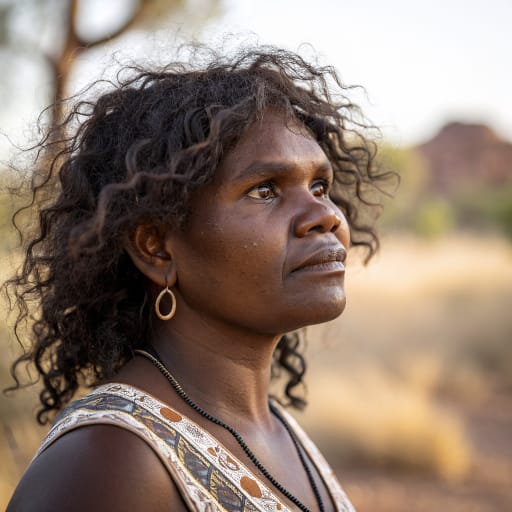
Arrernte
same region (Australia / New Zealand)
Noongar
same region (Australia / New Zealand)
Tiwi
same region (Australia / New Zealand)
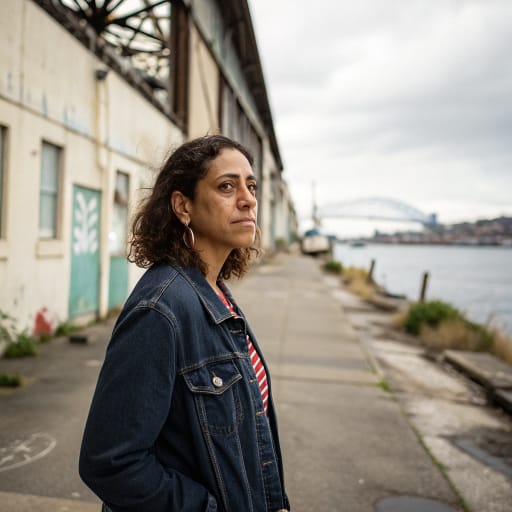
Eora
same region (Australia / New Zealand)
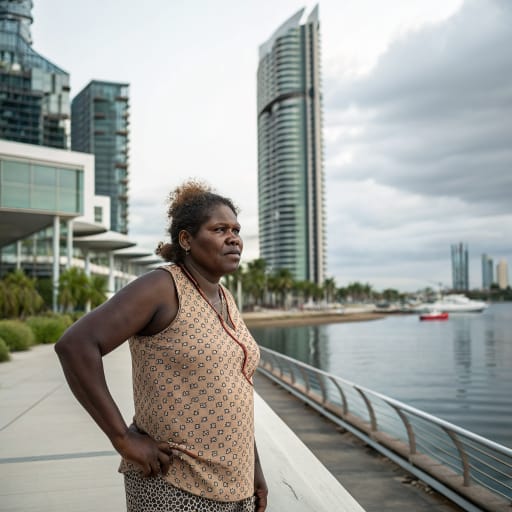
Darumbal
same region (Australia / New Zealand)
Uutaalnganu
same region (Australia / New Zealand)
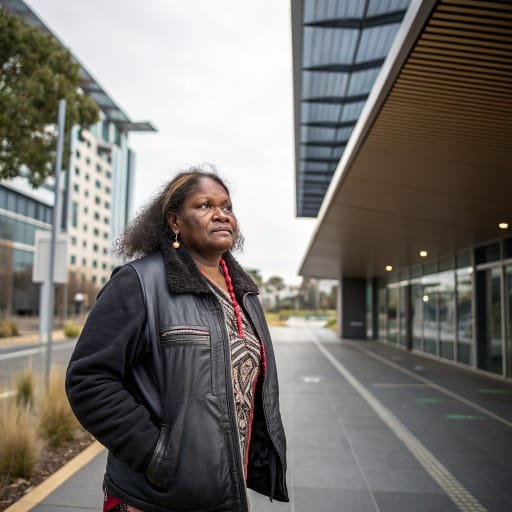
Djab Wurrung
same region (Australia / New Zealand)
Tharawal
same region (Australia / New Zealand)
Typical Yolngu Phenotypes
Reference for AI generation: hair, eyes, skin, facial structure, build
Yolngu Body & Anatomy Reference
Anatomy by feature, Aboriginal Australian phenotype
Yolngu Boobs & Breasts
Yolngu tits and boobs run small-to-medium cup, modest-to-moderate projection, the classic Aboriginal Australian bust profile. Yolngu nipples and areolas show deep-brown to near-black areolar pigmentation against the deep-brown skin tone, with areolar diameter typically in the 28-42mm range and forward-set positioning rather than the fuller Polynesian or West African bust. Yolngu breasts trend modest projection, firm, a function of the ectomorph-to-mesomorph, lean elongated frame adapted to arid environment body habitus and the mean adult female BMI 23-26. For anatomically accurate AI-generated Yolngu nudes the render preserves the small-to-medium cup, modest-to-moderate projection shape, 28-42mm areolas with deep-brown to near-black pigmentation, and the torso proportions of the Aboriginal Australian phenotype.
Yolngu Ass & Hips
Yolngu hips and butt usually read as small-to-medium, modest projection, narrower hip profile. The skeletal base is narrow-to-medium iliac crests, longer torso and limb proportions, the Aboriginal Australian pattern. Set against the very full Polynesian gluteal projection, the difference is easy to see, and the hip-to-waist ratio is often what identifies Yolngu women in photos.
Yolngu Vagina & Pussy
Expect deep-brown labial pigmentation on Yolngu women, in keeping with Aboriginal Australian ancestry. The pubic hair is wavy-to-coiled coarse texture. Coloring should run evenly from the deep-brown skin of the thighs to the labia, and Yolngu nude imagery should keep the hair's wavy-to-coiled coarse texture.
Yolngu Dicks & Penis
Yolngu dick and penile anatomy in adult AI generation should anchor on the regional reference data: regional mean ~13cm erect, moderate girth, and deep-brown shaft pigmentation. The Yolngu cock profile reflects the Aboriginal Australian population's anthropometric measurements. The shaft pigmentation should track the surrounding deep-brown skin tone, and the pubic hair should keep its wavy-to-coiled coarse texture in the typical inverted-V escutcheon.
Yolngu Body, Curves & Build
Yolngu body type: ectomorph-to-mesomorph, lean elongated frame adapted to arid environment, with mean adult female BMI 23-26. This is the typical Aboriginal Australian build. Height range, shoulder-to-hip ratio and fat distribution all follow from it, which is what an accurate Yolngu nude body should show.
Yolngu Skin Tone & Hair Texture
Yolngu skin tone falls in the deep-brown (Fitzpatrick V-VI) band, the surface signal most often miscalibrated by generic AI nude generators. Yolngu hair texture is typically wavy-to-curly 2C-3B, dark-brown to black; the distinctive blond-haired Aboriginal sub-population in Central Australia is documented and pigmentation-independent, characteristic of the Aboriginal Australian phenotype. In Yolngu nude renders the skin should hold that band consistently across the body.
Explore phenotype categories
Structured taxonomy with peer-reviewed scales · 22 anatomical categories
Erotic Poses & Sex Positions
From the pose catalog: 219 named positions with reference skeletons
Frequently asked questions about Yolngu people
Where is the Yolngu homeland?
The Yolngu homeland is Northeast Arnhem Land, Northern Territory, Australia, including Yirrkala and the Gove Peninsula, Galiwin'ku on Elcho Island, Milingimbi, Ramingining and Gapuwiyak. in Australia / New Zealand.
What language do Yolngu people speak?
Yolngu people primarily speak Yolŋu Matha, about a dozen clan varieties including Djambarrpuyŋu, Gumatj, Gupapuyŋu and Djapu (Pama-Nyungan, Yolŋu branch); English as a second or third language..
What religion do Yolngu people practice?
The predominant religion among Yolngu people is Ancestral ceremonial law, held widely alongside Christianity, mostly Uniting Church..






Make your own Yolngu images
Five a day, free, no credits to buy. The studio starts from this group's phenotype data, so you can set body type, pose and style and keep the traits accurate.
Start with Yolngu