No portrait yet
Warlpiri Erotic
Tanami Desert and surrounding country northwest of Alice Springs, Northern Territory, Australia; main communities are Yuendumu, Lajamanu, Nyirrpi and Willowra.
Warlpiri (Ngarrkic, Pama-Nyungan); also Light Warlpiri, a mixed language spoken at Lajamanu, Warlpiri Sign Language, Kriol and Aboriginal English.
Jukurrpa (Dreaming) law and ceremony, practiced alongside Christianity, mainly Baptist.
Ngarrkic speakers among the Pama-Nyungan peoples of the central desert; regional dialect groups include Ngaliya (south), Warnayaka (north), Wakirti (east) and Warrmarla (west). Neighbors include Warlmanpa, Anmatyerr, Pintupi and Gurindji.
About Warlpiri People
The Warlpiri are desert people of the Tanami, the red sand and spinifex country northwest of Alice Springs in Australia's Northern Territory, and they are among the Aboriginal nations whose language and law have held most firmly. What binds them is Jukurrpa, usually translated as the Dreaming: not a mythology kept for special occasions but a working body of law that ties each person to particular tracts of country, particular ancestral beings and particular obligations. Everyone is born into one of eight skin groups, each with a man's name beginning with J and a woman's with N: Japaljarri and Napaljarri, Jakamarra and Nakamarra, and so on. A skin name tells a stranger at once who is a potential spouse, who is a mother-in-law to be avoided, and who owes whom. For any site, some people are kirda, owners through their fathers, and others are kurdungurlu, managers through their mothers, and no ceremony runs properly without both.
Around 3,000 people speak Warlpiri as a first language, which makes it one of the strongest Indigenous languages in the country. It belongs to the Ngarrkic branch of Pama-Nyungan and is famous among linguists for word order so free that it reshaped theories of grammar. There is also a full sign language, used most by widows who observe long speech bans in mourning, and at Lajamanu young people have built a new mixed language, Light Warlpiri, out of Warlpiri, Kriol and English. When someone dies their name goes out of use, and Kumanjayi stands in for it.
The twentieth century came hard. In 1928 a police-led party answering the killing of a dingo trapper shot dozens of Warlpiri, Anmatyerr and Kaytetye people in what is remembered as the Coniston massacre. Government settlements followed: Yuendumu in 1946, then Hooker Creek, now Lajamanu, where families were trucked onto Gurindji country and some walked hundreds of kilometers home. Land rights legislation in 1976 opened the way to claims that returned much of the Tanami to Warlpiri title, and gold mining royalties now fund an education trust directed by Warlpiri people.
Today most Warlpiri live in Yuendumu, Lajamanu, Nyirrpi and Willowra, with many in Alice Springs, Tennant Creek and Katherine. Yuendumu produced the painted school doors of the early 1980s, the Warlukurlangu art center and the media association behind Bush Mechanics. Baptist churches sit alongside ceremony rather than replacing it, and the annual Yuendumu Sports Weekend draws football teams from across the desert. The 2019 police shooting of Kumanjayi Walker in Yuendumu, and the long inquest after it, put the community's relationship with the state back in national view.
Related ethnic groups
Groups that share Warlpiri's homeland, region, language, or religious tradition. These are likely candidates for comparative phenotype reference.
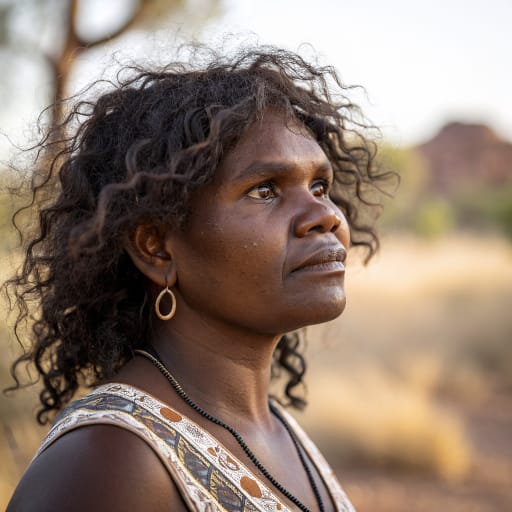
Arrernte
same region (Australia / New Zealand)
Noongar
same region (Australia / New Zealand)
Yolngu
same region (Australia / New Zealand)
Tiwi
same region (Australia / New Zealand)
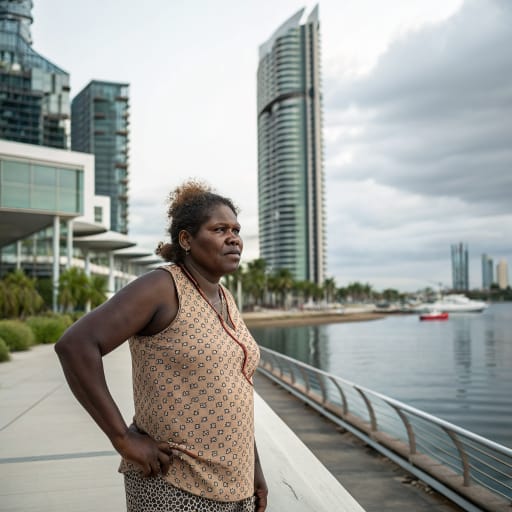
Darumbal
same region (Australia / New Zealand)
Spinifex
same region (Australia / New Zealand)
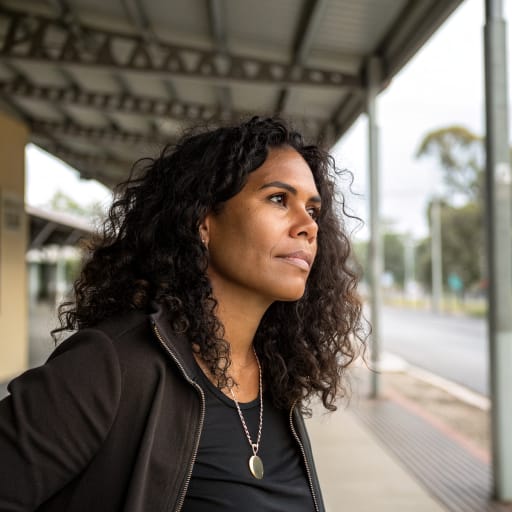
Jagera
same region (Australia / New Zealand)
Warumungu
same region (Australia / New Zealand)
Typical Warlpiri Phenotypes
Reference for AI generation: hair, eyes, skin, facial structure, build
Warlpiri Body & Anatomy Reference
Aboriginal Australian phenotype: anatomy reference for AI nude generation
Warlpiri Boobs & Breasts
Warlpiri boobs follow the Aboriginal Australian profile: small-to-medium cup, modest-to-moderate projection. Areolar diameter is usually 28-42mm, and the coloring is deep-brown to near-black areolar pigmentation against the deep-brown skin tone. Breast shape tracks body composition (ectomorph-to-mesomorph, lean elongated frame adapted to arid environment, mean adult female BMI 23-26), so Warlpiri breasts tend to be modest projection, firm. Expect a forward-set shape, not the fuller Polynesian or West African bust.
Warlpiri Ass & Hips
Warlpiri ass and hip morphology presents as small-to-medium, modest projection, narrower hip profile, distinctly different from the very full Polynesian gluteal projection. The Warlpiri pelvic profile shows narrow-to-medium iliac crests, longer torso and limb proportions, anchored in the Aboriginal Australian skeletal pattern. Warlpiri butt shots in adult AI imagery should render the small-to-medium, modest projection, narrower hip profile silhouette with the overall build (ectomorph-to-mesomorph, lean elongated frame adapted to arid environment) and the fat distribution typical of the Aboriginal Australian phenotype.
Warlpiri Vagina & Pussy
Warlpiri pussy anatomy typically shows deep-brown labial pigmentation. Pubic hair is usually wavy-to-coiled coarse texture. In AI-generated Warlpiri nudes, labial color should blend into the deep-brown skin with a gradual transition, and the hair should keep its wavy-to-coiled coarse texture.
Warlpiri Dicks & Penis
Penis reference for Warlpiri men: regional mean ~13cm erect, moderate girth. Coloring: deep-brown shaft pigmentation. An accurate Warlpiri cock in AI imagery matches the surrounding deep-brown skin rather than a generic porn default. Circumcision depends on religion and custom, not ancestry.
Warlpiri Body, Curves & Build
The Warlpiri figure is generally ectomorph-to-mesomorph, lean elongated frame adapted to arid environment, with mean adult female BMI 23-26, characteristic of Aboriginal Australian ancestry. AI image tools tend to flatten regional body types into a few stock shapes; here the Warlpiri build is kept as its own reference.
Warlpiri Skin Tone & Hair Texture
Skin: deep-brown (Fitzpatrick V-VI). Hair: wavy-to-curly 2C-3B, dark-brown to black; the distinctive blond-haired Aboriginal sub-population in Central Australia is documented and pigmentation-independent. Both are typical of Aboriginal Australian ancestry. The most common mistake in AI nudes of Warlpiri women is a body rendered lighter than the face.
Explore phenotype categories
Structured taxonomy with peer-reviewed scales · 22 anatomical categories
Erotic Poses & Sex Positions
From the pose catalog: 219 named positions with reference skeletons
Frequently asked questions about Warlpiri people
Where is the Warlpiri homeland?
The Warlpiri homeland is Tanami Desert and surrounding country northwest of Alice Springs, Northern Territory, Australia; main communities are Yuendumu, Lajamanu, Nyirrpi and Willowra. in Australia / New Zealand.
What language do Warlpiri people speak?
Warlpiri people primarily speak Warlpiri (Ngarrkic, Pama-Nyungan); also Light Warlpiri, a mixed language spoken at Lajamanu, Warlpiri Sign Language, Kriol and Aboriginal English..
What religion do Warlpiri people practice?
The predominant religion among Warlpiri people is Jukurrpa (Dreaming) law and ceremony, practiced alongside Christianity, mainly Baptist..






Make your own Warlpiri images
Five a day, free, no credits to buy. The studio starts from this group's phenotype data, so you can set body type, pose and style and keep the traits accurate.
Start with Warlpiri