No portrait yet
Warumungu Erotic
Barkly region of the Northern Territory, Australia, centered on Tennant Creek (Jurnkkurakurr) and reaching south toward Karlu Karlu
Warumungu (Pama-Nyungan); Wumpurrarni English and English widely spoken
Dreaming law and ceremony, alongside Christianity
Aboriginal Australian people of the North Central Desert, with close kin and ceremonial ties to Warlpiri, Warlmanpa, Kaytetye and Alyawarr neighbors
About Warumungu People
Ask in Tennant Creek whose country the town stands on and the answer is Warumungu. Their own name for the place is Jurnkkurakurr, and through the telegraph line, the gold rush and the highway, the Warumungu never stopped treating it as theirs. They are a desert people of the Barkly region of the Northern Territory, with country running out from the low ranges and soakages around town, and ceremonial ties reaching south to the granite boulders of Karlu Karlu.
Their language, also called Warumungu, belongs to the Pama-Nyungan family that spans most of the continent, though it sits somewhat apart within it. It also lies near one of Australia's sharpest language borders: Jingulu and Wambaya, spoken just to the north and northeast, belong to a different family altogether. Warlpiri, Warlmanpa, Kaytetye and Alyawarr speakers live to the west and south, and marriage, trade and ceremony have long crossed those lines. In town, people often talk in Wumpurrarni English, named for the Warumungu word for an Aboriginal person. Older speakers hold Warumungu most fully, and a local language center works to keep it in use.
Social life runs on two patrimoieties and eight skin names, which tell each person whom they may marry, whom they should avoid and what their duties are in ceremony. Behind that stands the Dreaming, the law laid down by ancestral beings as they shaped the land. The best known of these outside the community is the Wollunqua, a giant serpent tied to a waterhole in Warumungu country. Baldwin Spencer and Frank Gillen watched its ceremonies in 1901, and their accounts later fed European theories about the origins of religion. Churches came with the settlements and are now part of local life too. Mourning has its own strict forms: bereaved women traditionally kept long periods of silence, and Warumungu women developed a sign language that could carry a full conversation through them.
The twentieth century was rough on them. After gold was found near Tennant Creek in the 1930s, officials moved Warumungu families away from the diggings, first to a settlement at Phillip Creek and then in the 1950s to Warrabri, now Ali Curung, on other people's country well to the south. Many walked back. When they lodged a claim to their land under the new land rights law, the Territory government fought it, and the case dragged on for well over a decade. Parts of the claimed land have since been handed back. The Nyinkka Nyunyu cultural center in town stands beside a sacred site of the spiky-tailed goanna, a plain statement that Tennant Creek is still Warumungu ground.
Related ethnic groups
Groups that share Warumungu's homeland, region, language, or religious tradition. These are likely candidates for comparative phenotype reference.
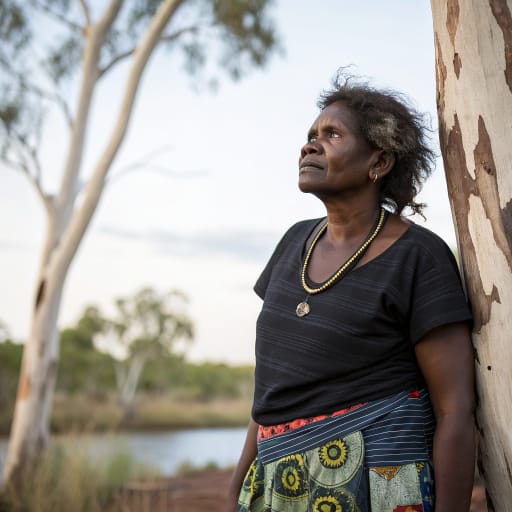
Gurindji
same region (Australia / New Zealand)
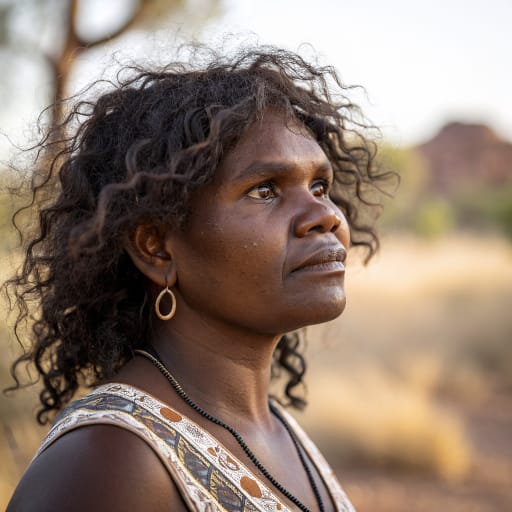
Arrernte
same region (Australia / New Zealand)
Noongar
same region (Australia / New Zealand)
Yolngu
same region (Australia / New Zealand)
Narungga
same region (Australia / New Zealand)
Warlpiri
same region (Australia / New Zealand)
Ngaanyatjarra
same region (Australia / New Zealand)
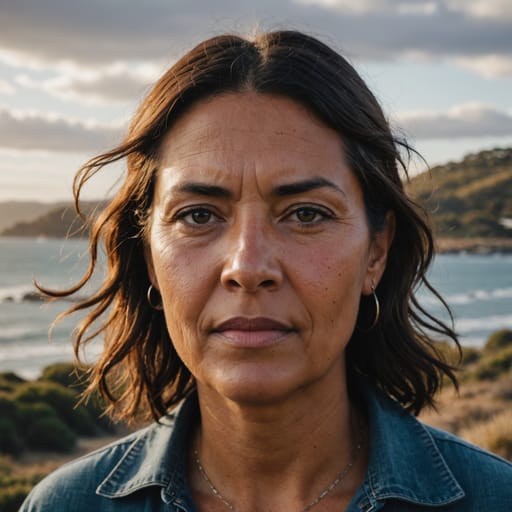
Bunurong
same region (Australia / New Zealand)
Typical Warumungu Phenotypes
Reference for AI generation: hair, eyes, skin, facial structure, build
Warumungu Body & Anatomy Reference
Per-feature anatomical profile for AI nude generation: Aboriginal Australian phenotype
Warumungu Boobs & Breasts
Bust reference for Warumungu women: small-to-medium cup, modest-to-moderate projection, which is typical of Aboriginal Australian ancestry. Areolas measure about 28-42mm across, with deep-brown to near-black pigmentation. Body type (ectomorph-to-mesomorph, lean elongated frame adapted to arid environment) shapes the bust as well, so Warumungu tits are usually modest projection, firm. In AI imagery, keep the forward-set shape rather than drifting toward the fuller Polynesian or West African bust.
Warumungu Ass & Hips
The Warumungu ass is typically small-to-medium, modest projection, narrower hip profile, which sets it apart from the very full Polynesian gluteal projection. Underneath, the pelvis shows narrow-to-medium iliac crests, longer torso and limb proportions, part of the Aboriginal Australian skeletal pattern. For Warumungu butt pics and AI renders, match that silhouette and the overall build (ectomorph-to-mesomorph, lean elongated frame adapted to arid environment).
Warumungu Vagina & Pussy
Warumungu pussy and vulvar anatomy presents deep-brown labial pigmentation, consistent with the Aboriginal Australian phenotype's pigmentation pattern. Warumungu pubic hair is typically wavy-to-coiled coarse texture, in the inverted-triangle pattern. For anatomically accurate Warumungu pussy renders the labial coloration should match the surrounding deep-brown skin tone with a continuous gradient, and the hair should keep its wavy-to-coiled coarse texture.
Warumungu Dicks & Penis
Warumungu dicks follow the Aboriginal Australian reference data: regional mean ~13cm erect; moderate girth; deep-brown shaft pigmentation. Shaft color should track the deep-brown skin tone with a smooth change toward the glans, and Warumungu pubic hair keeps its wavy-to-coiled coarse texture.
Warumungu Body, Curves & Build
Warumungu body type and overall build presents as ectomorph-to-mesomorph, lean elongated frame adapted to arid environment, with mean adult female BMI 23-26: the characteristic Aboriginal Australian habitus. Warumungu curves and proportions should keep the regional skeletal frame (height, shoulder-to-hip ratio, limb proportions) rather than a generic mesomorph default.
Warumungu Skin Tone & Hair Texture
Warumungu skin sits in the deep-brown (Fitzpatrick V-VI) band. Hair is typically wavy-to-curly 2C-3B, dark-brown to black; the distinctive blond-haired Aboriginal sub-population in Central Australia is documented and pigmentation-independent, in keeping with the Aboriginal Australian phenotype. In nude renders the skin should stay one even tone from face to body, and body, pubic and head hair should match.
Explore phenotype categories
Structured taxonomy with peer-reviewed scales · 22 anatomical categories
Erotic Poses & Sex Positions
From the pose catalog: 219 named positions with reference skeletons
Frequently asked questions about Warumungu people
Where is the Warumungu homeland?
The Warumungu homeland is Barkly region of the Northern Territory, Australia, centered on Tennant Creek (Jurnkkurakurr) and reaching south toward Karlu Karlu in Australia / New Zealand.
What language do Warumungu people speak?
Warumungu people primarily speak Warumungu (Pama-Nyungan); Wumpurrarni English and English widely spoken.
What religion do Warumungu people practice?
The predominant religion among Warumungu people is Dreaming law and ceremony, alongside Christianity.






Make your own Warumungu images
Five a day, free, no credits to buy. The studio starts from this group's phenotype data, so you can set body type, pose and style and keep the traits accurate.
Start with Warumungu