No portrait yet
Ngaanyatjarra Erotic
Ngaanyatjarra Lands in the Gibson and Great Victoria deserts, far eastern Western Australia near the Northern Territory and South Australia borders; communities include Warburton, Warakurna, Blackstone and Wingellina
Ngaanyatjarra and closely related Ngaatjatjarra (Western Desert language, Pama-Nyungan); English widely spoken as a second language
Christianity, largely from the Warburton mission era, practiced alongside Tjukurrpa (Dreaming) law and ceremony
Western Desert peoples; closely tied to Ngaatjatjarra speakers and neighbors of the Pitjantjatjara, Pintupi and Martu
About Ngaanyatjarra People
The name tells you who they are. Western Desert peoples often name themselves by the everyday words they use, and Ngaanyatjarra means roughly "having ngaanya," their word for "this." Speakers of the closely related Ngaatjatjarra dialect say ngaatja instead, and the Pitjantjatjara to the east are named the same way, after a verb form of their own. The differences are small, most of the speech is mutually intelligible, and families are linked across these lines by marriage, ceremony and shared country. Among themselves, people use a plainer word: Yarnangu, meaning people.
Their country covers a wide stretch of the Gibson and Great Victoria deserts in the far east of Western Australia, where the state meets the Northern Territory and South Australia. It is spinifex plain, red sand dunes and old worn ranges around Warburton, Blackstone and Wingellina. Knowing where to find rockholes, soaks and seasonal foods let families live here for thousands of years, and some groups were still living on the land with little contact with outsiders into the 1960s.
When contact came, it came late and quickly. The United Aborigines Mission opened at Warburton in 1934. In 1956 the Giles weather station was built to support rocket testing from Woomera, and it brought roads and patrol officers into the middle of the lands. In the same decade a parliamentary inquiry into hunger and sickness around Warburton caused a national stir. From the 1970s, families left the mission to start their own communities closer to their home country. The Ngaanyatjarra Council, formed in 1981, is still the main body running services across the lands, and native title was formally recognized in 2005.
Christianity took real root, and church singing in Ngaanyatjarra is part of community life. It sits alongside Tjukurrpa, the Dreaming law that binds people to particular sites, songlines and duties. Men's and women's ceremonies go on, the Seven Sisters story crosses the region, and kinship still shapes whom a person may marry, whom they must avoid, and who looks after which places. Women and girls still tell stories by drawing in the sand with a length of wire. The art scene is strong: Warburton is known for work in glass, Warakurna painters have painted their own history of contact, and sculptures woven from desert grasses end up in galleries far from the dunes.
Related ethnic groups
Groups that share Ngaanyatjarra's homeland, region, language, or religious tradition. These are likely candidates for comparative phenotype reference.
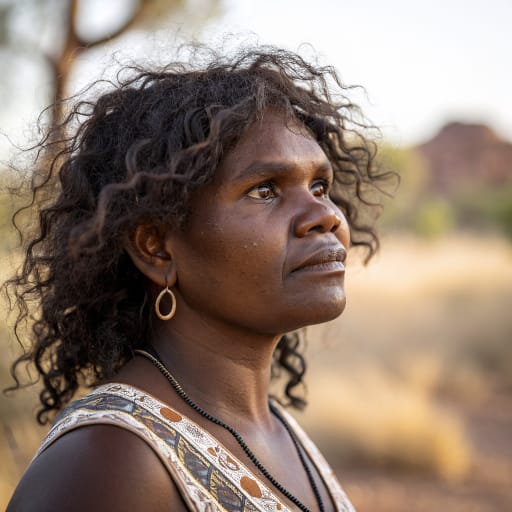
Arrernte
same region (Australia / New Zealand)
Noongar
same region (Australia / New Zealand)
Yolngu
same region (Australia / New Zealand)
Tiwi
same region (Australia / New Zealand)
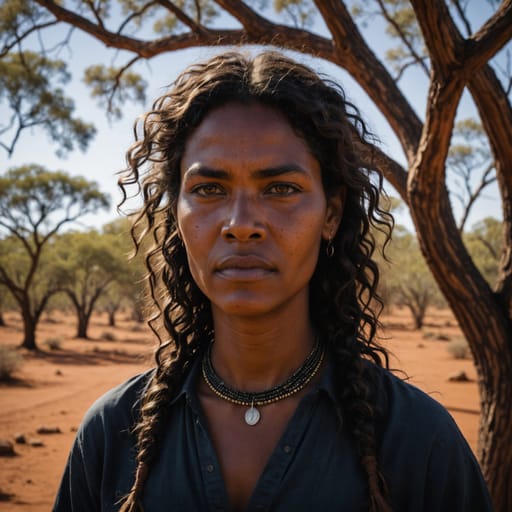
Anmatyerre
same region (Australia / New Zealand)
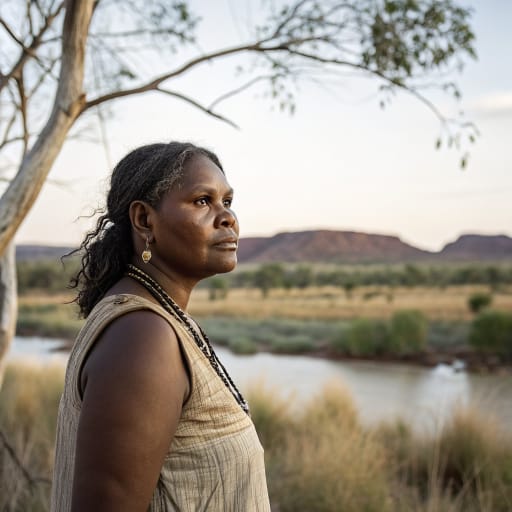
Kaytetye
same region (Australia / New Zealand)
Spinifex
same region (Australia / New Zealand)
Ngunnawal
same region (Australia / New Zealand)
Typical Ngaanyatjarra Phenotypes
Reference for AI generation: hair, eyes, skin, facial structure, build
Ngaanyatjarra Body & Anatomy Reference
Aboriginal Australian phenotype: anatomy reference for AI nude generation
Ngaanyatjarra Boobs & Breasts
Bust reference for Ngaanyatjarra women: small-to-medium cup, modest-to-moderate projection, which is typical of Aboriginal Australian ancestry. Areolas measure about 28-42mm across, with deep-brown to near-black pigmentation. Body type (ectomorph-to-mesomorph, lean elongated frame adapted to arid environment) shapes the bust as well, so Ngaanyatjarra tits are usually modest projection, firm. In AI imagery, keep the forward-set shape rather than drifting toward the fuller Polynesian or West African bust.
Ngaanyatjarra Ass & Hips
The Ngaanyatjarra ass is typically small-to-medium, modest projection, narrower hip profile, which sets it apart from the very full Polynesian gluteal projection. Underneath, the pelvis shows narrow-to-medium iliac crests, longer torso and limb proportions, part of the Aboriginal Australian skeletal pattern. For Ngaanyatjarra butt pics and AI renders, match that silhouette and the overall build (ectomorph-to-mesomorph, lean elongated frame adapted to arid environment).
Ngaanyatjarra Vagina & Pussy
Ngaanyatjarra pussy and vulvar anatomy presents deep-brown labial pigmentation, consistent with the Aboriginal Australian phenotype's pigmentation pattern. Ngaanyatjarra pubic hair is typically wavy-to-coiled coarse texture, in the inverted-triangle pattern. For anatomically accurate Ngaanyatjarra pussy renders the labial coloration should match the surrounding deep-brown skin tone with a continuous gradient, and the hair should keep its wavy-to-coiled coarse texture.
Ngaanyatjarra Dicks & Penis
Ngaanyatjarra dicks follow the Aboriginal Australian reference data: regional mean ~13cm erect; moderate girth; deep-brown shaft pigmentation. Shaft color should track the deep-brown skin tone with a smooth change toward the glans, and Ngaanyatjarra pubic hair keeps its wavy-to-coiled coarse texture.
Ngaanyatjarra Body, Curves & Build
Ngaanyatjarra body type and overall build presents as ectomorph-to-mesomorph, lean elongated frame adapted to arid environment, with mean adult female BMI 23-26: the characteristic Aboriginal Australian habitus. Ngaanyatjarra curves and proportions should keep the regional skeletal frame (height, shoulder-to-hip ratio, limb proportions) rather than a generic mesomorph default.
Ngaanyatjarra Skin Tone & Hair Texture
Ngaanyatjarra skin sits in the deep-brown (Fitzpatrick V-VI) band. Hair is typically wavy-to-curly 2C-3B, dark-brown to black; the distinctive blond-haired Aboriginal sub-population in Central Australia is documented and pigmentation-independent, in keeping with the Aboriginal Australian phenotype. In nude renders the skin should stay one even tone from face to body, and body, pubic and head hair should match.
Explore phenotype categories
Structured taxonomy with peer-reviewed scales · 22 anatomical categories
Erotic Poses & Sex Positions
From the pose catalog: 219 named positions with reference skeletons
Frequently asked questions about Ngaanyatjarra people
Where is the Ngaanyatjarra homeland?
The Ngaanyatjarra homeland is Ngaanyatjarra Lands in the Gibson and Great Victoria deserts, far eastern Western Australia near the Northern Territory and South Australia borders; communities include Warburton, Warakurna, Blackstone and Wingellina in Australia / New Zealand.
What language do Ngaanyatjarra people speak?
Ngaanyatjarra people primarily speak Ngaanyatjarra and closely related Ngaatjatjarra (Western Desert language, Pama-Nyungan); English widely spoken as a second language.
What religion do Ngaanyatjarra people practice?
The predominant religion among Ngaanyatjarra people is Christianity, largely from the Warburton mission era, practiced alongside Tjukurrpa (Dreaming) law and ceremony.






Make your own Ngaanyatjarra images
Five a day, free, no credits to buy. The studio starts from this group's phenotype data, so you can set body type, pose and style and keep the traits accurate.
Start with Ngaanyatjarra