No portrait yet
Ngunnawal Erotic
Southern Tablelands of New South Wales and the Australian Capital Territory, Australia: Canberra, Yass, Queanbeyan, Lake George and the upper Murrumbidgee valley
Ngunnawal (Pama-Nyungan), closely related to Gundungurra and now under revival; English in everyday use
Traditional Aboriginal spiritual belief tied to country and ancestral law; many are Christian
Aboriginal Australians of the southeast; closest in language to the Gundungurra. Families identifying as Ngambri claim a separate identity in the Canberra area.
About Ngunnawal People
The Ngunnawal are the Aboriginal people of the cold, high grasslands where Australia built its national capital. Their country spreads across the Southern Tablelands of New South Wales and the Australian Capital Territory, from the Yass district and the shores of Lake George through the Molonglo and upper Murrumbidgee valleys to the granite ranges now inside Namadgi National Park. To be Ngunnawal today means descending from the families of that country and having the standing to speak for it. That is why Ngunnawal elders so often give the Welcome to Country at civic events in Canberra. Their language, also called Ngunnawal, belongs to the Pama-Nyungan family and is very close to Gundungurra, which was spoken to the northeast. The Wiradjuri lived to the west, the Ngarigo to the south on the Monaro, and Yuin peoples toward the coast. Ngunnawal stopped being spoken day to day under colonial pressure. Revival work is now rebuilding it from nineteenth-century word lists and from what families kept. Traditional belief ties people to country through ancestral law, and many Ngunnawal are also Christian.
The year followed the seasons. In early summer people climbed into the Brindabellas and the higher Alps, where Bogong moths pack into rock crevices by the million. There they met neighboring groups for weeks of feasting, ceremony, trade and marriage arrangements. Tidbinbilla, southwest of the city, takes its name from a word usually translated as the place where boys became men, and rock shelters in the region show that people have lived there for many thousands of years. British settlers took over the Limestone Plains in the 1820s, and within a generation disease and the loss of land had done deep damage. Survivors lived on the edges of pastoral stations and towns, and in the twentieth century many families were moved onto reserves, notably around Yass. In 1913 the Commonwealth named its new capital Canberra, a word generally traced to a local name for the area, and built the city on Ngunnawal country. One of its suburbs now carries the Ngunnawal name. Even the question of who the traditional custodians are is contested: families who identify as Ngambri dispute parts of the Ngunnawal claim to the Canberra plains, and the disagreement still plays out in public.
Related ethnic groups
Groups that share Ngunnawal's homeland, region, language, or religious tradition. These are likely candidates for comparative phenotype reference.
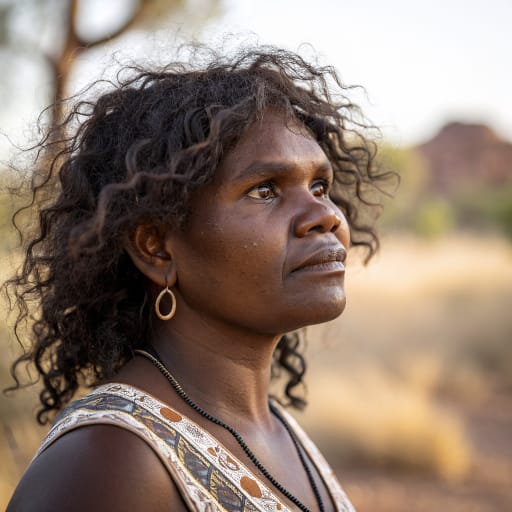
Arrernte
same region (Australia / New Zealand)
Noongar
same region (Australia / New Zealand)
Yolngu
same region (Australia / New Zealand)
Tiwi
same region (Australia / New Zealand)
Wirangu
same region (Australia / New Zealand)
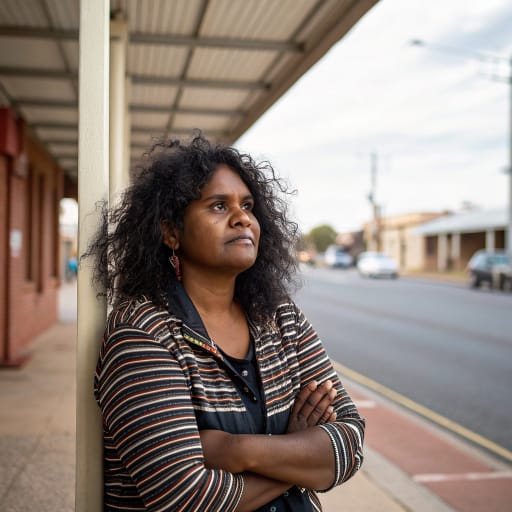
Adnyamathanha
same region (Australia / New Zealand)
Wodiwodi
same region (Australia / New Zealand)
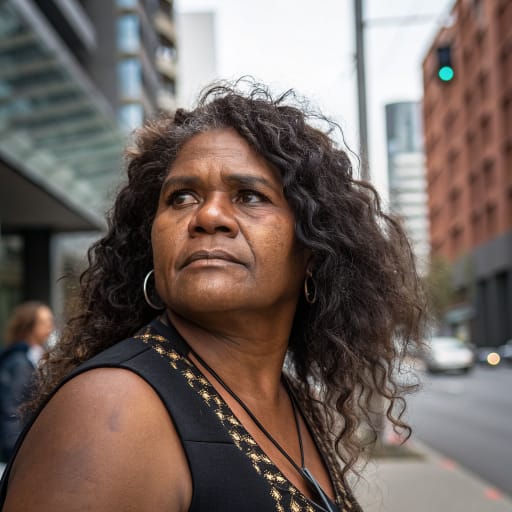
Aboriginal Tasmanians
same region (Australia / New Zealand)
Typical Ngunnawal Phenotypes
Reference for AI generation: hair, eyes, skin, facial structure, build
Ngunnawal Body & Anatomy Reference
Anatomy by feature, Aboriginal Australian phenotype
Ngunnawal Boobs & Breasts
Bust reference for Ngunnawal women: small-to-medium cup, modest-to-moderate projection, which is typical of Aboriginal Australian ancestry. Areolas measure about 28-42mm across, with deep-brown to near-black pigmentation. Body type (ectomorph-to-mesomorph, lean elongated frame adapted to arid environment) shapes the bust as well, so Ngunnawal tits are usually modest projection, firm. In AI imagery, keep the forward-set shape rather than drifting toward the fuller Polynesian or West African bust.
Ngunnawal Ass & Hips
The Ngunnawal ass is typically small-to-medium, modest projection, narrower hip profile, which sets it apart from the very full Polynesian gluteal projection. Underneath, the pelvis shows narrow-to-medium iliac crests, longer torso and limb proportions, part of the Aboriginal Australian skeletal pattern. For Ngunnawal butt pics and AI renders, match that silhouette and the overall build (ectomorph-to-mesomorph, lean elongated frame adapted to arid environment).
Ngunnawal Vagina & Pussy
Ngunnawal pussy and vulvar anatomy presents deep-brown labial pigmentation, consistent with the Aboriginal Australian phenotype's pigmentation pattern. Ngunnawal pubic hair is typically wavy-to-coiled coarse texture, in the inverted-triangle pattern. For anatomically accurate Ngunnawal pussy renders the labial coloration should match the surrounding deep-brown skin tone with a continuous gradient, and the hair should keep its wavy-to-coiled coarse texture.
Ngunnawal Dicks & Penis
Ngunnawal dicks follow the Aboriginal Australian reference data: regional mean ~13cm erect; moderate girth; deep-brown shaft pigmentation. Shaft color should track the deep-brown skin tone with a smooth change toward the glans, and Ngunnawal pubic hair keeps its wavy-to-coiled coarse texture.
Ngunnawal Body, Curves & Build
Ngunnawal body type and overall build presents as ectomorph-to-mesomorph, lean elongated frame adapted to arid environment, with mean adult female BMI 23-26: the characteristic Aboriginal Australian habitus. Ngunnawal curves and proportions should keep the regional skeletal frame (height, shoulder-to-hip ratio, limb proportions) rather than a generic mesomorph default.
Ngunnawal Skin Tone & Hair Texture
Ngunnawal skin sits in the deep-brown (Fitzpatrick V-VI) band. Hair is typically wavy-to-curly 2C-3B, dark-brown to black; the distinctive blond-haired Aboriginal sub-population in Central Australia is documented and pigmentation-independent, in keeping with the Aboriginal Australian phenotype. In nude renders the skin should stay one even tone from face to body, and body, pubic and head hair should match.
Explore phenotype categories
Structured taxonomy with peer-reviewed scales · 22 anatomical categories
Erotic Poses & Sex Positions
From the pose catalog: 219 named positions with reference skeletons
Frequently asked questions about Ngunnawal people
Where is the Ngunnawal homeland?
The Ngunnawal homeland is Southern Tablelands of New South Wales and the Australian Capital Territory, Australia: Canberra, Yass, Queanbeyan, Lake George and the upper Murrumbidgee valley in Australia / New Zealand.
What language do Ngunnawal people speak?
Ngunnawal people primarily speak Ngunnawal (Pama-Nyungan), closely related to Gundungurra and now under revival; English in everyday use.
What religion do Ngunnawal people practice?
The predominant religion among Ngunnawal people is Traditional Aboriginal spiritual belief tied to country and ancestral law; many are Christian.






Make your own Ngunnawal images
Five a day, free, no credits to buy. The studio starts from this group's phenotype data, so you can set body type, pose and style and keep the traits accurate.
Start with Ngunnawal