No portrait yet
Pitjantjatjara Erotic
Western Desert of central Australia: the APY Lands in far northwest South Australia around the Mann, Tomkinson and Musgrave ranges, extending into the southwest Northern Territory and eastern Western Australia
Pitjantjatjara, a dialect of the Western Desert Language (Pama-Nyungan, Wati subgroup); English widely spoken as a second language
Tjukurpa (traditional law and ancestral religion) alongside Christianity, mainly Uniting Church from the former Presbyterian mission at Ernabella
Anangu of the Western Desert cultural bloc; closely allied with Yankunytjatjara and Ngaanyatjarra; Southern Pitjantjatjara communities at Yalata and Oak Valley
About Pitjantjatjara People
Pitjantjatjara people take their name from a single word. Across the Western Desert, neighboring groups speak closely related forms of one language and tell themselves apart by small differences in vocabulary, including the word for coming or going. Pitjantjatjara say pitjantja, so they are the ones "having pitjantja". Their eastern neighbors say yankunytja, so they are Yankunytjatjara. Both call themselves Anangu, simply "people", and share country, ceremony and family ties. That country is red sand, spinifex and mulga broken by the Mann, Tomkinson and Musgrave ranges. It lies in the far northwest of South Australia and spills over into the Northern Territory and Western Australia. Most families live in small communities such as Amata, Pipalyatjara and Pukatja, also known as Ernabella, or on outstations between them. Children still learn the language as their first tongue, which puts it among the healthiest Aboriginal languages in the country. Beneath daily life sits Tjukurpa. It is often translated as the Dreaming, but it is closer to law: the account of how ancestral beings made the land, which also sets out kinship duties, marriage rules and who is allowed to know what. Christianity came mainly through the Presbyterian mission at Ernabella, opened in 1937, and church and ceremony now sit side by side in many communities.
In the twentieth century, pressure came in from the edges of the desert. Drought, dingo scalp hunters and pastoral leases pulled families toward missions and ration points. In the 1950s the British atomic tests at Maralinga closed off a large stretch of the southern desert. The turning point came in 1981, when South Australia gave Anangu freehold title over more than 100,000 square kilometers, one of the landmark land rights settlements in Australia. Uluru, just over the Territory border, was handed back to its Pitjantjatjara and Yankunytjatjara traditional owners in 1985, and the climb closed for good in 2019. Some customs rarely reach outsiders. Girls and women tell stories by drawing in the sand with a bent wire or stick, a practice called milpatjunanyi, and smooth the ground clean between scenes. Some relatives by marriage avoid one another or use a special respectful way of speaking. Song cycles such as the Seven Sisters run across hundreds of kilometers of desert, linking Pitjantjatjara country to that of groups far away. Art has also long been a livelihood. Ernabella Arts grew out of a mission craft room in 1948 and is counted among the oldest continuously running Aboriginal art centers in Australia, while Tjanpi weavers turn desert grass into baskets and sculpture.
Related ethnic groups
Groups that share Pitjantjatjara's homeland, region, language, or religious tradition. These are likely candidates for comparative phenotype reference.
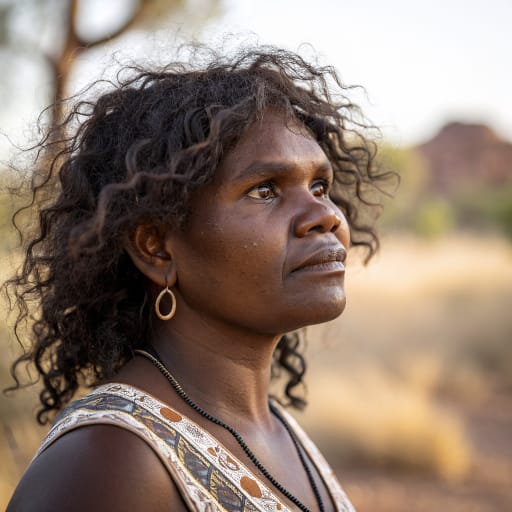
Arrernte
same region (Australia / New Zealand)
Noongar
same region (Australia / New Zealand)
Yolngu
same region (Australia / New Zealand)
Tiwi
same region (Australia / New Zealand)
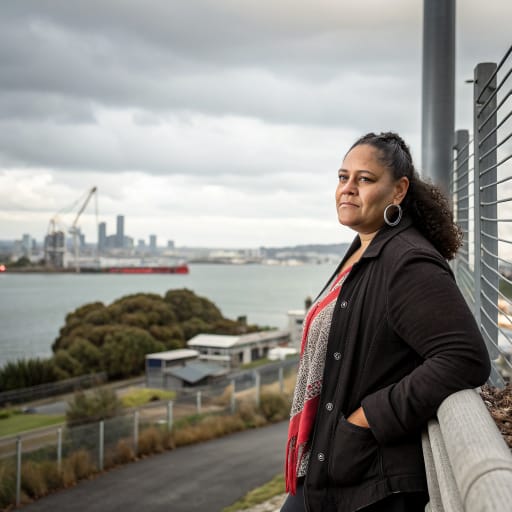
Gunditjmara
same region (Australia / New Zealand)
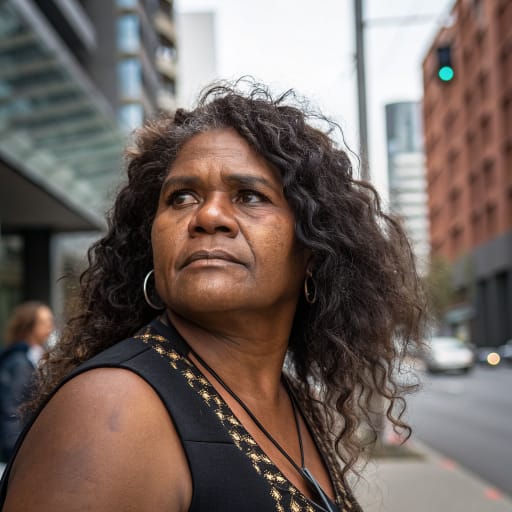
Aboriginal Tasmanians
same region (Australia / New Zealand)
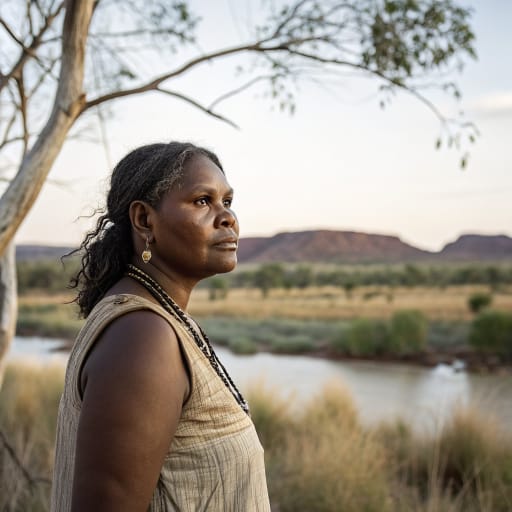
Kaytetye
same region (Australia / New Zealand)
Wodiwodi
same region (Australia / New Zealand)
Typical Pitjantjatjara Phenotypes
Reference for AI generation: hair, eyes, skin, facial structure, build
Pitjantjatjara Body & Anatomy Reference
Anatomy by feature, Aboriginal Australian phenotype
Pitjantjatjara Boobs & Breasts
Bust reference for Pitjantjatjara women: small-to-medium cup, modest-to-moderate projection, which is typical of Aboriginal Australian ancestry. Areolas measure about 28-42mm across, with deep-brown to near-black pigmentation. Body type (ectomorph-to-mesomorph, lean elongated frame adapted to arid environment) shapes the bust as well, so Pitjantjatjara tits are usually modest projection, firm. In AI imagery, keep the forward-set shape rather than drifting toward the fuller Polynesian or West African bust.
Pitjantjatjara Ass & Hips
The Pitjantjatjara ass is typically small-to-medium, modest projection, narrower hip profile, which sets it apart from the very full Polynesian gluteal projection. Underneath, the pelvis shows narrow-to-medium iliac crests, longer torso and limb proportions, part of the Aboriginal Australian skeletal pattern. For Pitjantjatjara butt pics and AI renders, match that silhouette and the overall build (ectomorph-to-mesomorph, lean elongated frame adapted to arid environment).
Pitjantjatjara Vagina & Pussy
Pitjantjatjara pussy and vulvar anatomy presents deep-brown labial pigmentation, consistent with the Aboriginal Australian phenotype's pigmentation pattern. Pitjantjatjara pubic hair is typically wavy-to-coiled coarse texture, in the inverted-triangle pattern. For anatomically accurate Pitjantjatjara pussy renders the labial coloration should match the surrounding deep-brown skin tone with a continuous gradient, and the hair should keep its wavy-to-coiled coarse texture.
Pitjantjatjara Dicks & Penis
Pitjantjatjara dicks follow the Aboriginal Australian reference data: regional mean ~13cm erect; moderate girth; deep-brown shaft pigmentation. Shaft color should track the deep-brown skin tone with a smooth change toward the glans, and Pitjantjatjara pubic hair keeps its wavy-to-coiled coarse texture.
Pitjantjatjara Body, Curves & Build
Pitjantjatjara body type and overall build presents as ectomorph-to-mesomorph, lean elongated frame adapted to arid environment, with mean adult female BMI 23-26: the characteristic Aboriginal Australian habitus. Pitjantjatjara curves and proportions should keep the regional skeletal frame (height, shoulder-to-hip ratio, limb proportions) rather than a generic mesomorph default.
Pitjantjatjara Skin Tone & Hair Texture
Pitjantjatjara skin sits in the deep-brown (Fitzpatrick V-VI) band. Hair is typically wavy-to-curly 2C-3B, dark-brown to black; the distinctive blond-haired Aboriginal sub-population in Central Australia is documented and pigmentation-independent, in keeping with the Aboriginal Australian phenotype. In nude renders the skin should stay one even tone from face to body, and body, pubic and head hair should match.
Explore phenotype categories
Structured taxonomy with peer-reviewed scales · 22 anatomical categories
Erotic Poses & Sex Positions
From the pose catalog: 219 named positions with reference skeletons
Frequently asked questions about Pitjantjatjara people
Where is the Pitjantjatjara homeland?
The Pitjantjatjara homeland is Western Desert of central Australia: the APY Lands in far northwest South Australia around the Mann, Tomkinson and Musgrave ranges, extending into the southwest Northern Territory and eastern Western Australia in Australia / New Zealand.
What language do Pitjantjatjara people speak?
Pitjantjatjara people primarily speak Pitjantjatjara, a dialect of the Western Desert Language (Pama-Nyungan, Wati subgroup); English widely spoken as a second language.
What religion do Pitjantjatjara people practice?
The predominant religion among Pitjantjatjara people is Tjukurpa (traditional law and ancestral religion) alongside Christianity, mainly Uniting Church from the former Presbyterian mission at Ernabella.






Make your own Pitjantjatjara images
Five a day, free, no credits to buy. The studio starts from this group's phenotype data, so you can set body type, pose and style and keep the traits accurate.
Start with Pitjantjatjara