Help us get this right
Does this portrait look right for Turkmens?
One tap. It takes a second and it is recorded.
1 says it looks right, 0 say it looks off.
Turkmens Erotic
Also known as: Turkmen
About Turkmens People
The Turkmens are an Oghuz Turkic people whose identity was forged on the move. Their ancestors swept south and west out of the Central Asian steppe in the eleventh century — the same migration that produced the Seljuks and, eventually, the Ottomans — and the Turkmen who stayed behind around the Karakum desert kept the older nomadic life longest. Until the Soviet conquest in the 1880s, the defining unit of Turkmen society was not the village or the state but the tribe: the Teke, Yomut, Ersary, Salyr, Saryk, Chowdur, Goklen and others, each with its own dialect inflections, carpet motifs, and historical grievances. A Turkmen still introduces himself by tribe before nationality in many contexts, and the tribal map continues to shape politics inside Turkmenistan and the Turkmen communities of northern Afghanistan and Iran's Golestan Province.
Their language is Oghuz Turkic, in the same branch as Turkish and Azerbaijani — a Turk from Istanbul and a Turkmen from Mary can puzzle out a conversation if both speak slowly. But Turkmen has stayed closer to its older grammar, and a thousand years of Persian neighbors have layered Persian vocabulary into everyday speech, especially in the south. Sunni Islam of the Hanafi school arrived gradually and sat lightly on top of an older steppe religion: Sufi orders, particularly the Naqshbandi and Yasawi, did the actual conversion work, and the cult of saints — pilgrimage to the tombs of holy ancestors, the owliya — remains more central to lived practice than mosque attendance. Among older Turkmen, the line between Islamic piety and pre-Islamic ancestor veneration is not a line anyone bothers to draw.
The Akhal-Teke horse and the hand-knotted carpet are the two artifacts the Turkmen have carried into world memory, and both repay attention. The carpets, with their tribal gül medallions, functioned as portable identification — a Saryk rug and a Yomut rug were as distinct as flags, and Turkmen women wove their tribe's gül from memory long before any of it was written down. Turkmen weddings still feature the bride's kürte, a heavy embroidered coat draped over the head; brideprice negotiations remain serious business; and the New Year festival of Nowruz, shared with the Iranian world, is celebrated alongside the Islamic calendar with no apparent contradiction. Turkmenistan itself, sealed off for most of the post-Soviet period under an eccentric personality cult, has kept much of this older texture preserved almost by accident.
Related ethnic groups
Groups that share Turkmens's homeland, region, language, or religious tradition. These are likely candidates for comparative phenotype reference.
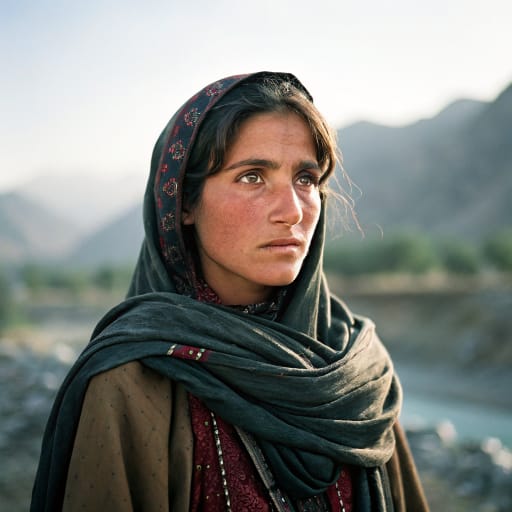
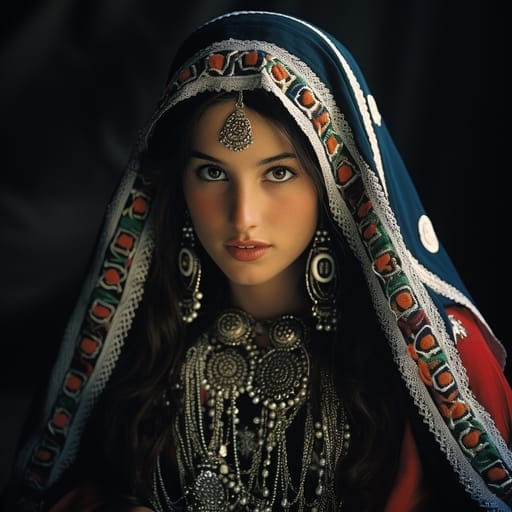
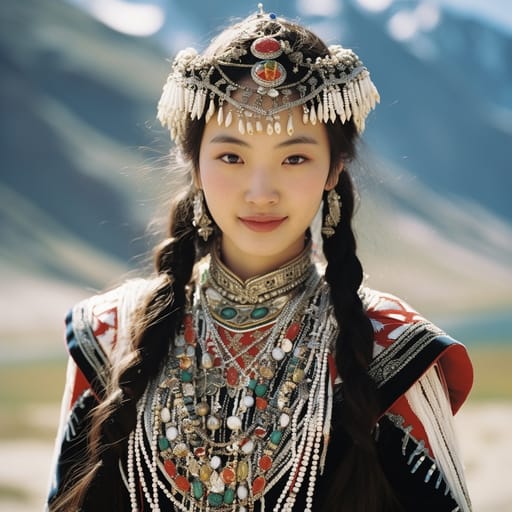
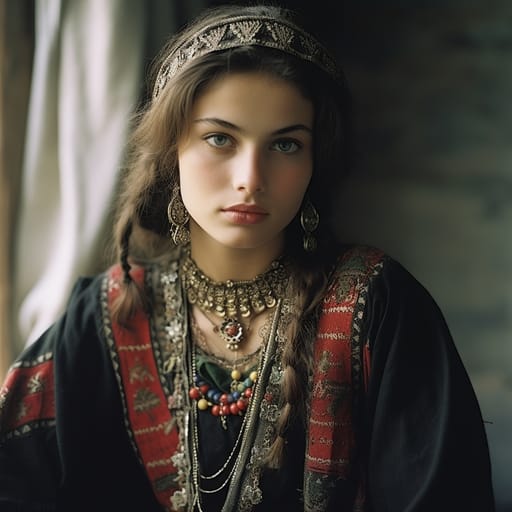
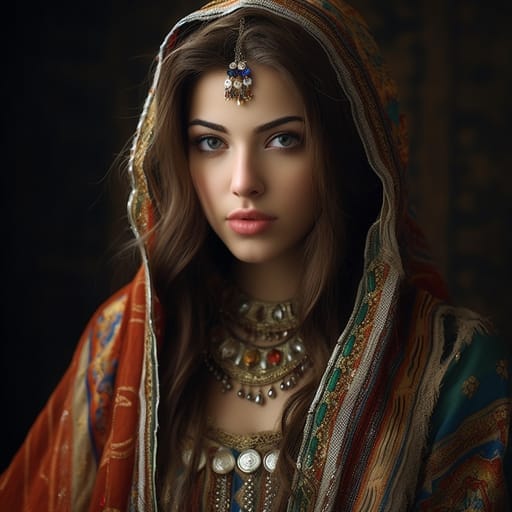
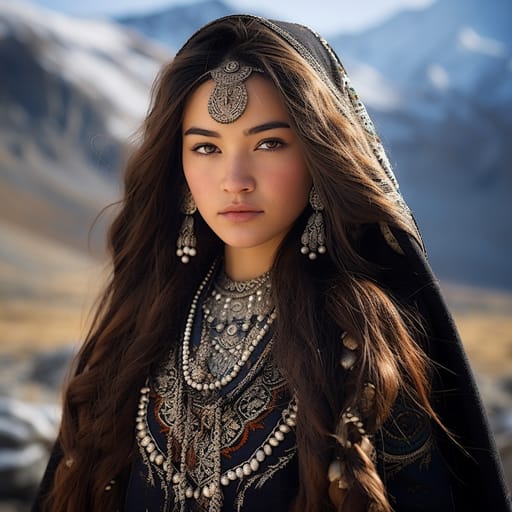
Typical Turkmens Phenotypes
Reference for AI generation: hair, eyes, skin, facial structure, build
Turkmens occupy a phenotype zone where Inner Asian and West Asian features overlap, and most individuals carry visible traces of both. The dominant pattern is moderate, not extreme: features that read as Central Asian without the strong Mongoloid morphology of groups further east, and West Asian elements that don't tip fully into Iranian or Anatolian appearance.
Hair is overwhelmingly dark — black to dark brown — and typically straight to gently wavy. Coarse, thick texture is the norm; tight curl is rare. Premature graying and a striking shift to silver-white in older men is common and culturally noted, often framed by the traditional black telpek sheepskin hat. Beard growth is moderate, less dense than among Iranian or Caucasian neighbors but heavier than among Kazakhs or Kyrgyz.
Eyes are usually dark brown to near-black, with hazel and light brown appearing in a minority, particularly in western and southern Turkmenistan. The epicanthic fold is present in a substantial share of the population but rarely as pronounced as in Kazakh or Mongol phenotypes — many Turkmens show a partial or vestigial fold, giving the eye a slightly almond shape rather than a fully East Asian one. Eye sockets sit moderately deep.
Skin tones cluster in Fitzpatrick III–IV: light olive to medium tan with warm, yellow-tinged undertones. Desert sun exposure deepens the tone considerably in rural Karakum populations.
Facial structure tends toward a broad, somewhat flattened midface with high, wide cheekbones and a relatively short, straight nose with a moderate bridge — narrower than Mongol noses, wider than Persian. Lips are medium full. Jaws are squared rather than tapered.
Build is typically medium-statured and wiry-muscular, with male average height around 172–174 cm. The Teke, the largest tribal confederation, tend toward the more West Asian end of the spectrum; Yomut and northern Choudur Turkmens often show stronger Inner Asian features, including more pronounced epicanthic folds and flatter facial profiles.
Turkmens Body & Anatomy Reference
Anatomy by feature, Central Asian Turkic-Mongolic phenotype
Turkmens Boobs & Breasts
Bust reference for Turkmens women: medium cup, moderate projection, which is typical of Central Asian Turkic-Mongolic ancestry. Areolas measure about 30-42mm across, with medium-brown pigmentation. Body type (mesomorph, broader frame than the East Asian norm) shapes the bust as well, so Turkmens tits are usually full and modestly projecting. In AI imagery, keep the forward-set shape rather than drifting toward the smaller East Asian bust.
Turkmens Ass & Hips
The Turkmens ass is typically medium, moderate projection, broader hip profile than the East Asian norm, which sets it apart from the slim East Asian narrow-hip profile. Underneath, the pelvis shows medium iliac crests, moderate gluteal-femoral fat deposition, part of the Central Asian Turkic-Mongolic skeletal pattern. For Turkmens butt pics and AI renders, match that silhouette and the overall build (mesomorph, broader frame than the East Asian norm).
Turkmens Vagina & Pussy
Turkmens pussy and vulvar anatomy presents medium-brown labial pigmentation, consistent with the Central Asian Turkic-Mongolic phenotype's pigmentation pattern. Turkmens pubic hair is typically straight-to-wavy medium-coarse texture, in the inverted-triangle pattern. For anatomically accurate Turkmens pussy renders the labial coloration should match the surrounding tan to light-brown skin tone with a continuous gradient, and the hair should keep its straight-to-wavy medium-coarse texture.
Turkmens Dicks & Penis
Turkmens dicks follow the Central Asian Turkic-Mongolic reference data: regional mean ~13cm erect; moderate girth; medium-brown shaft pigmentation. Shaft color should track the tan to light-brown skin tone with a smooth change toward the glans, and Turkmens pubic hair keeps its straight-to-wavy medium-coarse texture.
Turkmens Body, Curves & Build
Turkmens body type and overall build presents as mesomorph, broader frame than the East Asian norm, with mean adult female BMI 23-26: the characteristic Central Asian Turkic-Mongolic habitus. Turkmens curves and proportions should keep the regional skeletal frame (height, shoulder-to-hip ratio, limb proportions) rather than a generic mesomorph default.
Turkmens Skin Tone & Hair Texture
Turkmens skin sits in the tan to light-brown (Fitzpatrick III-IV) band. Hair is typically straight 1A-1B, dark-brown to black, in keeping with the Central Asian Turkic-Mongolic phenotype. In nude renders the skin should stay one even tone from face to body, and body, pubic and head hair should match.
Data depth
37/100Coverage of image-grounded phenotype observations · drives AI generation diversity
- Sample size
- 10/40· 3 images
- Image quality
- 17/30· 33% high
- Confidence
- 10/20· mean 0.62
- Source diversity
- 0/10· wikipedia
- ·Small sample (n<10)
- ·Wikipedia-only source, not population-representative
Observed Distribution: Image Sample
Empirical observations from analyzed photographs · supplementary signal, not population truth
Sample: 3 images analyzed (3 wikipedia). Quality: 1 high, 2 medium, 0 low, 0 very_low. Avg analyzer confidence: 0.62.
Skin tone (Fitzpatrick): II (67%), III (33%)
Hair color: gray/white (67%), black (33%)
Hair texture: wavy (67%), covered (33%)
Eye color: blue (33%), dark brown (33%), unclear (33%)
Epicanthic fold: 0% present, 100% absent, 0% unclear
Caveats: Sample size 3 is small, so the observed distribution should be treated as suggestive, not definitive. Sample is 100% Wikipedia notable people, which skews toward male, public-life, and modern figures, not population-representative.
Last aggregated: May 7, 2026
Explore phenotype categories
Structured taxonomy with peer-reviewed scales · 22 anatomical categories
Notable Turkmens People
7 reference figures, sourced from Wikipedia
- Turkmenistan, where some 85% of the population of 5,042,920 people (July 2006 est.) are eth…
- Afghanistan, where as of 2006, 200,000 ethnic Turkmen are concentrated primarily along the…
- Iran, where about 719,000 Turkmen are primarily concentrated in the provinces of Go…
- Quli Qutb Shah, and his descendants
- Nelson, Sarah, ; et al. (14 February 2020). "Tracing population movements in ancient East As…
- Robbeets, Martine, 1 January 2017). "Austronesian influence and Transeurasian ancestry in Japane…
- Cornell University Press, Bacon, Elizabeth E. Central Asians Under Russian Rule: A Study in Culture Cha…
Erotic Poses & Sex Positions
From the pose catalog: 219 named positions with reference skeletons
Frequently asked questions about Turkmens people
Where is the Turkmens homeland?
The Turkmens homeland is Turkmenistan, Turkmen Sahra, Afghanistan in Central Asia.
What language do Turkmens people speak?
Turkmens people primarily speak Turkic / Oghuz / Turkmen.
What religion do Turkmens people practice?
The predominant religion among Turkmens people is Islam / Sunni Islam.
What are other names for Turkmens people?
Turkmens people are also known as Turkmen.






Make your own Turkmens images
Five a day, free, no credits to buy. The studio starts from this group's phenotype data, so you can set body type, pose and style and keep the traits accurate.
Start with Turkmens