Help us get this right
Does this portrait look right for Nuristanis?
One tap. It takes a second and it is recorded.
5 say it looks right, 0 say it looks off.
Nuristanis Erotic
Nuristan (Afghanistan)
Islam / Sunni Islam
Safed-Posh Kaffirs (including Askunis), Kamkata-viris (including Kata and Kom)
About Nuristanis People
The Nuristanis live in a knot of steep valleys in the Hindu Kush, in the northeastern corner of Afghanistan. Until 1896 they were known to outsiders as the Kafirs — the unbelievers — and their region as Kafiristan. That name was not their own, and it stuck because they had spent centuries refusing the religion of every kingdom that surrounded them. Their territory is hard country: narrow gorges, oak and cedar forests on the lower slopes, snow above. Villages cling to the sides of valleys in stacked timber-and-stone houses, the flat roof of one home serving as the front yard of the one above it. The land made them difficult to conquer, and for a long time it made them difficult to know.
Their languages — Kati, Kamviri, Vasi-vari, Askunu, Prasun, Waigali, Tregami — form the Nuristani branch of Indo-European. It is a small branch and a strange one: not Indo-Aryan, not Iranian, but a third sibling that broke off early and developed in isolation. Linguists still argue about exactly where it sits on the family tree. The community itself splits along old lines, with the Safed-Posh Kaffirs (the "white-robed," including the Askunis) on one side and the Kamkata-viris (Kata, Kom, and related groups) on the other, each with its own speech, lineage memory, and traditional rivalries.
The conversion to Sunni Islam came late and came at the point of a sword. In 1895–96 the Afghan amir Abdur Rahman Khan launched a military campaign that subdued the valleys within a year, after which the region was renamed Nuristan — the Land of Light. Older religion, older shrines, and a great deal of carved wooden iconography were destroyed, though some pieces survive in museums in Kabul and elsewhere. Islam has now been the framework of Nuristani life for more than a century, but earlier layers persist quietly: a vocabulary of clan-honor and oath, traditions of pastoral transhumance moving herds between summer and winter pastures, distinctive woodcarving on house pillars and grave markers, and a strong sense of being separate from the Pashtun and Tajik majorities around them. Through the Soviet war, the civil wars, and the Taliban years, Nuristan has remained one of the more closed corners of Afghanistan — geographically, linguistically, and in temperament.
Related ethnic groups
Groups that share Nuristanis's homeland, region, language, or religious tradition. These are likely candidates for comparative phenotype reference.
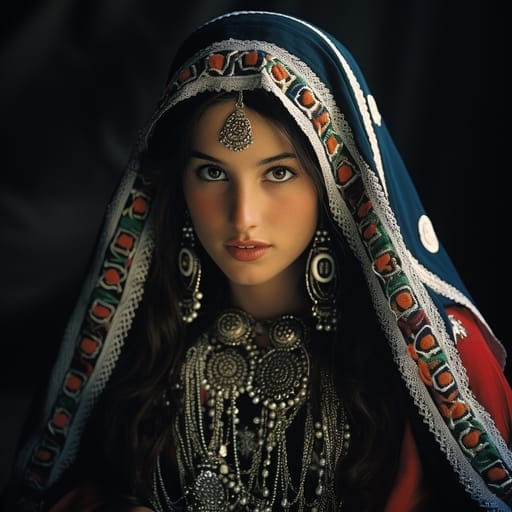
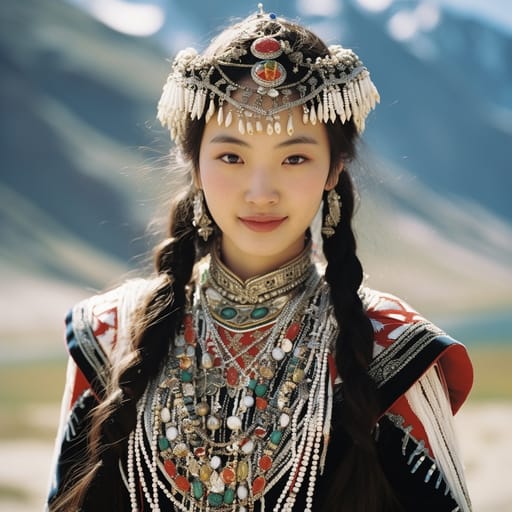
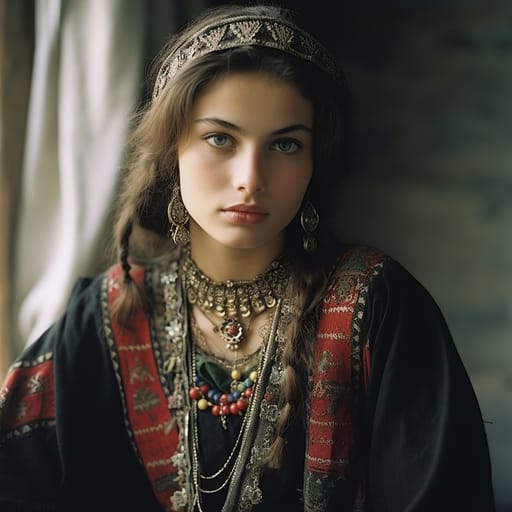
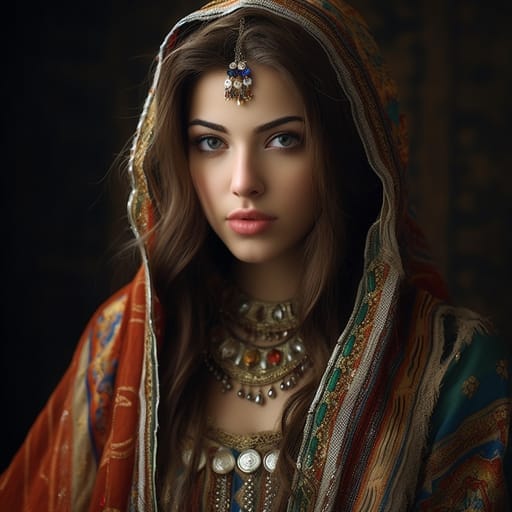
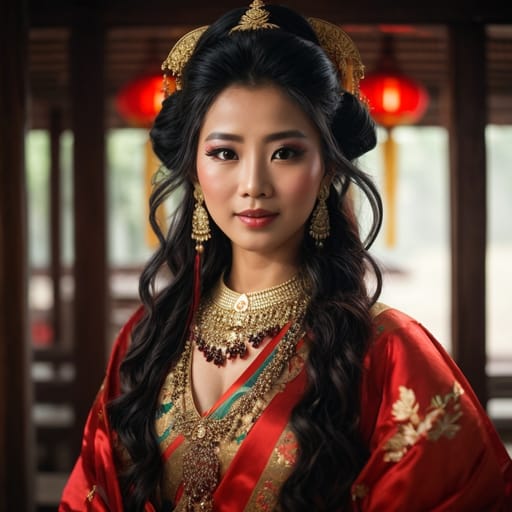
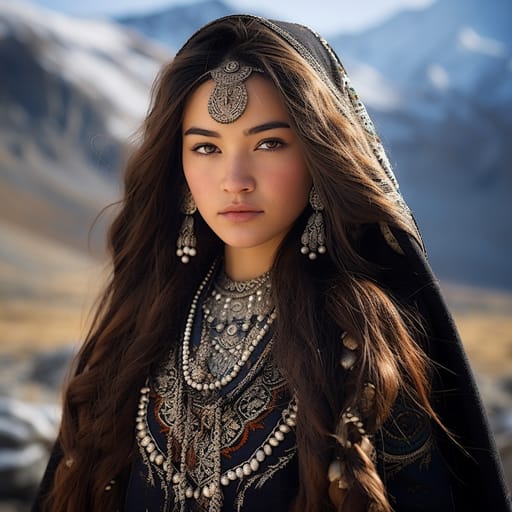
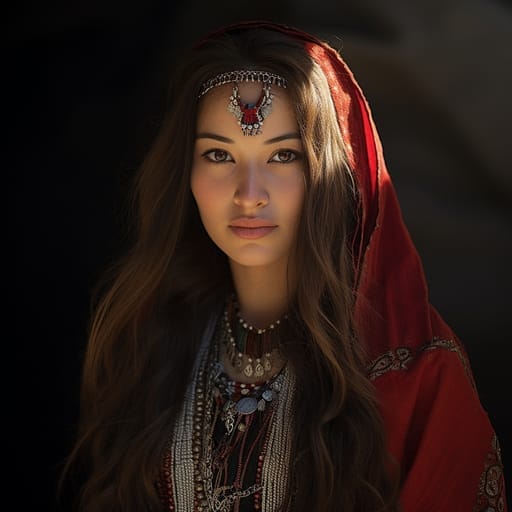
Typical Nuristanis Phenotypes
Reference for AI generation: hair, eyes, skin, facial structure, build
Nuristanis are one of the most phenotypically striking populations in Central Asia, distinguished by a frequency of light pigmentation that is highly unusual for the region. Tucked into isolated valleys of the Hindu Kush, the group retained recessive traits at rates closer to Northern European populations than to surrounding Pashtun or Tajik neighbors. Blue and green eyes are common — estimates range from roughly a quarter to over a third of the population — with hazel and lighter browns also frequent. Hair runs from dark brown through chestnut and auburn, with genuine blond and reddish-blond hair appearing at rates rare elsewhere in Afghanistan, particularly among children, often darkening toward adulthood. Texture is typically straight to lightly wavy and fine to medium in body.
Skin tone sits across Fitzpatrick II–IV: pale, faintly pink-undertoned complexions in the high western valleys, shifting toward warmer olive and light tan in lower-altitude communities. Sun exposure at altitude creates a weathered ruddiness on cheekbones and the bridge of the nose that's characteristic of older men.
Facial structure tends toward narrow, high-bridged noses — often slightly aquiline — with relatively narrow alar bases, a long midface, defined cheekbones, and angular jawlines. Brow ridges are pronounced in men. Lips are usually moderate, neither thin nor full. Epicanthic folds are essentially absent; eye shape is wide and almond, set under straight to gently arched brows. Beards grow full and often come in lighter than scalp hair, with auburn and reddish tones not uncommon.
Build is wiry and lean, shaped by mountain agriculture and herding — men typically 5'6" to 5'9", women slightly shorter, with low body fat, broad shoulders relative to hip width, and strong calves. Between sub-groups, the western Safed-Posh ("white-robed") communities, including the Askunis, lean toward the lightest pigmentation; the eastern Kamkata-viri branches, the Kata and Kom, show somewhat warmer skin tones and a higher frequency of dark hair while retaining the same skeletal structure.
Data depth
0/100Coverage of image-grounded phenotype observations · drives AI generation diversity
- Sample size
- 0/40· 0 images
- Image quality
- 0/30· 0% high
- Confidence
- 0/20
- Source diversity
- 0/10
- ·No image observations yet
Explore phenotype categories
Structured taxonomy with peer-reviewed scales · 22 anatomical categories
Erotic Poses & Sex Positions
From the pose catalog: 219 named positions with reference skeletons
Frequently asked questions about Nuristanis people
Where is the Nuristanis homeland?
The Nuristanis homeland is Nuristan (Afghanistan) in Central Asia.
What language do Nuristanis people speak?
Nuristanis people primarily speak Indo-European / Nuristani.
What religion do Nuristanis people practice?
The predominant religion among Nuristanis people is Islam / Sunni Islam.






Make your own Nuristanis images
Five a day, free, no credits to buy. The studio starts from this group's phenotype data, so you can set body type, pose and style and keep the traits accurate.
Start with Nuristanis