Help us get this right
Does this portrait look right for Salar?
One tap. It takes a second and it is recorded.
3 say it looks right, 0 say it looks off.
Salar Erotic
China (Qinghai, Gansu)
Islam / Sunni Islam
About Salar People
The Salar are a Turkic-speaking Muslim people clustered in the bend of the Yellow River where Qinghai and Gansu meet — a high, dry country of loess terraces and mosque towers. They are unusual on two counts. First, their language: Salar is an Oghuz Turkic tongue, which puts it in the same branch as Turkish, Azerbaijani, and Turkmen, not with the Karluk Turkic languages spoken by their nearer neighbors the Uyghurs and Uzbeks. The Salar are essentially the easternmost Oghuz speakers on the map, an island roughly four thousand kilometers from the rest of the family. Second, their origin story is unusually specific. The community traces itself to a group from Samarkand who left for the east in the fourteenth century, guided, in the telling, by a white camel carrying a copy of the Qur'an and a jar of soil and water from home. When the camel knelt and turned to stone at Xunhua, they stopped and built a town. The petrified camel is still pointed out.
That migration left a Central Asian community embedded in northwest China, and the Salar have spent six centuries adjusting the seam. The language has absorbed heavy Chinese and Tibetan vocabulary and some grammatical influence from Mongolic neighbors, while keeping its Oghuz bones. Most Salar are bilingual or trilingual, working in Mandarin or the local Chinese dialect outside the home and in Salar within it. There is no traditional script — Salar has been written in Arabic, in modified Turkic Latin, and in pinyin-based systems, none of them dominant — so the language has stayed primarily oral, transmitted through family and mosque.
Sunni Islam structures the year and the village. The Hua Si and other Sufi orders run deep here, and the Xunhua valley is dotted with mosques, some of them built in a hybrid style that borrows the swept eaves and timber bracketing of Chinese temple architecture and puts a minaret on top. Salar men have a long history as boatmen and traders along the Yellow River, ferrying goods on inflated sheepskin rafts, and as soldiers — Salar units served the Qing and later figured in the Hui-Muslim risings of the nineteenth century, which the community paid for heavily. Today the population sits at roughly 130,000, concentrated in the Xunhua Salar Autonomous County and a smaller pocket in Gansu's Jishishan, with diaspora in the cities of Lanzhou and Xining.
Related ethnic groups
Groups that share Salar's homeland, region, language, or religious tradition. These are likely candidates for comparative phenotype reference.
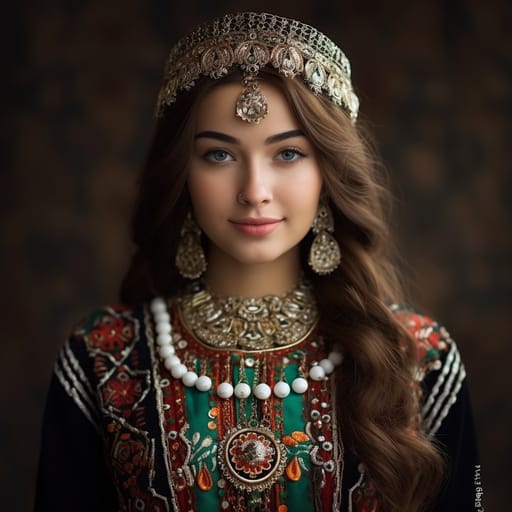
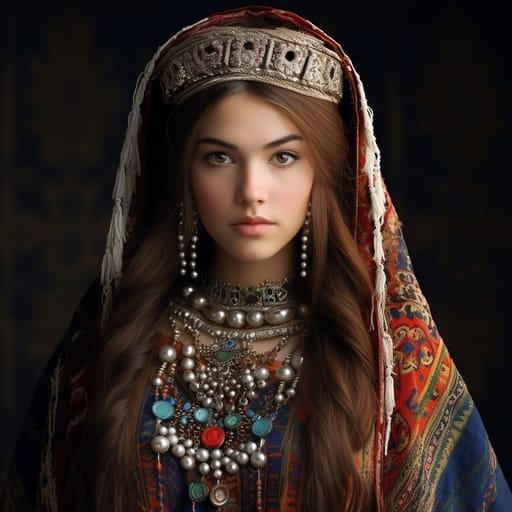
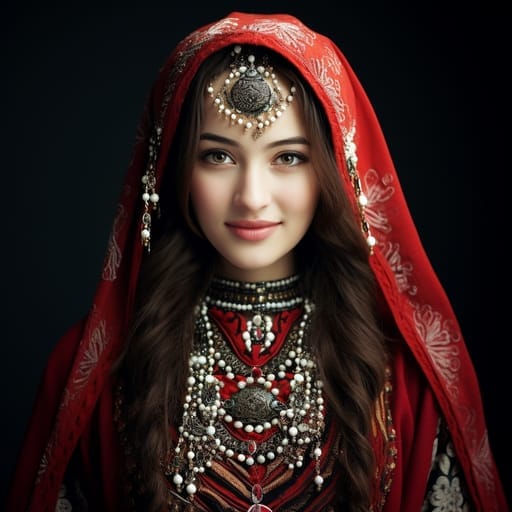
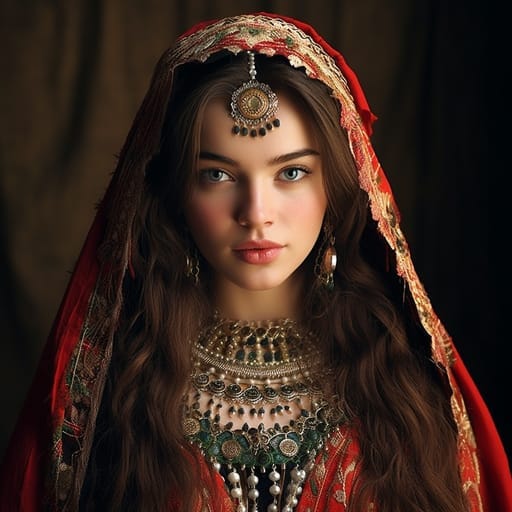
Typical Salar Phenotypes
Reference for AI generation: hair, eyes, skin, facial structure, build
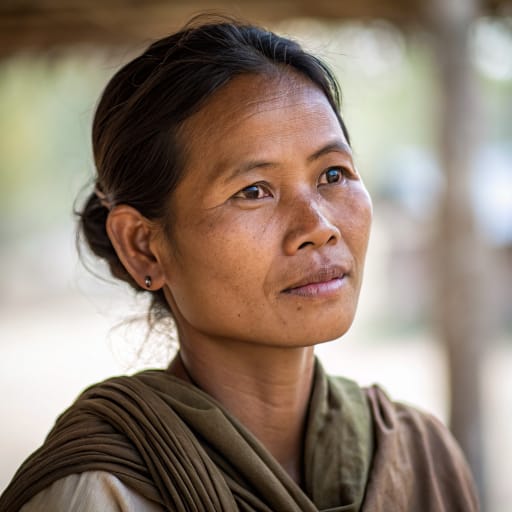
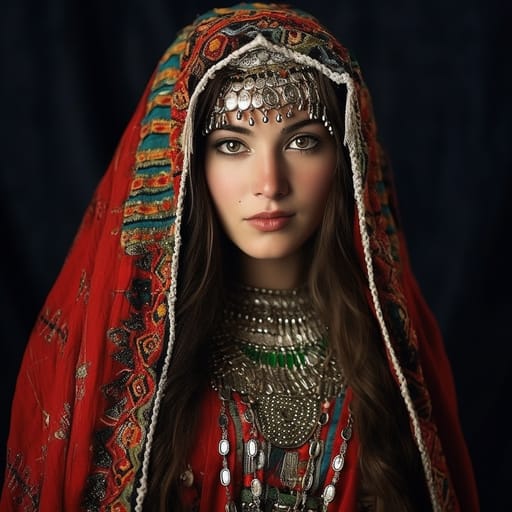
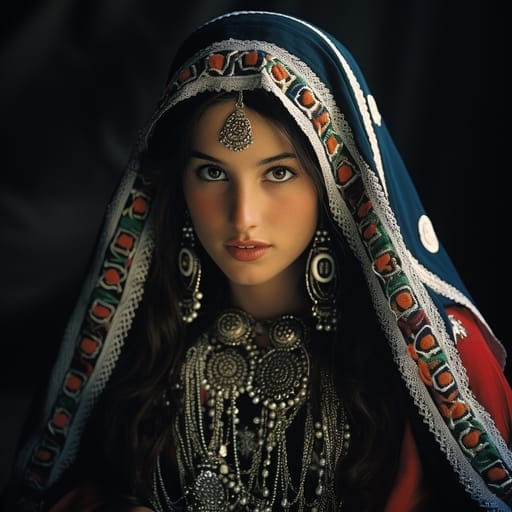
The Salar are a small Turkic-speaking Muslim population concentrated around Xunhua in eastern Qinghai, descended from Oghuz Turks who migrated east from Samarkand in the 14th century and intermarried with neighboring Tibetan, Han, and Hui populations. The phenotype reflects that mix: a Central Asian base layered with several centuries of East Asian admixture, producing a face that reads as transitional rather than cleanly Turkic or cleanly Sinitic.
Hair is almost uniformly black or very dark brown, straight to slightly wavy, coarser than typical Han hair and with somewhat heavier facial and body hair on men — a Turkic legacy. Beards grow in fully and are commonly worn by older men. Eyes are dark brown to near-black; the epicanthic fold is present in most individuals but is often shallower or partial compared to Han or Tibetan neighbors, and a meaningful minority show only a faint fold or none at all. Eye shape tends to be moderately almond, less narrow than in lowland Han populations.
Skin sits in the Fitzpatrick III–IV range, warm beige to light olive, with a yellow-tan undertone rather than the pinker cast common further west. Highland sun and dry continental climate produce visible weathering on rural faces — ruddiness across the cheekbones, pronounced squint lines.
Facial structure is the most distinctive feature: cheekbones are high and broad in the Central Asian manner, but the nose is frequently straighter and narrower than in Han or Mongolic populations, with a defined bridge and a moderate, sometimes slightly aquiline profile. Lips are medium in fullness. Jawlines are squared in men, softer in women, and the overall face shape trends toward a broad oval.
Build is medium — adult men typically 165–172 cm, women 153–160 cm — wiry and lean in agricultural populations, with a tendency toward stockier proportions in older adults. Compared to the closely related Salar-adjacent Bao'an and Dongxiang, Salars tend to retain slightly more visibly Turkic features, particularly in the nose and brow.
Salar Body & Anatomy Reference
Per-feature anatomical profile for AI nude generation: Central Asian Turkic-Mongolic phenotype
Salar Boobs & Breasts
Bust reference for Salar women: medium cup, moderate projection, which is typical of Central Asian Turkic-Mongolic ancestry. Areolas measure about 30-42mm across, with medium-brown pigmentation. Body type (mesomorph, broader frame than the East Asian norm) shapes the bust as well, so Salar tits are usually full and modestly projecting. In AI imagery, keep the forward-set shape rather than drifting toward the smaller East Asian bust.
Salar Ass & Hips
The Salar ass is typically medium, moderate projection, broader hip profile than the East Asian norm, which sets it apart from the slim East Asian narrow-hip profile. Underneath, the pelvis shows medium iliac crests, moderate gluteal-femoral fat deposition, part of the Central Asian Turkic-Mongolic skeletal pattern. For Salar butt pics and AI renders, match that silhouette and the overall build (mesomorph, broader frame than the East Asian norm).
Salar Vagina & Pussy
Salar pussy and vulvar anatomy presents medium-brown labial pigmentation, consistent with the Central Asian Turkic-Mongolic phenotype's pigmentation pattern. Salar pubic hair is typically straight-to-wavy medium-coarse texture, in the inverted-triangle pattern. For anatomically accurate Salar pussy renders the labial coloration should match the surrounding tan to light-brown skin tone with a continuous gradient, and the hair should keep its straight-to-wavy medium-coarse texture.
Salar Dicks & Penis
Salar dicks follow the Central Asian Turkic-Mongolic reference data: regional mean ~13cm erect; moderate girth; medium-brown shaft pigmentation. Shaft color should track the tan to light-brown skin tone with a smooth change toward the glans, and Salar pubic hair keeps its straight-to-wavy medium-coarse texture.
Salar Body, Curves & Build
Salar body type and overall build presents as mesomorph, broader frame than the East Asian norm, with mean adult female BMI 23-26: the characteristic Central Asian Turkic-Mongolic habitus. Salar curves and proportions should keep the regional skeletal frame (height, shoulder-to-hip ratio, limb proportions) rather than a generic mesomorph default.
Salar Skin Tone & Hair Texture
Salar skin sits in the tan to light-brown (Fitzpatrick III-IV) band. Hair is typically straight 1A-1B, dark-brown to black, in keeping with the Central Asian Turkic-Mongolic phenotype. In nude renders the skin should stay one even tone from face to body, and body, pubic and head hair should match.
Data depth
0/100Coverage of image-grounded phenotype observations · drives AI generation diversity
- Sample size
- 0/40· 0 images
- Image quality
- 0/30· 0% high
- Confidence
- 0/20
- Source diversity
- 0/10
- ·No image observations yet
Explore phenotype categories
Structured taxonomy with peer-reviewed scales · 22 anatomical categories
Erotic Poses & Sex Positions
From the pose catalog: 219 named positions with reference skeletons
Frequently asked questions about Salar people
Where is the Salar homeland?
The Salar homeland is China (Qinghai, Gansu) in Central Asia.
What language do Salar people speak?
Salar people primarily speak Turkic / Oghuz / Salar.
What religion do Salar people practice?
The predominant religion among Salar people is Islam / Sunni Islam.






Make your own Salar images
Five a day, free, no credits to buy. The studio starts from this group's phenotype data, so you can set body type, pose and style and keep the traits accurate.
Start with Salar