No portrait yet
Tinguian Erotic
Abra province in the Cordillera of northwestern Luzon, Philippines, with smaller communities in Ilocos Sur, Ilocos Norte, Kalinga and Apayao
Itneg languages (Austronesian, Northern Luzon branch), several varieties including Binongan, Inlaud, Maeng, Masadiit and Moyadan; Ilocano widely spoken as a second language
Mostly Roman Catholic and Protestant; indigenous beliefs centered on the sky deity Kadaklan and ancestral spirits persist alongside Christianity
Cordillera (Igorot) peoples of Luzon; subgroups include Adasen, Balatok, Banao, Belwang, Binongan, Gubang, Inlaud, Mabaka, Maeng, Masadiit and Moyadan
About Tinguian People
The Tinguian, who call themselves Itneg, are the people of Abra, a landlocked province wedged between the Ilocos coast and the high Cordillera of northern Luzon in the Philippines. The outside name is usually traced to a Malay word meaning high, which Spanish writers applied to hill dwellers. The inside name points to the Tineg River, which drains the province's northern uplands. Smaller communities spill over into Ilocos Sur, Ilocos Norte, Kalinga and Apayao. They are usually grouped under the Igorot umbrella with the other Cordillera peoples, but their valley-based wet-rice farming and centuries of trade with the coast give them a different history from the terrace builders deeper in the range.
There is no single Tinguian language. Eleven subgroups are usually named, among them the Adasen, Banao, Binongan, Inlaud, Maeng, Masadiit and Moyadan, and most have their own speech variety within the Northern Luzon branch of the Austronesian family. These sit closest to the Kalinga languages, and nearly everyone also speaks Ilocano, the coastal trade language that has been absorbing Tinguian communities for centuries. The Inlaud of the lower Abra valley were the first to intermarry, take up Catholicism and dress like their Ilocano neighbors, and the boundary between Tinguian and Ilocano in the valley towns is porous to this day.
Most Tinguian now identify as Catholic or Protestant, but the older religion recorded by the American anthropologist Fay-Cooper Cole in 1907 and 1908 has not gone away. It centers on Kadaklan, a sky deity, and a crowd of spirits addressed through mediums who were, and often still are, women. The great ceremonies called for a small spirit house, the balaua, and for generous pouring of basi, the sugarcane wine of the region. Funerals kept the dead seated upright in a chair for days while relatives sang over the body. Peace pacts between villages, sealed with feasting and enforced by the pact holders' kin, did the work that courts do elsewhere.
The sharpest recent turn came in 1973, when the Marcos government handed a logging concession of roughly 200,000 hectares across Abra and neighboring provinces to Cellophil Resources Corporation. Tinguian villages revived the peace-pact network to organize against it, and that fight became one of the founding stories of the Cordillera indigenous movement. Weaving on the backstrap loom remains a living craft in the Abra towns, and the old blanket motifs, whirlwinds and flowers among them, are still in production.
Related ethnic groups
Groups that share Tinguian's homeland, region, language, or religious tradition. These are likely candidates for comparative phenotype reference.
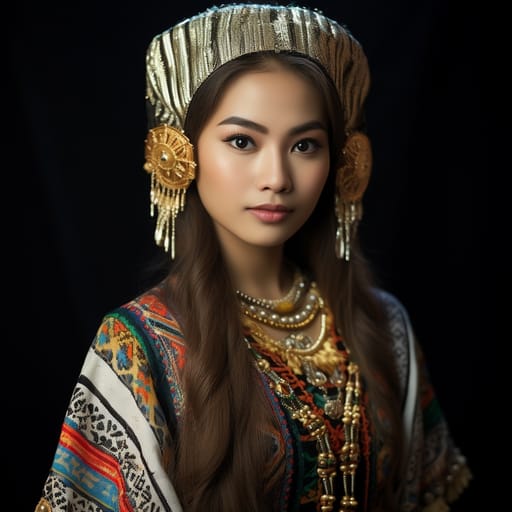
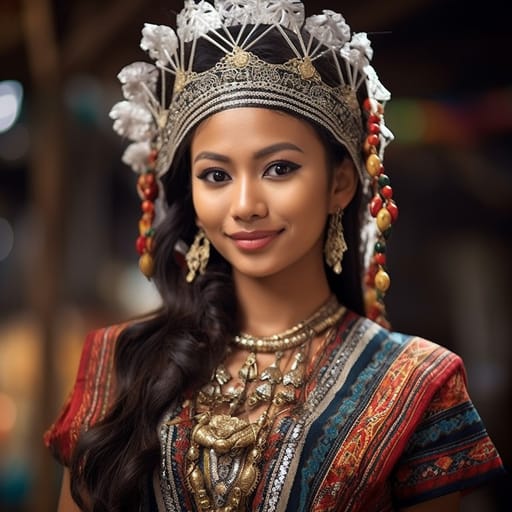
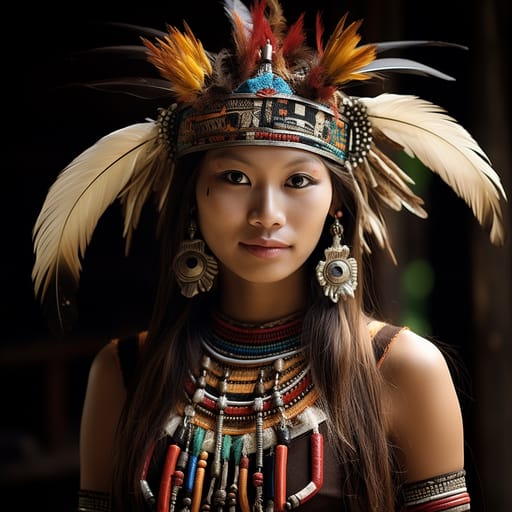
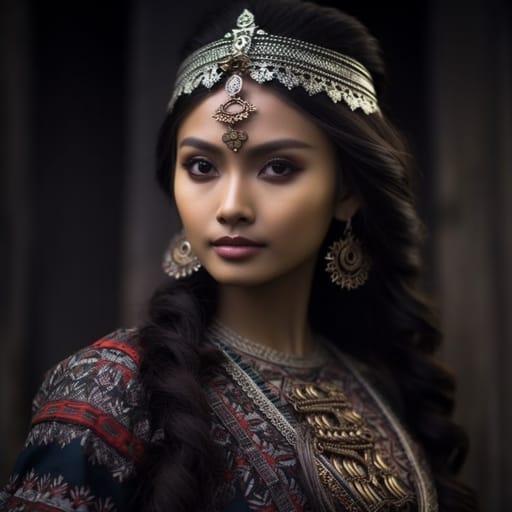
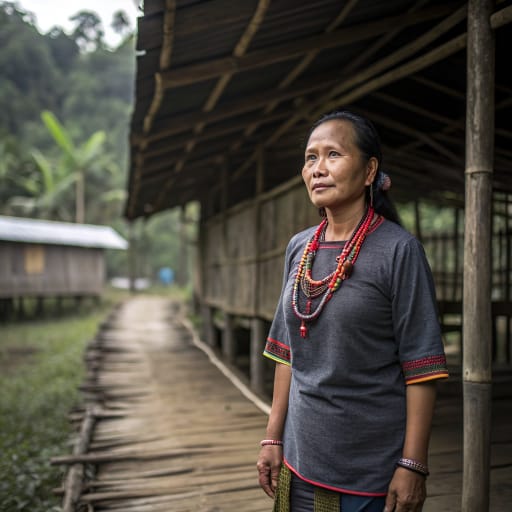
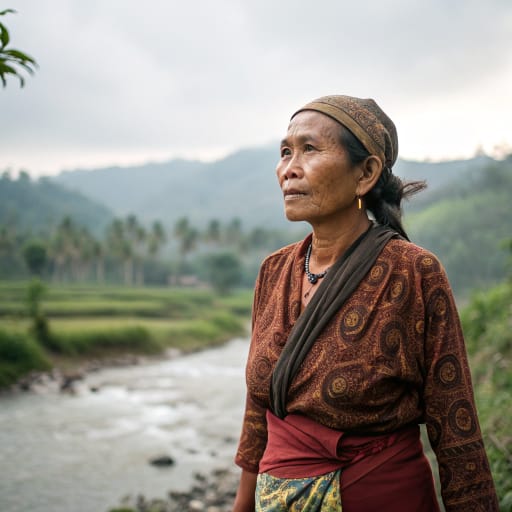
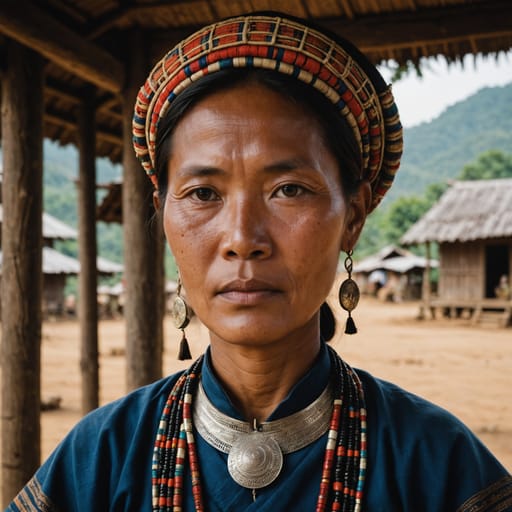
Typical Tinguian Phenotypes
Reference for AI generation: hair, eyes, skin, facial structure, build
Tinguian Body & Anatomy Reference
Anatomy by feature, Southeast Asian Austronesian / Austroasiatic phenotype
Tinguian Boobs & Breasts
Bust reference for Tinguian women: small-to-medium cup, modest projection, which is typical of Southeast Asian Austronesian / Austroasiatic ancestry. Areolas measure about 26-38mm across, with medium-brown to dark-brown pigmentation. Body type (ectomorph, petite frame) shapes the bust as well, so Tinguian tits are usually firm, modest projection. In AI imagery, keep the forward-set shape rather than drifting toward the fuller South Asian or Polynesian bust.
Tinguian Ass & Hips
The Tinguian ass is typically small-to-medium, modest projection, narrower hip profile, which sets it apart from the fuller glutes of the Pacific Islander phenotype. Underneath, the pelvis shows narrow-to-medium iliac crests, part of the Southeast Asian Austronesian / Austroasiatic skeletal pattern. For Tinguian butt pics and AI renders, match that silhouette and the overall build (ectomorph, petite frame).
Tinguian Vagina & Pussy
Tinguian pussy and vulvar anatomy presents medium-brown to dark-brown labial pigmentation, consistent with the Southeast Asian Austronesian / Austroasiatic phenotype's pigmentation pattern. Tinguian pubic hair is typically straight-to-wavy fine-to-medium texture, in the inverted-triangle pattern. For anatomically accurate Tinguian pussy renders the labial coloration should match the surrounding tan to medium-brown skin tone with a continuous gradient, and the hair should keep its straight-to-wavy fine-to-medium texture.
Tinguian Dicks & Penis
Tinguian dicks follow the Southeast Asian Austronesian / Austroasiatic reference data: regional mean ~11cm erect; moderate girth; medium-brown shaft pigmentation. Shaft color should track the tan to medium-brown skin tone with a smooth change toward the glans, and Tinguian pubic hair keeps its straight-to-wavy fine-to-medium texture.
Tinguian Body, Curves & Build
Tinguian body type and overall build presents as ectomorph, petite frame, with mean adult female BMI 20-23: the characteristic Southeast Asian Austronesian / Austroasiatic habitus. Tinguian curves and proportions should keep the regional skeletal frame (height, shoulder-to-hip ratio, limb proportions) rather than a generic mesomorph default.
Tinguian Skin Tone & Hair Texture
Tinguian skin sits in the tan to medium-brown (Fitzpatrick III-V) band. Hair is typically straight-to-wavy 1A-2A, dark-brown to black, in keeping with the Southeast Asian Austronesian / Austroasiatic phenotype. In nude renders the skin should stay one even tone from face to body, and body, pubic and head hair should match.
Explore phenotype categories
Structured taxonomy with peer-reviewed scales · 22 anatomical categories
Erotic Poses & Sex Positions
From the pose catalog: 219 named positions with reference skeletons
Frequently asked questions about Tinguian people
Where is the Tinguian homeland?
The Tinguian homeland is Abra province in the Cordillera of northwestern Luzon, Philippines, with smaller communities in Ilocos Sur, Ilocos Norte, Kalinga and Apayao in Southeast Asia.
What language do Tinguian people speak?
Tinguian people primarily speak Itneg languages (Austronesian, Northern Luzon branch), several varieties including Binongan, Inlaud, Maeng, Masadiit and Moyadan; Ilocano widely spoken as a second language.
What religion do Tinguian people practice?
The predominant religion among Tinguian people is Mostly Roman Catholic and Protestant; indigenous beliefs centered on the sky deity Kadaklan and ancestral spirits persist alongside Christianity.






Make your own Tinguian images
Five a day, free, no credits to buy. The studio starts from this group's phenotype data, so you can set body type, pose and style and keep the traits accurate.
Start with Tinguian