No portrait yet
Tikar Erotic
The Tikar Plain and upper Mbam valley, in the Adamawa and Centre regions of Cameroon.
Tikar, also called Tumu or Tikari (Southern Bantoid, Niger-Congo)
Christianity and Islam, alongside ancestral observance centered on the chiefdom.
Southern Bantoid, in chiefdoms including Bankim, Ngambe Tikar, Ditam, Nditam and Kong. Widely claimed as ancestral by Grassfields dynasties such as the Bamum and Nso.
About Tikar People
The Tikar are a small people with an outsized claim on other people's ancestry. Across the Cameroon Grassfields, ruling houses from Bamum to Nso, Kom and Bafut open their founding stories the same way: we came from Tikar. Scholars have worked this over for decades and mostly read it as a charter rather than a migration record, since the languages of those kingdoms belong to a different branch of the family than Tikar does. What the phrase really conveyed was a right to rule, and it traveled much farther than any actual population ever did. The Tikar themselves live where the Adamawa plateau breaks down into the upper Mbam valley, wooded savanna and river country split between Cameroon's Adamawa and Centre regions, with Bankim, Ngambe Tikar, Ditam and Kong among the main chiefdoms. Each is headed by a fon with a court of notables and a regulatory society standing behind him. Their own traditions trace an arrival from the north, out of the Mbum country near Tibati, a few centuries back. The language, called Tikar or Tumu, is Southern Bantoid and sits on a limb of its own: not Grassfields, not quite Bantu, with no close relative among its neighbors.
The nineteenth century came at them as cavalry. Fulani emirates on the Adamawa raided the plain for captives, and that corridor fed people into both the trans-Saharan and Atlantic trades, which is one reason the name surfaces so often in the modern American diaspora: commercial ancestry tests match a striking number of African American customers to Tikar reference samples, and the result has given the name a second life among people saying it about themselves thousands of miles away. Islam entered by the Fulani route and holds among a minority. Christian missions followed the German and then French administrations, and most Tikar today identify as Christian or Muslim while keeping the obligations a chiefdom actually runs on: death celebrations held long after the burial, offerings to ancestors, the palace's authority over land. The regional craft reputation rests on lost wax brass casting and on smoking pipes with heavy modeled clay or cast metal bowls, though a buyer should know that Tikar on a gallery label is often a catchall for Grassfields work of uncertain origin, the art market's version of the same borrowed prestige. Divination here has its own signature: serious questions are put to a burrowing ground spider, which rearranges marked leaf cards overnight for the diviner to read in the morning.
Related ethnic groups
Groups that share Tikar's homeland, region, language, or religious tradition. These are likely candidates for comparative phenotype reference.
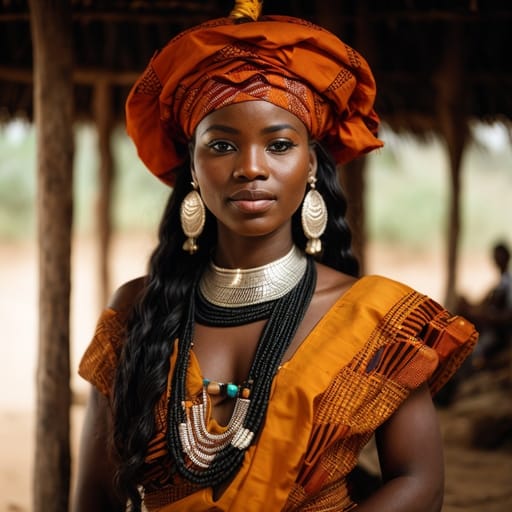
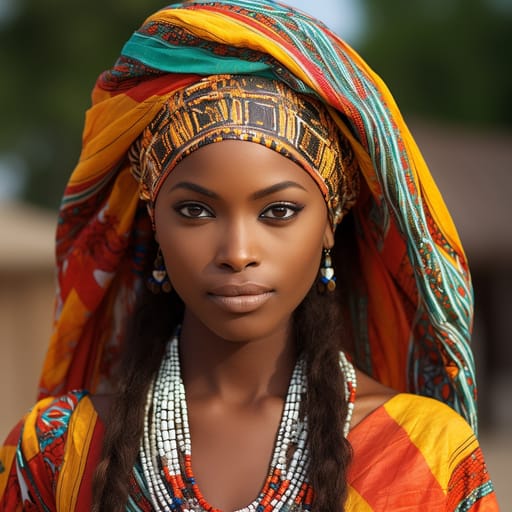
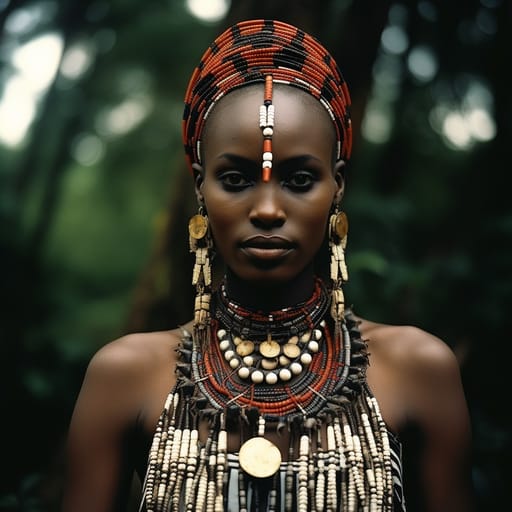
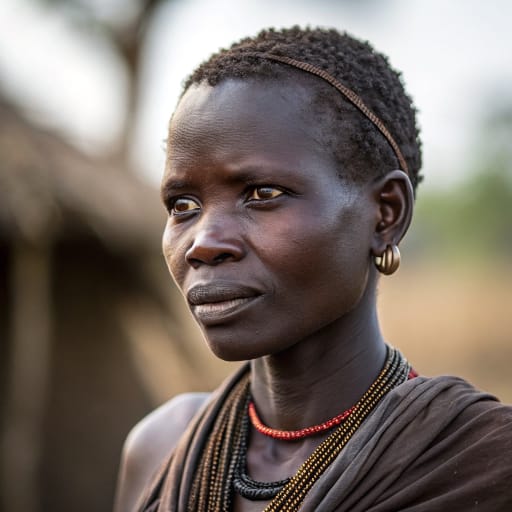
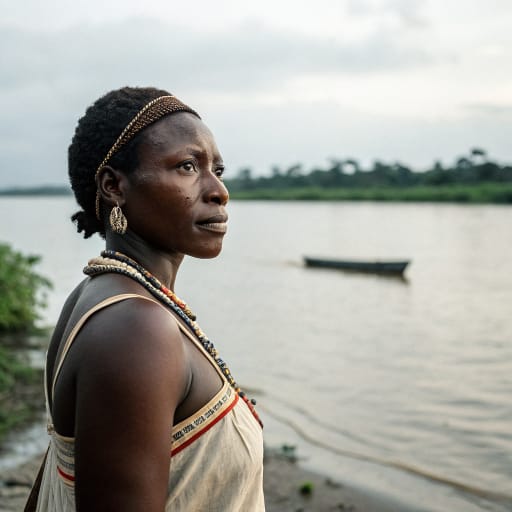
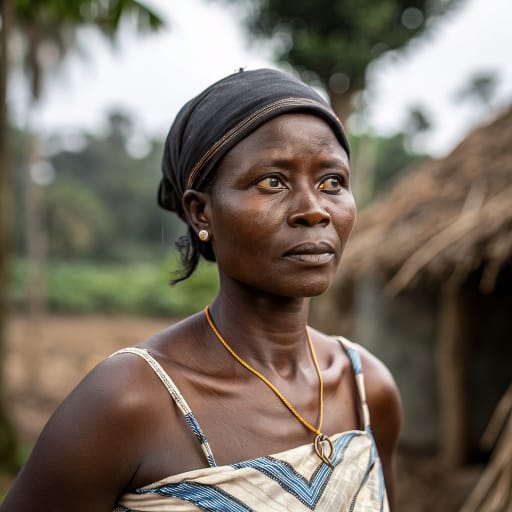
Typical Tikar Phenotypes
Reference for AI generation: hair, eyes, skin, facial structure, build
Tikar Body & Anatomy Reference
Anatomy by feature, Bantu / Central African Niger-Congo phenotype
Tikar Boobs & Breasts
Bust reference for Tikar women: medium-to-large cup, full, projecting, which is typical of Bantu / Central African Niger-Congo ancestry. Areolas measure about 32-48mm across, with deep-brown pigmentation. Body type (mesomorph with strong gluteal-femoral fat deposition) shapes the bust as well, so Tikar tits are usually fuller projection than East African; comparable to West African norm. In AI imagery, keep the forward-set shape rather than drifting toward the smaller East African conical profile.
Tikar Ass & Hips
The Tikar ass is typically full, projected, wide-set glutes, which sets it apart from the slim narrow-hip Cushitic East African profile. Underneath, the pelvis shows broad iliac crests, gynoid pelvic pattern, part of the Bantu / Central African Niger-Congo skeletal pattern. For Tikar butt pics and AI renders, match that silhouette and the overall build (mesomorph with strong gluteal-femoral fat deposition).
Tikar Vagina & Pussy
Tikar pussy and vulvar anatomy presents deep-brown labial pigmentation, fuller labia minora, consistent with the Bantu / Central African Niger-Congo phenotype's pigmentation pattern. Tikar pubic hair is typically tightly-coiled coarse texture, dense distribution, in the inverted-triangle pattern. For anatomically accurate Tikar pussy renders the labial coloration should match the surrounding deep-brown skin tone with a continuous gradient, and the hair should keep its tightly-coiled coarse texture.
Tikar Dicks & Penis
Tikar dicks follow the Bantu / Central African Niger-Congo reference data: regional mean ~14cm erect; above-average girth; deep-brown shaft pigmentation. Shaft color should track the deep-brown skin tone with a smooth change toward the glans, and Tikar pubic hair keeps its tightly-coiled coarse texture.
Tikar Body, Curves & Build
Tikar body type and overall build presents as mesomorph with strong gluteal-femoral fat deposition, with mean adult female BMI 23-26: the characteristic Bantu / Central African Niger-Congo habitus. Tikar curves and proportions should keep the regional skeletal frame (height, shoulder-to-hip ratio, limb proportions) rather than a generic mesomorph default.
Tikar Skin Tone & Hair Texture
Tikar skin sits in the deep-brown (Fitzpatrick VI) band. Hair is typically tight 4A-4C coil, in keeping with the Bantu / Central African Niger-Congo phenotype. In nude renders the skin should stay one even tone from face to body, and body, pubic and head hair should match.
Explore phenotype categories
Structured taxonomy with peer-reviewed scales · 22 anatomical categories
Erotic Poses & Sex Positions
From the pose catalog: 219 named positions with reference skeletons
Frequently asked questions about Tikar people
Where is the Tikar homeland?
The Tikar homeland is The Tikar Plain and upper Mbam valley, in the Adamawa and Centre regions of Cameroon. in Central Africa.
What language do Tikar people speak?
Tikar people primarily speak Tikar, also called Tumu or Tikari (Southern Bantoid, Niger-Congo).
What religion do Tikar people practice?
The predominant religion among Tikar people is Christianity and Islam, alongside ancestral observance centered on the chiefdom..






Make your own Tikar images
Five a day, free, no credits to buy. The studio starts from this group's phenotype data, so you can set body type, pose and style and keep the traits accurate.
Start with Tikar