Help us get this right
Does this portrait look right for Tarok?
One tap. It takes a second and it is recorded.
1 says it looks right, 0 say it looks off.
Tarok Erotic
Plateau State (Nigeria)
Christianity
About Tarok People
The Tarok occupy the southern lip of the Jos Plateau, in and around Langtang in Nigeria's Plateau State, where the high savanna begins to fall away toward the Benue valley. They call themselves iTarok, and their language — also Tarok, or cTarok — belongs to the Plateau branch of Benue–Congo, a cluster of small, often unrelated-feeling languages packed into one of the most linguistically dense corners of Africa. Tarok sits among neighbors like Berom, Ngas, and Goemai without being especially close to any of them; the plateau has a way of letting languages develop in relative isolation, ridge by ridge, valley by valley.
Historically the Tarok are a settled farming people — yam, sorghum, millet, and increasingly maize — with a strong identification with the rocky hill country that protected them, like several plateau peoples, from the nineteenth-century Sokoto jihad pushing up from the south and west. That period of pressure from the Fulani emirates, and the later British consolidation of the plateau under colonial rule, shaped a sharp sense of territorial and communal self-definition that still runs through Tarok politics today. The community is organized around patrilineal clans and a system of age-grades, and traditional authority is vested in a paramount chief, the Ponzhi Tarok, based at Langtang.
Christianity, brought largely through twentieth-century mission work, is now the dominant religion, and the Tarok are widely identified as one of the Christian-majority groups of the Middle Belt. In practice, faith threads through ordinary life rather than sitting apart from it: church membership doubles as social network, funerals and harvest observances pull in extended kin, and older ritual vocabulary survives in proverbs, naming, and the rhythms of the agricultural year even where the older religious practice itself has receded. A smaller traditionalist current persists, and a Muslim minority lives among them, particularly in the towns.
The Tarok have an outsized reputation in Nigerian public life for military service — Langtang produced a striking number of senior army officers in the post-independence decades, enough that "Langtang mafia" became shorthand in Nigerian political commentary. Less remarked on, but more telling day to day, is a strong oral tradition: praise singing, proverb, and a body of historical narrative that locates the Tarok firmly on their hills, in conversation with the plateau peoples around them rather than as anyone's periphery.
Related ethnic groups
Groups that share Tarok's homeland, region, language, or religious tradition. These are likely candidates for comparative phenotype reference.
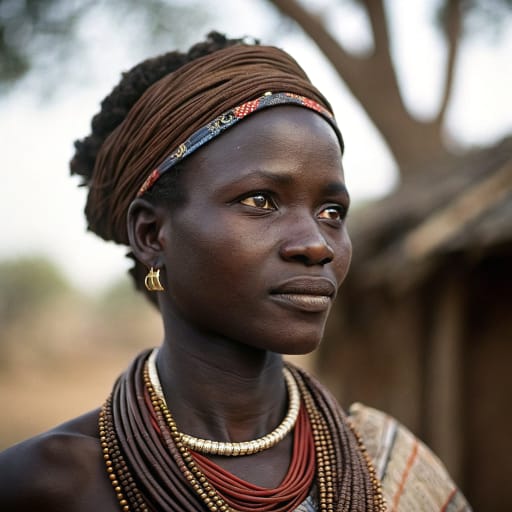
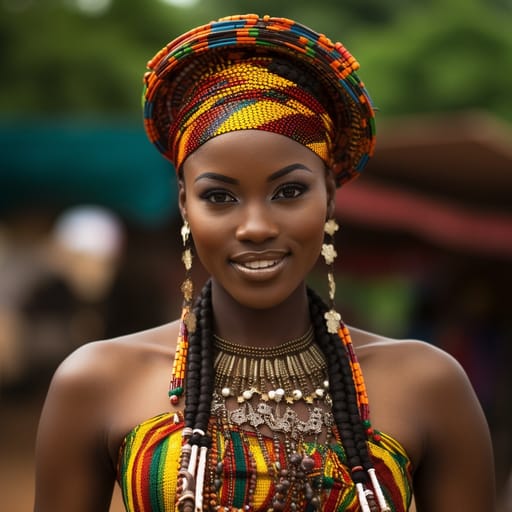
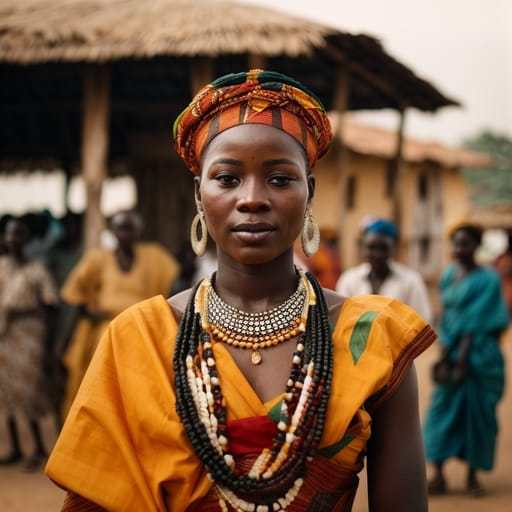
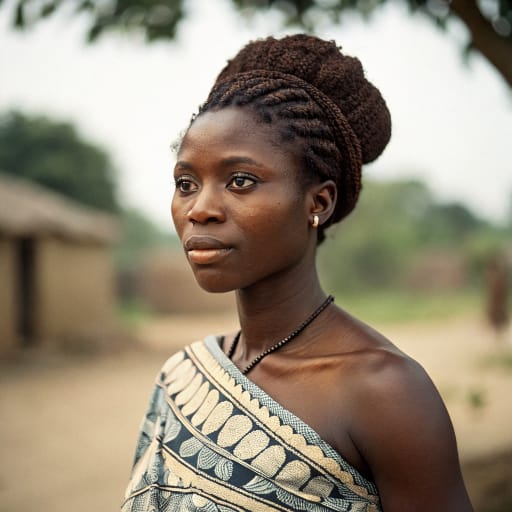
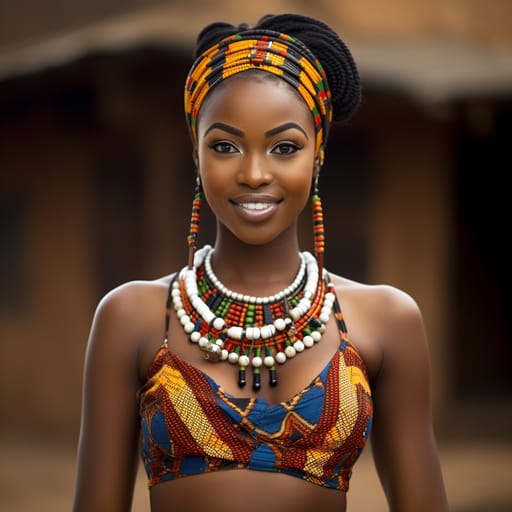
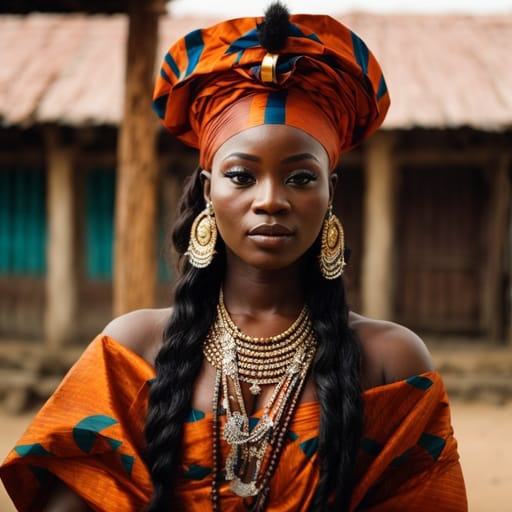

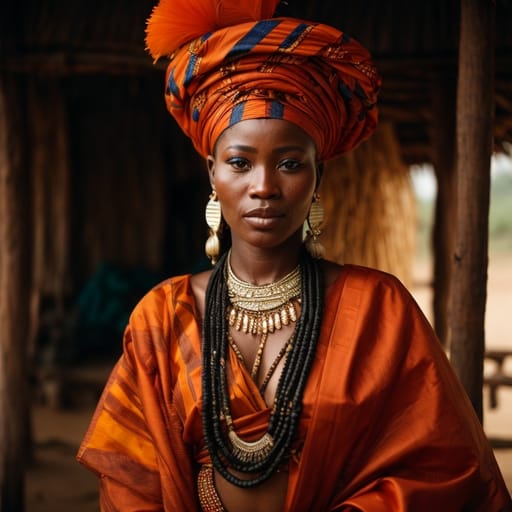
Typical Tarok Phenotypes
Reference for AI generation: hair, eyes, skin, facial structure, build
The Tarok are a Plateau people of central Nigeria, and their phenotype sits at the visual seam where West African Sudanic populations meet the older highland groups of the Jos Plateau. Skin tone clusters in the deep brown to very dark brown range — Fitzpatrick V to VI — with warm reddish-brown and cool blue-black undertones both well represented. The plateau climate is cooler and drier than the surrounding lowlands, and you see slightly less of the heavily sun-darkened, weathered tone common in Sahel-edge populations further north.
Hair is almost universally Type 4, tightly coiled and densely packed, ranging from springy 4A to compact 4C; natural color is jet black with occasional very dark brown. Eyes are dark brown to near-black, set under moderately heavy brows; the eye opening tends to be wide and slightly almond-shaped rather than round, with no epicanthic fold. Eyelashes are typically thick and curl tightly.
Facial structure is where the Tarok read as distinctly Plateau rather than generically West African. Cheekbones are broad and high-set, the midface is relatively flat, and the jaw is square and well-defined — military officers like Domkat Bali and Jeremiah Useni show the type clearly. Noses tend to be moderate in width with a low-to-medium bridge and rounded, fairly fleshy alae, less broad than typical Yoruba or Igbo profiles but wider than Fulani. Lips are full and evenly proportioned, with a defined cupid's bow more often than a soft one. Foreheads are commonly broad and slightly rounded.
Build trends tall and rangy. Adult men frequently fall in the 175–185 cm range with long limbs, narrow hips, and lean musculature that fills out solidly with age; women are typically slim-shouldered with longer legs relative to torso, and hip-to-waist ratios that read fuller in the lower body than the upper. There is no significant visible sub-group divergence within the Tarok proper — variation is individual rather than regional.
Tarok Body & Anatomy Reference
Anatomy by feature, West African Niger-Congo phenotype
Tarok Boobs & Breasts
The typical Tarok bust is medium-to-large cup, full, projecting, in line with the wider West African Niger-Congo pattern. Areolas usually fall in the 35-50mm range, with deep-brown to near-black areolar pigmentation against the medium-to-deep-brown skin tone. Compared with the smaller conical Cushitic East African profile, Tarok breasts sit forward and are generally fuller and more projecting than the East African norm. A faithful AI render of Tarok tits keeps that shape and areola size.
Tarok Ass & Hips
Butt shape among Tarok women: wide-set, full, heavily projected glutes, over wide iliac crests, broad gynoid pelvic pattern, high glute-to-waist ratio. This follows West African Niger-Congo ancestry and looks quite unlike the slim narrow-hip Cushitic East African profile. An accurate Tarok ass in adult AI imagery keeps both the silhouette and the overall build (mesomorph with strong gluteal-femoral fat distribution) instead of a generic average.
Tarok Vagina & Pussy
Vulvar anatomy among Tarok women: deep-brown to near-black labial pigmentation, fuller labia minora. Pubic hair tends to be tightly-coiled coarse texture, densely distributed, in the usual inverted-triangle pattern. Both follow West African Niger-Congo pigmentation, which is why Tarok pussy renders should not fall back on a pale, sparse Western template.
Tarok Dicks & Penis
The Tarok cock profile, from West African Niger-Congo anthropometric data: regional mean ~14-15cm erect; above-average girth, ~13cm circumference; deep-brown-to-near-black shaft pigmentation. Pubic hair has a tightly-coiled coarse texture and forms the usual inverted-V pattern. Whether Tarok men are circumcised follows religious and cultural practice rather than phenotype.
Tarok Body, Curves & Build
Build and curves among Tarok women follow the West African Niger-Congo pattern: mesomorph with strong gluteal-femoral fat distribution, mean adult female BMI 24-27. Proportions matter as much as skin tone, so Tarok figures should keep their regional height and limb ratios.
Tarok Skin Tone & Hair Texture
The Tarok skin range is medium-brown to deep-brown (Fitzpatrick V-VI), and hair tends to be tight 4A-4C coil, often worn natural, braided, or relaxed. That combination marks the West African Niger-Congo phenotype, and skin tone is the trait AI generators most often get wrong for Tarok women.
Data depth
0/100Coverage of image-grounded phenotype observations · drives AI generation diversity
- Sample size
- 0/40· 0 images
- Image quality
- 0/30· 0% high
- Confidence
- 0/20
- Source diversity
- 0/10
- ·No image observations yet
Explore phenotype categories
Structured taxonomy with peer-reviewed scales · 22 anatomical categories
Notable Tarok People
9 reference figures, sourced from Wikipedia
- Domkat Bali, military
- Solomon Dalung, politician (minister)
- Joseph Nanven Garba, military
- Beni Lar, politician (House of Representatives)
- Victor Lar, politician (Senate)
- John Nanzip Shagaya, military
- Sim Shagaya, businessman
- Jeremiah Useni, military
- Jonah Wuyep, military
Erotic Poses & Sex Positions
From the pose catalog: 219 named positions with reference skeletons
Frequently asked questions about Tarok people
Where is the Tarok homeland?
The Tarok homeland is Plateau State (Nigeria) in Western Africa.
What language do Tarok people speak?
Tarok people primarily speak Niger-Congo / Plateau / Tarok.
What religion do Tarok people practice?
The predominant religion among Tarok people is Christianity.






Make your own Tarok images
Five a day, free, no credits to buy. The studio starts from this group's phenotype data, so you can set body type, pose and style and keep the traits accurate.
Start with Tarok