No portrait yet
Sissipahaw Erotic
Haw River valley in the North Carolina Piedmont, around present-day Alamance and Chatham counties, United States.
Unrecorded; presumed to be an eastern Siouan language (Siouan family) on the evidence of their neighbors.
Indigenous Piedmont Siouan religion; no specific account survives.
Piedmont (eastern) Siouan peoples; closely associated with the Shakori and Eno; survivors likely absorbed by the Catawba.
About Sissipahaw People
The Sissipahaw were a small Native people of the North Carolina Piedmont who lived along the Haw River from at least the seventeenth century until the 1710s, when they vanished from the colonial record after the Yamasee War. Their survivors are believed to have been absorbed by the Catawba and other Siouan neighbors. Their name has outlasted nearly everything else about them. The Haw River takes its name from them, and so does Saxapahaw, a former mill village in Alamance County. A Spanish account from the Juan Pardo expeditions of the 1560s mentions a place called Sauxpa, which some scholars have read as the same people, though that identification is a guess. The English explorer John Lawson, crossing the Piedmont in 1701, recorded the name but never reached their town.
That thin paper trail is the central fact about the Sissipahaw. No word list of their language survives, not even a handful of terms. They are classed as Siouan because of the company they kept. The Shakori, Eno, Occaneechi, Saponi and Tutelo around them spoke eastern Siouan languages, and ethnographers have tied the Sissipahaw to the Shakori in particular. What their daily life looked like has to be inferred from those neighbors and from the ground. Piedmont Siouan towns were compact riverside villages, often palisaded, fed by corn, beans and squash from the bottomland, with deer hunting and river fishing filling out the year. Archaeologists from the University of North Carolina have tentatively linked a seventeenth-century village on the Haw in Chatham County, known as the Mitchum site, to the Sissipahaw. Their religion went unrecorded, as did the names of their leaders.
By the time Lawson came through, the whole region was emptying. Smallpox, the rum and deerskin trade, and slave raiding fed by the Carolina market had cut the Piedmont peoples down to fragments, and small nations were merging simply to stay viable. In 1715 the Sissipahaw joined the Yamasee and their allies in the war against South Carolina. The colonists won, and afterward the Sissipahaw are no longer mentioned as a separate people. The likeliest reading is that the remaining families moved south and folded into the Catawba, the nation that took in many of the region's refugees.
Their legacy today is mostly on the map, but not only there. The Occaneechi Band of the Saponi Nation, a state-recognized tribe based in Alamance County, carries forward the Piedmont Siouan presence in the same river valley the Sissipahaw once farmed.
Related ethnic groups
Groups that share Sissipahaw's homeland, region, language, or religious tradition. These are likely candidates for comparative phenotype reference.
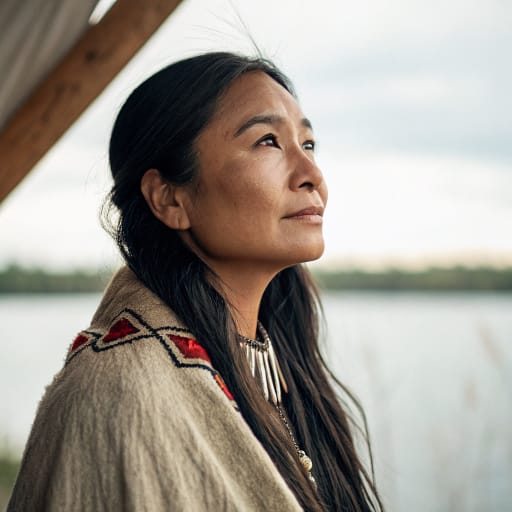
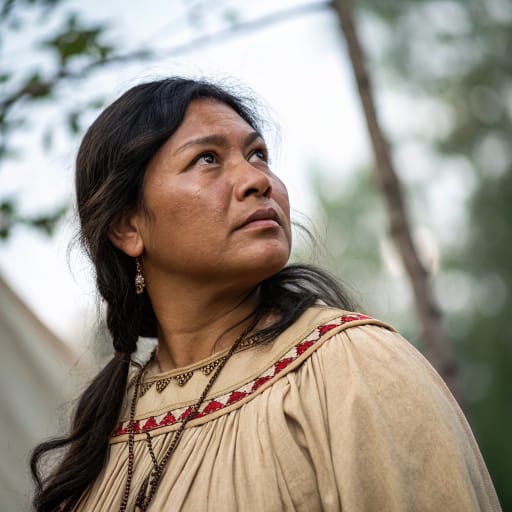
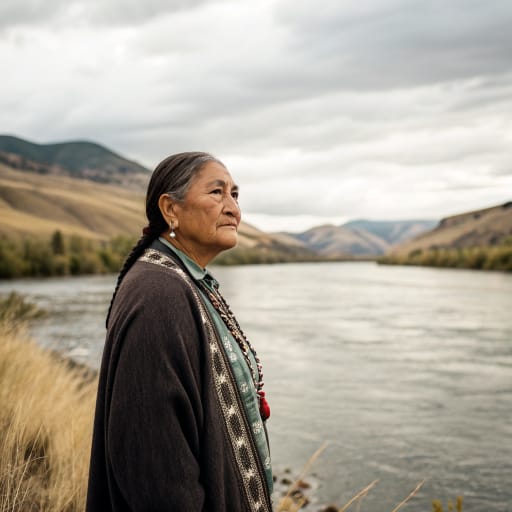
Typical Sissipahaw Phenotypes
Reference for AI generation: hair, eyes, skin, facial structure, build
Sissipahaw Body & Anatomy Reference
Anatomy by feature, Indigenous Northern American / Algonquian-Iroquoian phenotype
Sissipahaw Boobs & Breasts
Sissipahaw tits and boobs run medium cup, moderate projection, the classic Indigenous Northern American / Algonquian-Iroquoian bust profile. Sissipahaw nipples and areolas show medium-brown areolar pigmentation against the copper-to-medium-brown skin tone, with areolar diameter typically in the 30-44mm range and forward-set positioning rather than the smaller East Asian bust. Sissipahaw breasts trend full and moderate projection, a function of the mesomorph, broader frame in northern Indigenous populations body habitus and the mean adult female BMI 25-28. For anatomically accurate AI-generated Sissipahaw nudes the render preserves the medium cup, moderate projection shape, 30-44mm areolas with medium-brown pigmentation, and the torso proportions of the Indigenous Northern American / Algonquian-Iroquoian phenotype.
Sissipahaw Ass & Hips
Sissipahaw hips and butt usually read as medium, moderate-to-full projection. The skeletal base is medium iliac crests, the Indigenous Northern American / Algonquian-Iroquoian pattern. Set against the slim East Asian narrow-hip profile, the difference is easy to see, and the hip-to-waist ratio is often what identifies Sissipahaw women in photos.
Sissipahaw Vagina & Pussy
Expect medium-brown labial pigmentation on Sissipahaw women, in keeping with Indigenous Northern American / Algonquian-Iroquoian ancestry. The pubic hair is straight medium-coarse texture. Coloring should run evenly from the copper to medium-brown skin of the thighs to the labia, and Sissipahaw nude imagery should keep the hair's straight medium-coarse texture.
Sissipahaw Dicks & Penis
Sissipahaw dick and penile anatomy in adult AI generation should anchor on the regional reference data: regional mean ~13cm erect, moderate girth, and medium-brown shaft pigmentation. The Sissipahaw cock profile reflects the Indigenous Northern American / Algonquian-Iroquoian population's anthropometric measurements. The shaft pigmentation should track the surrounding copper to medium-brown skin tone, and the pubic hair should keep its straight medium-coarse texture in the typical inverted-V escutcheon.
Sissipahaw Body, Curves & Build
Sissipahaw body type: mesomorph, broader frame in northern Indigenous populations, with mean adult female BMI 25-28. This is the typical Indigenous Northern American / Algonquian-Iroquoian build. Height range, shoulder-to-hip ratio and fat distribution all follow from it, which is what an accurate Sissipahaw nude body should show.
Sissipahaw Skin Tone & Hair Texture
Sissipahaw skin tone falls in the copper to medium-brown (Fitzpatrick III-V) band, the surface signal most often miscalibrated by generic AI nude generators. Sissipahaw hair texture is typically straight 1A, dark-brown to black, often thick and dense, characteristic of the Indigenous Northern American / Algonquian-Iroquoian phenotype. In Sissipahaw nude renders the skin should hold that band consistently across the body.
Explore phenotype categories
Structured taxonomy with peer-reviewed scales · 22 anatomical categories
Erotic Poses & Sex Positions
From the pose catalog: 219 named positions with reference skeletons
Frequently asked questions about Sissipahaw people
Where is the Sissipahaw homeland?
The Sissipahaw homeland is Haw River valley in the North Carolina Piedmont, around present-day Alamance and Chatham counties, United States. in North America.
What language do Sissipahaw people speak?
Sissipahaw people primarily speak Unrecorded; presumed to be an eastern Siouan language (Siouan family) on the evidence of their neighbors..
What religion do Sissipahaw people practice?
The predominant religion among Sissipahaw people is Indigenous Piedmont Siouan religion; no specific account survives..






Make your own Sissipahaw images
Five a day, free, no credits to buy. The studio starts from this group's phenotype data, so you can set body type, pose and style and keep the traits accurate.
Start with Sissipahaw