No portrait yet
Sihasapa Erotic
Northern Great Plains west of the Missouri River, along the Grand and Moreau rivers in North and South Dakota, United States; today chiefly the Standing Rock and Cheyenne River reservations.
Lakota, a dialect of the Sioux language (Siouan, Dakotan branch); English is universal today.
Lakota traditional religion centered on the seven rites of the sacred pipe, alongside long established Catholic and Episcopal congregations.
One of the seven bands of the Titonwan (Teton Lakota), within the Oceti Sakowin; sometimes rendered Siha Sapa or Blackfoot Sioux.
About Sihasapa People
The first thing worth clearing up is the name. Sihasapa means black feet in Lakota, and English speakers have been confusing them with the Blackfoot Confederacy of Montana and Alberta since the day they first wrote it down. The two peoples are not related. The Niitsitapi speak an Algonquian language; the Sihasapa speak Lakota, and they are one of the seven bands of the Titonwan, the western branch of the Oceti Sakowin, the Seven Council Fires that outsiders flatten into the single word Sioux. Their relatives in that council are the Oglala, Sicangu, Hunkpapa, Miniconjou, Itazipco and Oohenumpa. How the name attached to them is not settled. The usual account has moccasins blackened from walking across burned prairie, which is the kind of explanation that sounds too tidy to trust and may still be true.
Their country is the northern Great Plains west of the Missouri, along the Grand and Moreau rivers in what is now the Dakotas. Like the other Lakota bands they moved west out of the Minnesota woodlands during the seventeenth and eighteenth centuries, took up the horse, and rebuilt their whole economy around the bison herds inside a couple of generations, which is a faster reinvention than most peoples manage. The nineteenth century arrived as a sequence of treaties and the breaking of them: Fort Laramie in 1851, Fort Laramie again in 1868, the seizure of the Black Hills once gold turned up there, then the 1889 agreement that cut the Great Sioux Reservation into separate pieces. John Grass, a Sihasapa headman at Standing Rock and a formidable speaker, argued his way through much of that last round.
Today the Sihasapa are enrolled mainly at Standing Rock and at Cheyenne River, where they are one of four bands sharing the reservation. Ceremony carried on through the decades when the federal government banned it: the Sun Dance, the sweat lodge, the vision fast, the rites that Lakota tradition credits to White Buffalo Calf Woman. Catholic and Episcopal missions took root at the agencies as well, and plenty of families hold both without treating it as a contradiction. Lakota itself is spoken by a shrinking number of fluent elders and a growing number of children in immersion classrooms, a race that is being run in earnest.
Related ethnic groups
Groups that share Sihasapa's homeland, region, language, or religious tradition. These are likely candidates for comparative phenotype reference.
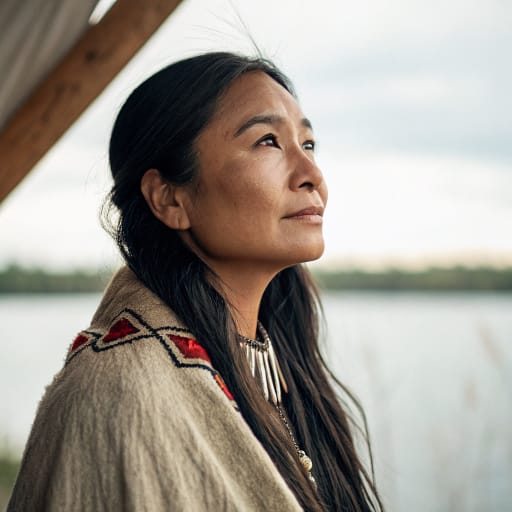
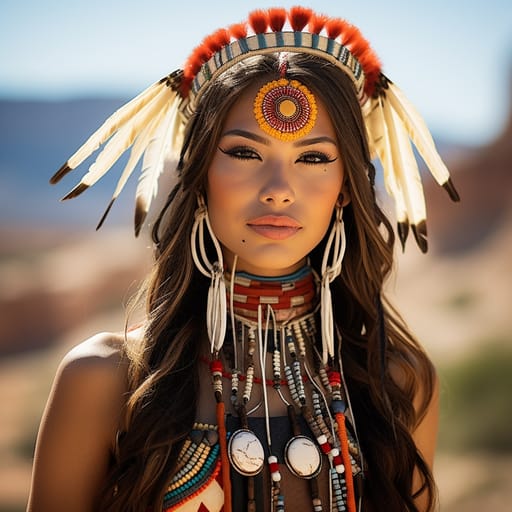
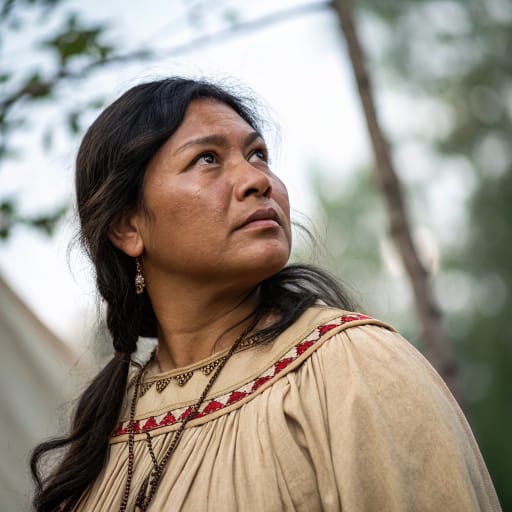
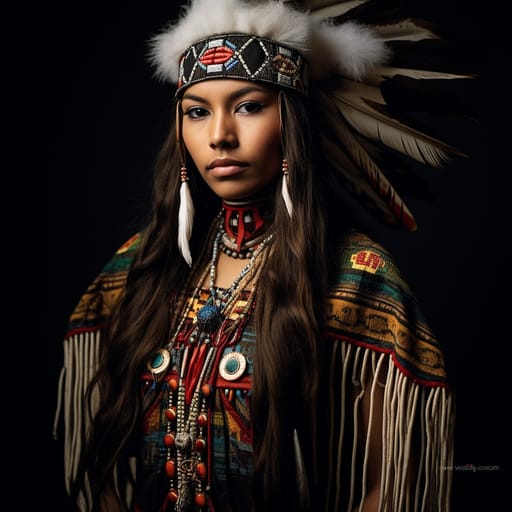
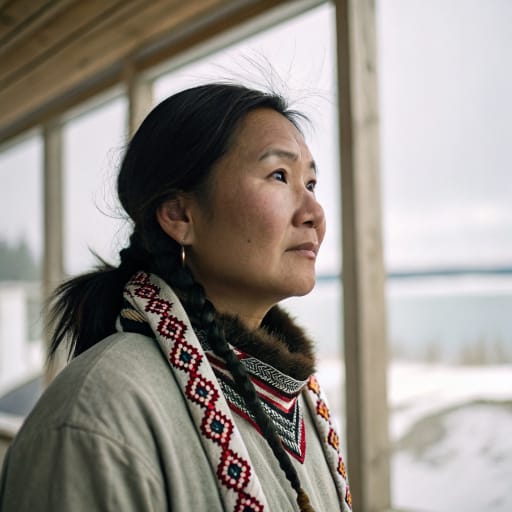
Typical Sihasapa Phenotypes
Reference for AI generation: hair, eyes, skin, facial structure, build
Sihasapa Body & Anatomy Reference
Per-feature anatomical profile for AI nude generation: Indigenous Northern American / Algonquian-Iroquoian phenotype
Sihasapa Boobs & Breasts
Sihasapa boobs follow the Indigenous Northern American / Algonquian-Iroquoian profile: medium cup, moderate projection. Areolar diameter is usually 30-44mm, and the coloring is medium-brown areolar pigmentation against the copper-to-medium-brown skin tone. Breast shape tracks body composition (mesomorph, broader frame in northern Indigenous populations, mean adult female BMI 25-28), so Sihasapa breasts tend to be full and moderate projection. Expect a forward-set shape, not the smaller East Asian bust.
Sihasapa Ass & Hips
Sihasapa ass and hip morphology presents as medium, moderate-to-full projection, distinctly different from the slim East Asian narrow-hip profile. The Sihasapa pelvic profile shows medium iliac crests, anchored in the Indigenous Northern American / Algonquian-Iroquoian skeletal pattern. Sihasapa butt shots in adult AI imagery should render the medium, moderate-to-full projection silhouette with the overall build (mesomorph, broader frame in northern Indigenous populations) and the fat distribution typical of the Indigenous Northern American / Algonquian-Iroquoian phenotype.
Sihasapa Vagina & Pussy
Sihasapa pussy anatomy typically shows medium-brown labial pigmentation. Pubic hair is usually straight medium-coarse texture. In AI-generated Sihasapa nudes, labial color should blend into the copper to medium-brown skin with a gradual transition, and the hair should keep its straight medium-coarse texture.
Sihasapa Dicks & Penis
Penis reference for Sihasapa men: regional mean ~13cm erect, moderate girth. Coloring: medium-brown shaft pigmentation. An accurate Sihasapa cock in AI imagery matches the surrounding copper to medium-brown skin rather than a generic porn default. Circumcision depends on religion and custom, not ancestry.
Sihasapa Body, Curves & Build
The Sihasapa figure is generally mesomorph, broader frame in northern Indigenous populations, with mean adult female BMI 25-28, characteristic of Indigenous Northern American / Algonquian-Iroquoian ancestry. AI image tools tend to flatten regional body types into a few stock shapes; here the Sihasapa build is kept as its own reference.
Sihasapa Skin Tone & Hair Texture
Skin: copper to medium-brown (Fitzpatrick III-V). Hair: straight 1A, dark-brown to black, often thick and dense. Both are typical of Indigenous Northern American / Algonquian-Iroquoian ancestry. The most common mistake in AI nudes of Sihasapa women is a body rendered lighter than the face.
Explore phenotype categories
Structured taxonomy with peer-reviewed scales · 22 anatomical categories
Erotic Poses & Sex Positions
From the pose catalog: 219 named positions with reference skeletons
Frequently asked questions about Sihasapa people
Where is the Sihasapa homeland?
The Sihasapa homeland is Northern Great Plains west of the Missouri River, along the Grand and Moreau rivers in North and South Dakota, United States; today chiefly the Standing Rock and Cheyenne River reservations. in North America.
What language do Sihasapa people speak?
Sihasapa people primarily speak Lakota, a dialect of the Sioux language (Siouan, Dakotan branch); English is universal today..
What religion do Sihasapa people practice?
The predominant religion among Sihasapa people is Lakota traditional religion centered on the seven rites of the sacred pipe, alongside long established Catholic and Episcopal congregations..






Make your own Sihasapa images
Five a day, free, no credits to buy. The studio starts from this group's phenotype data, so you can set body type, pose and style and keep the traits accurate.
Start with Sihasapa