No portrait yet
Si La Erotic
Mường Tè district in Lai Châu province and Mường Nhé in Điện Biên province, northwestern Vietnam, with related communities in Phongsaly province, northern Laos
Si La (Sino-Tibetan, Tibeto-Burman, Loloish/Ngwi branch), with Vietnamese, Lao and neighboring minority languages widely spoken as second languages
Ancestor worship with household and village spirit rites; no institutional religion
Loloish (Ngwi) speaking peoples of the Vietnam-Laos uplands; closely related to Phunoi, and to Hà Nhì, Lahu and Akha at greater distance; called Sida in Laos
About Si La People
Ask which of Vietnam's fifty-four recognized ethnic groups you are least likely to meet, and the Si La are a fair answer. Fewer than a thousand of them live in the country, nearly all in a handful of villages in Mường Tè district of Lai Châu and Mường Nhé in Điện Biên, hard against the Lao border in the far northwest. A few thousand more live on the other side of that border in Phongsaly province, where they are generally called Sida. Their own account of themselves is a migration account: they came out of Laos within the last few centuries, working up the river country, and settled the slopes above the Đà. That river has since been rearranged around them. Hydropower reservoirs drowned valley land in Mường Tè and moved whole settlements uphill, which for a population this small is not a statistic but a change of address for almost everyone.
Their language sits in the Loloish branch of Tibeto-Burman, in the same neighborhood as Hà Nhì, Lahu and Akha, and closest of all to Phunoi across the border. It is nobody's market language and nobody's school language, so most Si La are bilingual at least, in Vietnamese and often in the Tai or Hà Nhì spoken around them. Religion is the ancestors, and it lives in the house rather than in a building: an altar kept at the main post, offerings made by the head of the household, rites at planting and harvest, and ceremonies for the spirits of the village and the forest at its edge. Descent runs through named lineages, and those rites are the machinery that keeps the lines legible. The most recognizable Si La object is a woman's tunic, indigo, closed over a fitted chest panel sewn with dense rows of small silver coins and buttons that she may add to across years, worn with a headcloth whose winding announces whether she is married. Tooth coloring belonged to the same code, black for women and red for men, and has largely gone with the generation that practiced it. Everyday clothes are everyday clothes now; the coin panel comes out for weddings, funerals and the new year. At this size, a language and a set of rites survive on the decisions of a few hundred adults, and the Si La understand that better than anyone writing about them.
Related ethnic groups
Groups that share Si La's homeland, region, language, or religious tradition. These are likely candidates for comparative phenotype reference.
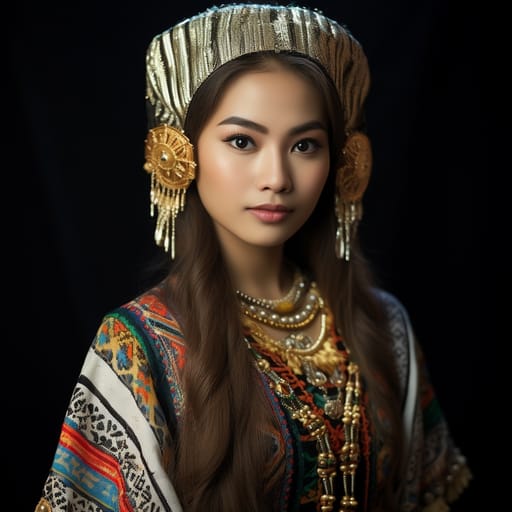
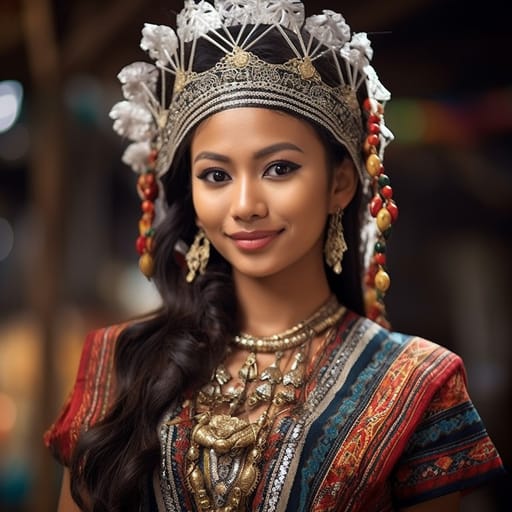
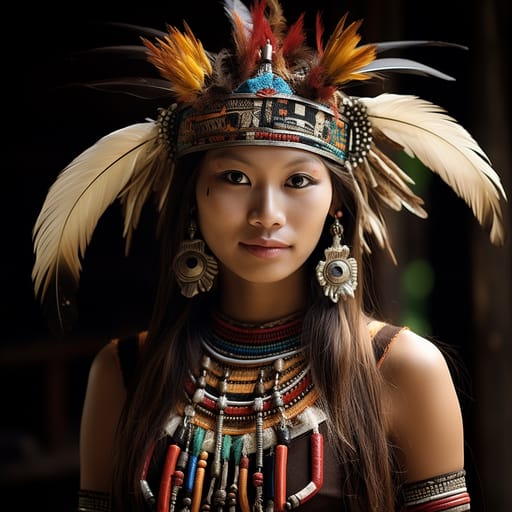

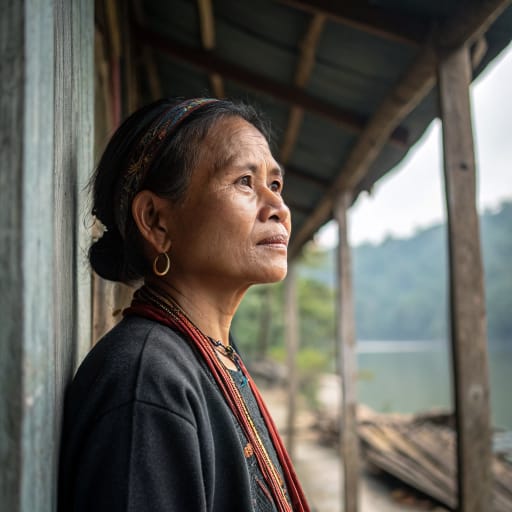
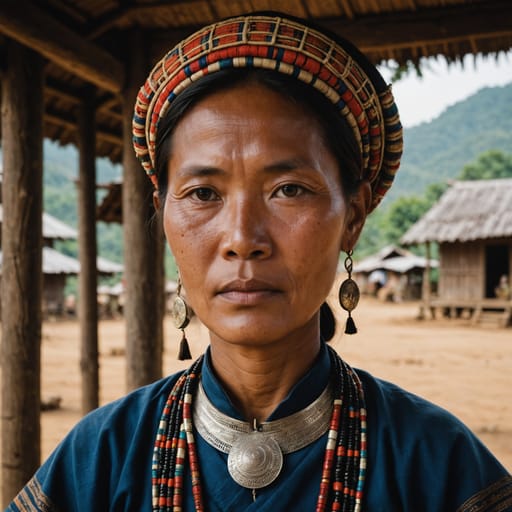
Typical Si La Phenotypes
Reference for AI generation: hair, eyes, skin, facial structure, build
Si La Body & Anatomy Reference
Anatomy by feature, Southeast Asian Austronesian / Austroasiatic phenotype
Si La Boobs & Breasts
Bust reference for Si La women: small-to-medium cup, modest projection, which is typical of Southeast Asian Austronesian / Austroasiatic ancestry. Areolas measure about 26-38mm across, with medium-brown to dark-brown pigmentation. Body type (ectomorph, petite frame) shapes the bust as well, so Si La tits are usually firm, modest projection. In AI imagery, keep the forward-set shape rather than drifting toward the fuller South Asian or Polynesian bust.
Si La Ass & Hips
The Si La ass is typically small-to-medium, modest projection, narrower hip profile, which sets it apart from the fuller glutes of the Pacific Islander phenotype. Underneath, the pelvis shows narrow-to-medium iliac crests, part of the Southeast Asian Austronesian / Austroasiatic skeletal pattern. For Si La butt pics and AI renders, match that silhouette and the overall build (ectomorph, petite frame).
Si La Vagina & Pussy
Si La pussy and vulvar anatomy presents medium-brown to dark-brown labial pigmentation, consistent with the Southeast Asian Austronesian / Austroasiatic phenotype's pigmentation pattern. Si La pubic hair is typically straight-to-wavy fine-to-medium texture, in the inverted-triangle pattern. For anatomically accurate Si La pussy renders the labial coloration should match the surrounding tan to medium-brown skin tone with a continuous gradient, and the hair should keep its straight-to-wavy fine-to-medium texture.
Si La Dicks & Penis
Si La dicks follow the Southeast Asian Austronesian / Austroasiatic reference data: regional mean ~11cm erect; moderate girth; medium-brown shaft pigmentation. Shaft color should track the tan to medium-brown skin tone with a smooth change toward the glans, and Si La pubic hair keeps its straight-to-wavy fine-to-medium texture.
Si La Body, Curves & Build
Si La body type and overall build presents as ectomorph, petite frame, with mean adult female BMI 20-23: the characteristic Southeast Asian Austronesian / Austroasiatic habitus. Si La curves and proportions should keep the regional skeletal frame (height, shoulder-to-hip ratio, limb proportions) rather than a generic mesomorph default.
Si La Skin Tone & Hair Texture
Si La skin sits in the tan to medium-brown (Fitzpatrick III-V) band. Hair is typically straight-to-wavy 1A-2A, dark-brown to black, in keeping with the Southeast Asian Austronesian / Austroasiatic phenotype. In nude renders the skin should stay one even tone from face to body, and body, pubic and head hair should match.
Explore phenotype categories
Structured taxonomy with peer-reviewed scales · 22 anatomical categories
Erotic Poses & Sex Positions
From the pose catalog: 219 named positions with reference skeletons
Frequently asked questions about Si La people
Where is the Si La homeland?
The Si La homeland is Mường Tè district in Lai Châu province and Mường Nhé in Điện Biên province, northwestern Vietnam, with related communities in Phongsaly province, northern Laos in Southeast Asia.
What language do Si La people speak?
Si La people primarily speak Si La (Sino-Tibetan, Tibeto-Burman, Loloish/Ngwi branch), with Vietnamese, Lao and neighboring minority languages widely spoken as second languages.
What religion do Si La people practice?
The predominant religion among Si La people is Ancestor worship with household and village spirit rites; no institutional religion.






Make your own Si La images
Five a day, free, no credits to buy. The studio starts from this group's phenotype data, so you can set body type, pose and style and keep the traits accurate.
Start with Si La