Help us get this right
Does this portrait look right for Sharchops?
Nobody has judged this one yet. You would be the first.
Sharchops Erotic
Also known as: Sharchop
Bhutan (Lhuntse, Mongar, Pemagatshel, Samdrup Jongkhar, Trashigang, and Trashiyangtse Districts)
Buddhism / Tibetan Buddhism
About Sharchops People
The Sharchops are the people of eastern Bhutan — the name itself just means "easterners" in Dzongkha, a label given by the western Bhutanese rather than one the group originally chose for itself. They are widely thought to be among the oldest continuously settled populations in Bhutan, predating the arrival of the Ngalop from Tibet in the 9th century, and their homeland sits in the steep, forested districts that run from Lhuntse down to Samdrup Jongkhar on the Indian border. The land is not gentle: ridge after ridge of subtropical broadleaf forest cut by deep river valleys, with maize and rice terraces clinging to whatever ground holds still long enough to farm.
Their language, Tshangla, is Sino-Tibetan but sits awkwardly inside it — close enough to Tibetan and Dzongkha to share vocabulary, distant enough that a speaker of one cannot follow the other without effort. Tshangla is the working tongue of the east and the lingua franca across communities that otherwise speak Kurtöp, Chocangaca, or one of several smaller languages of the same valleys. It has historically been an oral language; most Tshangla speakers read and write in Dzongkha or English instead.
Religion in Sharchop life is Drukpa Kagyu and Nyingma Buddhism, the same schools that define the rest of Bhutan, but layered over an older substrate of Bön-influenced local practice that has not entirely been absorbed. Household shrines coexist with offerings to mountain deities and territorial spirits; village festivals built around lamas and masked dance share the calendar with rituals tied to crops, illness, and the dead that long predate the formal monastic tradition. The Trashigang region in particular is known for these layered practices, and for a strain of folk Buddhism that is more domestic and less monastery-centered than what one sees in the western dzongs.
Politically, the Sharchops have shaped modern Bhutan more than their relative obscurity outside the country suggests. They are often described as the largest single ethnic component of the population, though precise figures are contested and the government does not publish ethnic breakdowns. Eastern Bhutan was historically more loosely integrated into the central state than the west, and roads only reached much of the region in the second half of the twentieth century — a recency that still informs how Sharchop communities relate to the capital, the monarchy, and the rest of the country.
Related ethnic groups
Groups that share Sharchops's homeland, region, language, or religious tradition. These are likely candidates for comparative phenotype reference.
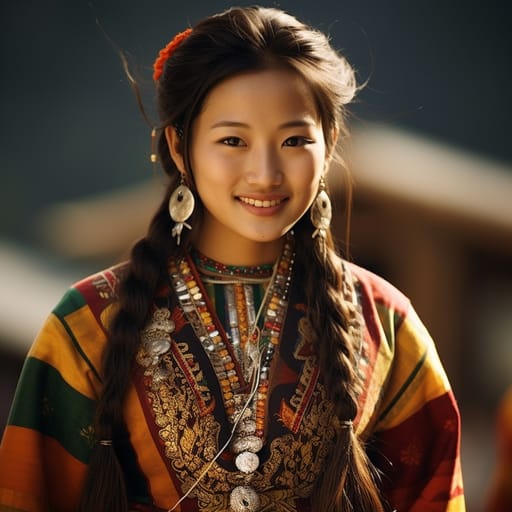
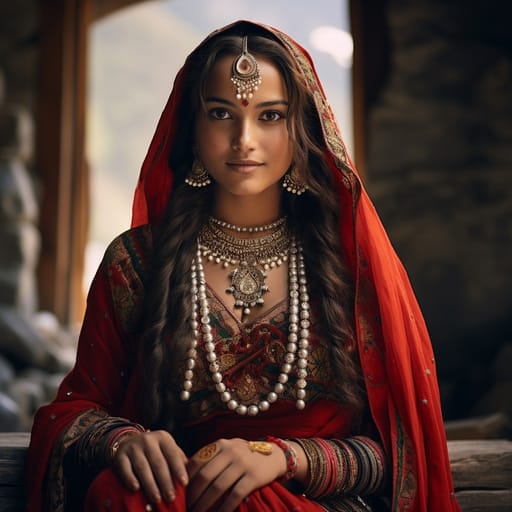
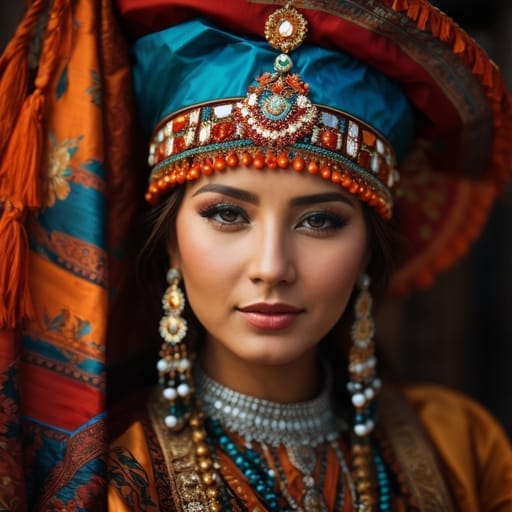
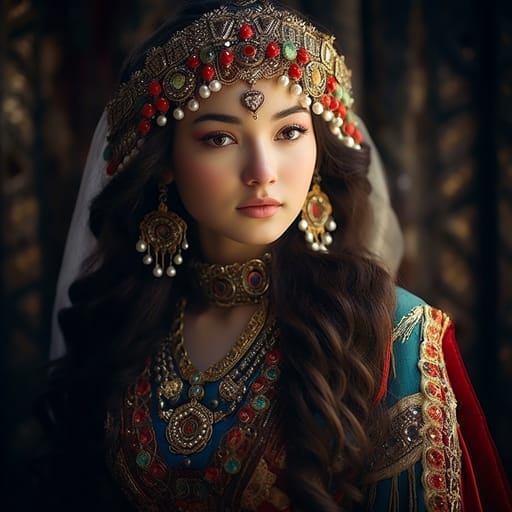
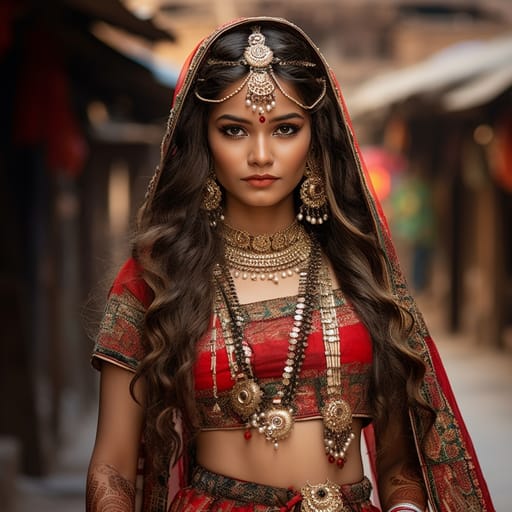
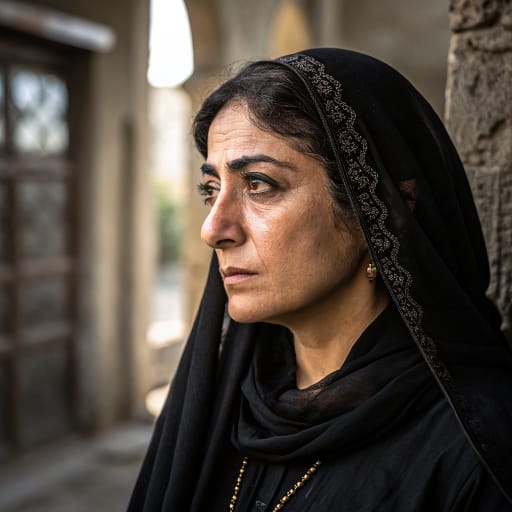
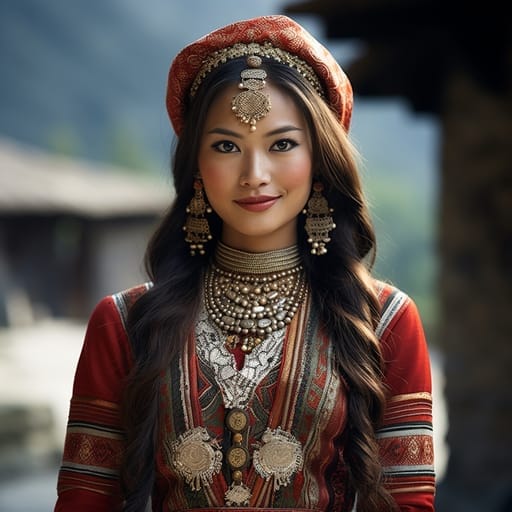
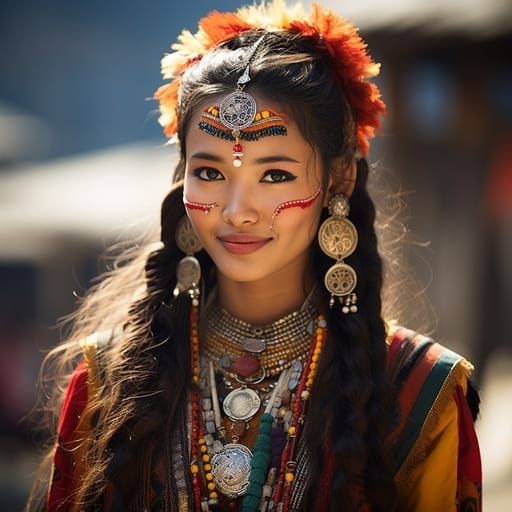
Typical Sharchops Phenotypes
Reference for AI generation: hair, eyes, skin, facial structure, build
The Sharchops ("easterners") of Bhutan's six eastern districts sit at a phenotypic seam where Tibetan highland stock meets older Indo-Burmese substrate populations from the southeastern hills. The result is a face that reads recognizably East/Southeast Asian but carries softer, more rounded features than Tibetan or Han neighbors to the north — less angular cheekbone projection, broader mid-face, and a mandible that tapers rather than squares.
Hair is uniformly black to blue-black, coarse to medium in shaft thickness, and overwhelmingly straight, though a loose wave is not uncommon — full curl is essentially absent. Greying tends to come late. Eye color sits in the dark brown to near-black range; the epicanthic fold is near-universal but typically lighter and shorter than in Tibetan or Mongolian populations, often producing an almond shape rather than a strongly hooded one. Lashes are dense and straight.
Skin tone is the most visible departure from highland Bhutanese: Sharchops average noticeably warmer and deeper than Ngalops of the western valleys, sitting around Fitzpatrick III–IV with golden-to-olive undertones, and tanning readily given the lower-altitude, more humid eastern terrain. Sun-darkened forearms and faces against lighter torsos are typical in rural populations.
Nasal structure is moderate — a low-to-medium bridge, rounded tip, and alar width broader than Tibetan norms but narrower than lowland Assamese. Lips are medium-full, often with a well-defined cupid's bow. Brows are straight to gently arched, set close to the eye.
Build runs short to medium-short by global standards: men typically 160–168 cm, women 150–158 cm, with compact, wiry frames, modest shoulder width, and lean musculature shaped by mountainous farm and forest labor. Body fat distribution is generally even; obesity is rare in traditional populations.
Sub-group variation is real but subtle. Communities deeper in Trashigang and Trashiyangtse, closer to the Arunachal frontier, often show slightly stronger Indo-Burmese influence — fuller lips, broader noses, warmer skin — while Mongar and Lhuntse populations trend toward the Tibetan-leaning end of the range.
Data depth
0/100Coverage of image-grounded phenotype observations · drives AI generation diversity
- Sample size
- 0/40· 0 images
- Image quality
- 0/30· 0% high
- Confidence
- 0/20
- Source diversity
- 0/10
- ·No image observations yet
Explore phenotype categories
Structured taxonomy with peer-reviewed scales · 22 anatomical categories
Erotic Poses & Sex Positions
From the pose catalog: 219 named positions with reference skeletons
Frequently asked questions about Sharchops people
Where is the Sharchops homeland?
The Sharchops homeland is Bhutan (Lhuntse, Mongar, Pemagatshel, Samdrup Jongkhar, Trashigang, and Trashiyangtse Districts) in Southern Asia.
What language do Sharchops people speak?
Sharchops people primarily speak Sino-Tibetan / Tshangla.
What religion do Sharchops people practice?
The predominant religion among Sharchops people is Buddhism / Tibetan Buddhism.
What are other names for Sharchops people?
Sharchops people are also known as Sharchop.






Make your own Sharchops images
Five a day, free, no credits to buy. The studio starts from this group's phenotype data, so you can set body type, pose and style and keep the traits accurate.
Start with Sharchops