No portrait yet
Sedang Erotic
Northern Central Highlands of Vietnam: the Kon Tum plateau and Ngọc Linh massif, extending into the mountain districts of Quảng Nam and Quảng Ngãi
Sedang and the closely related Halang, Todrah, Monom and Kayong (Austroasiatic, North Bahnaric); Vietnamese widely spoken as a second language
Traditional belief in spirits and ancestors; significant Catholic presence, especially around Kon Tum
Xơ Teng, Tơ Đrá (Todrah), Mơ Nâm (Monom), Hà Lăng (Halang) and Ca Dong (Kayong); part of the Bahnaric-speaking highland peoples alongside the Bahnar
About Sedang People
The Sedang are a mountain people of central Vietnam, and their name covers more than one community. Vietnam officially recognizes 54 ethnic groups, and the Xơ Đăng category among them takes in the Xơ Teng, Tơ Đrá, Mơ Nâm, Hà Lăng and Ca Dong. Their speech differs enough that linguists often count separate languages. Their country is the steep, often clouded upland where the Central Highlands meet the Annamite Range. It covers the Kon Tum plateau and the high ground around the Ngọc Linh massif, and it reaches east into the mountain districts of Quảng Nam and Quảng Ngãi. With a little over 200,000 people, they are one of the larger highland minorities.
All of these languages belong to the North Bahnaric branch of the Austroasiatic family. That makes them close relatives of Bahnar, spoken to the south, and very distant cousins of Vietnamese, the language of schools, markets and government. A village traditionally forms around its rông, a communal house with a tall thatched roof where elders deliberate, guests are received and ceremonies are held. Upland rice grown in swidden fields is the old staple, though around Tu Mơ Rông some communities cut terraced paddies into the slopes. Ironwork has a long tradition here. Names follow a simple rule: men's names begin with A, women's with Y. The Ngọc Linh ginseng that now sells for extraordinary prices was a local remedy long before scientists noticed it in the 1970s.
Religious life still turns toward the spirits of mountains, water, rice and ancestors. The major occasions, such as a new harvest or a new communal house, call for gongs, jars of rice wine drunk through bamboo straws, and animal sacrifice. The buffalo is the weightiest offering. The gong music of the Sedang and their neighbors is part of the Central Highlands gong culture recognized by UNESCO. Catholicism has deep roots too. French missionaries brought it in the middle of the nineteenth century, when they founded the Kon Tum mission.
History has mostly come to the Sedang uninvited. In 1888 a French adventurer, Marie-Charles David de Mayréna, collected oaths from highland chiefs and declared himself King Marie I of the Sedang. His kingdom collapsed within about two years, but it fixed the name in European memory. Eight decades later the hills around Đắk Tô saw some of the heaviest fighting of the American war, and the upheaval reached villages across the region. Today most Sedang mix hill farming with cash crops, wage work and Vietnamese schooling. Handwoven cloth now comes out mainly when the gongs do.
Related ethnic groups
Groups that share Sedang's homeland, region, language, or religious tradition. These are likely candidates for comparative phenotype reference.

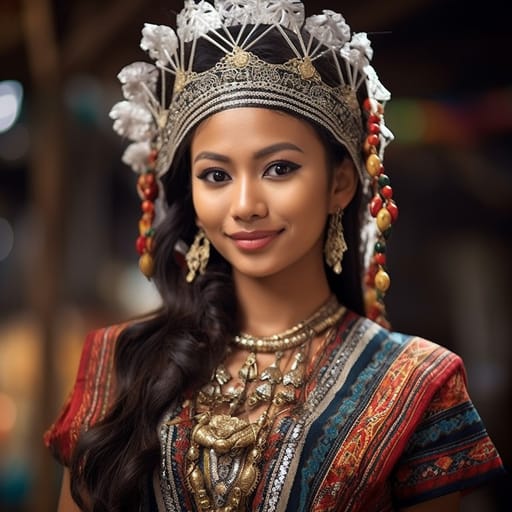



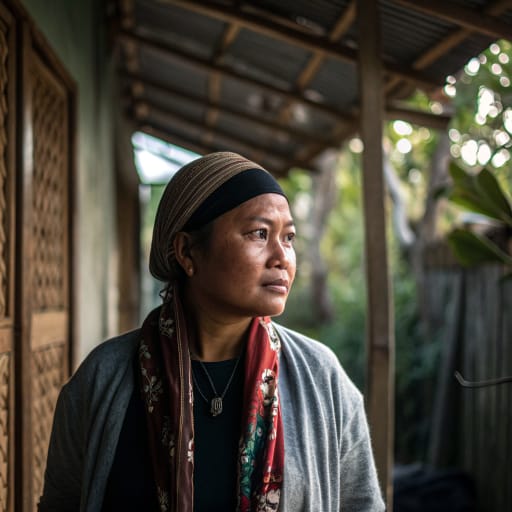
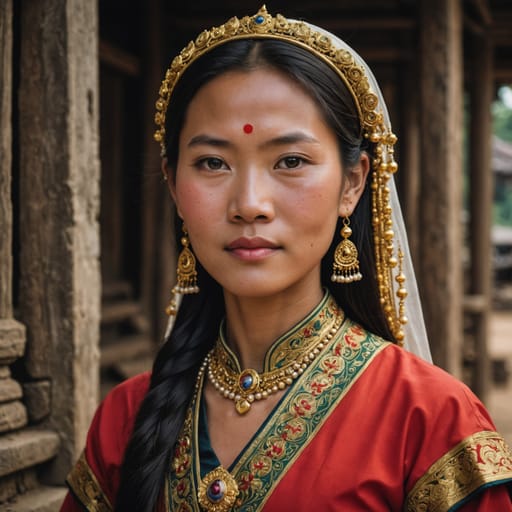

Typical Sedang Phenotypes
Reference for AI generation: hair, eyes, skin, facial structure, build
Sedang Body & Anatomy Reference
Anatomy by feature, Southeast Asian Austronesian / Austroasiatic phenotype
Sedang Boobs & Breasts
Sedang boobs follow the Southeast Asian Austronesian / Austroasiatic profile: small-to-medium cup, modest projection. Areolar diameter is usually 26-38mm, and the coloring is medium-brown to dark-brown areolar pigmentation against the tan-to-medium-brown skin tone. Breast shape tracks body composition (ectomorph, petite frame, mean adult female BMI 20-23), so Sedang breasts tend to be firm, modest projection. Expect a forward-set shape, not the fuller South Asian or Polynesian bust.
Sedang Ass & Hips
Sedang ass and hip morphology presents as small-to-medium, modest projection, narrower hip profile, distinctly different from the fuller glutes of the Pacific Islander phenotype. The Sedang pelvic profile shows narrow-to-medium iliac crests, anchored in the Southeast Asian Austronesian / Austroasiatic skeletal pattern. Sedang butt shots in adult AI imagery should render the small-to-medium, modest projection, narrower hip profile silhouette with the overall build (ectomorph, petite frame) and the fat distribution typical of the Southeast Asian Austronesian / Austroasiatic phenotype.
Sedang Vagina & Pussy
Sedang pussy anatomy typically shows medium-brown to dark-brown labial pigmentation. Pubic hair is usually straight-to-wavy fine-to-medium texture. In AI-generated Sedang nudes, labial color should blend into the tan to medium-brown skin with a gradual transition, and the hair should keep its straight-to-wavy fine-to-medium texture.
Sedang Dicks & Penis
Penis reference for Sedang men: regional mean ~11cm erect, moderate girth. Coloring: medium-brown shaft pigmentation. An accurate Sedang cock in AI imagery matches the surrounding tan to medium-brown skin rather than a generic porn default. Circumcision depends on religion and custom, not ancestry.
Sedang Body, Curves & Build
The Sedang figure is generally ectomorph, petite frame, with mean adult female BMI 20-23, characteristic of Southeast Asian Austronesian / Austroasiatic ancestry. AI image tools tend to flatten regional body types into a few stock shapes; here the Sedang build is kept as its own reference.
Sedang Skin Tone & Hair Texture
Skin: tan to medium-brown (Fitzpatrick III-V). Hair: straight-to-wavy 1A-2A, dark-brown to black. Both are typical of Southeast Asian Austronesian / Austroasiatic ancestry. The most common mistake in AI nudes of Sedang women is a body rendered lighter than the face.
Explore phenotype categories
Structured taxonomy with peer-reviewed scales · 22 anatomical categories
Erotic Poses & Sex Positions
From the pose catalog: 219 named positions with reference skeletons
Frequently asked questions about Sedang people
Where is the Sedang homeland?
The Sedang homeland is Northern Central Highlands of Vietnam: the Kon Tum plateau and Ngọc Linh massif, extending into the mountain districts of Quảng Nam and Quảng Ngãi in Southeast Asia.
What language do Sedang people speak?
Sedang people primarily speak Sedang and the closely related Halang, Todrah, Monom and Kayong (Austroasiatic, North Bahnaric); Vietnamese widely spoken as a second language.
What religion do Sedang people practice?
The predominant religion among Sedang people is Traditional belief in spirits and ancestors; significant Catholic presence, especially around Kon Tum.






Make your own Sedang images
Five a day, free, no credits to buy. The studio starts from this group's phenotype data, so you can set body type, pose and style and keep the traits accurate.
Start with Sedang