Help us get this right
Does this portrait look right for Ngaju?
Nobody has judged this one yet. You would be the first.
Ngaju Erotic
Central Kalimantan (Indonesia)
Kaharingan
Bakumpai, Meratus
About Ngaju People
The Ngaju are the largest Dayak people of Central Kalimantan, settled along the Kapuas, Kahayan, Katingan, and Mentaya rivers that run south out of Borneo's interior toward the Java Sea. The rivers are not just geography for them — they are the organizing logic of village life, trade, funerary procession, and the cosmological map itself. Upstream is associated with the headwaters of life and the upper world; downstream carries the dead. A Ngaju longhouse community traditionally faces the water, and a person's standing in the world has long been measured partly by how their family relates to the river's flow.
Their language belongs to the Barito branch of Malayo-Polynesian, sitting alongside the tongues of neighboring Dayak groups and — distantly but verifiably — Malagasy, the language carried by Barito-speaking sailors to Madagascar more than a thousand years ago. Two of the major sub-groups are the Bakumpai, a largely Muslim river people of the Barito basin who have been mercantile middlemen between the interior and the coast for centuries, and the Meratus, the more dispersed hill-dwelling cousins of southeastern Kalimantan. The Bakumpai's conversion to Islam from the eighteenth century onward gave them a distinct trajectory; the inland Ngaju kept their own religion.
That religion is Kaharingan, a name coined in the twentieth century from a word meaning "life," and now recognized by the Indonesian state under the umbrella of Hinduism for administrative reasons rather than theological ones. Its actual content is its own: a tiered cosmos overseen by a high god, Ranying Hatalla, with a populated upper and lower world and an elaborate ritual life centered on the soul's long journey after death. The defining ceremony is Tiwah, a secondary mortuary rite held months or years after burial, in which the bones of the deceased are exhumed, cleaned, and placed in a carved ossuary called a sandung while the soul is escorted by priests through chanted itineraries to the upper world. Tiwah is communal, expensive, and can run for days; it remains the centerpiece of Kaharingan practice.
Ngaju country has been pressed hard in the last half-century by transmigration policy, oil-palm expansion, peatland fires, and missionary activity, and the picture is uneven — Christian villages, Kaharingan villages, and Muslim Bakumpai towns sit within short boat rides of each other. The river still organizes most of it.
Related ethnic groups
Groups that share Ngaju's homeland, region, language, or religious tradition. These are likely candidates for comparative phenotype reference.
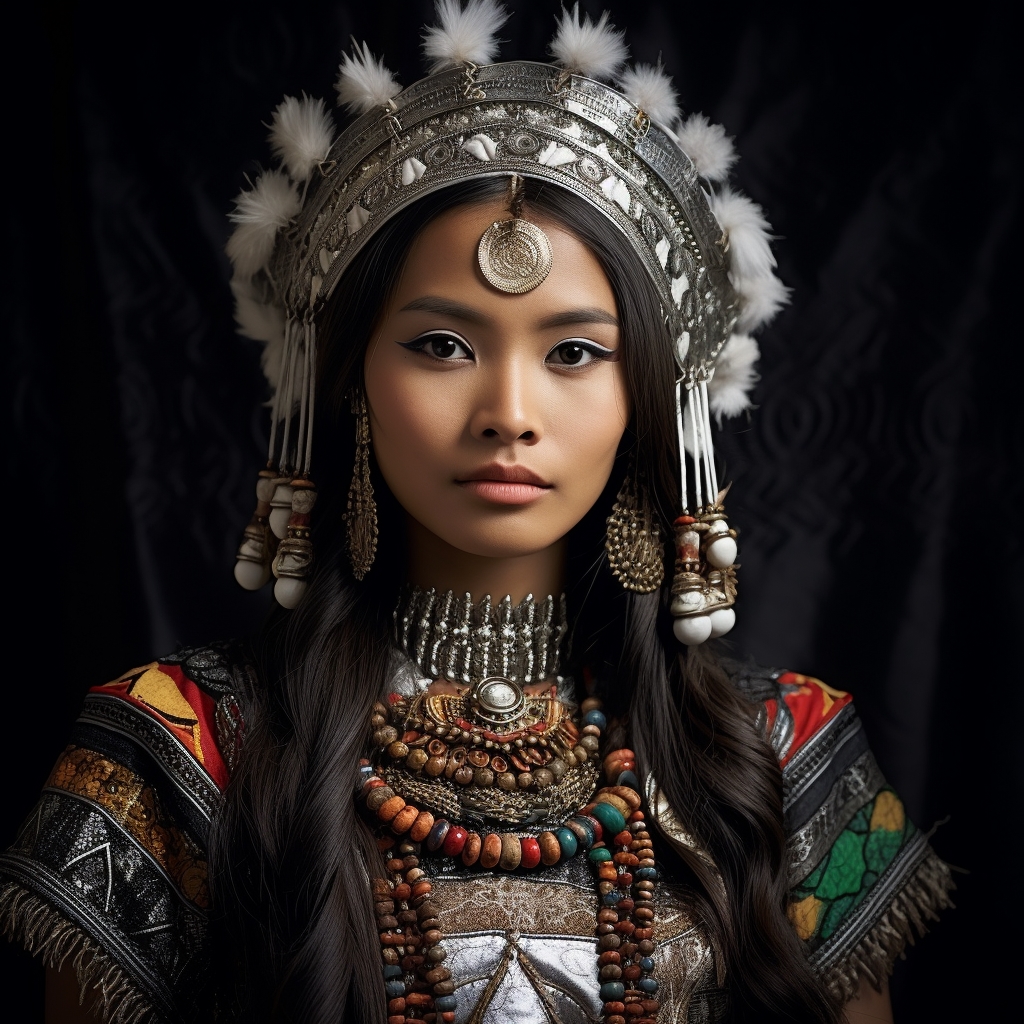
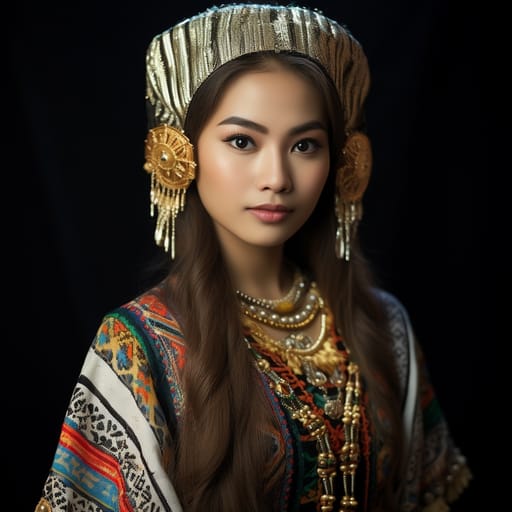
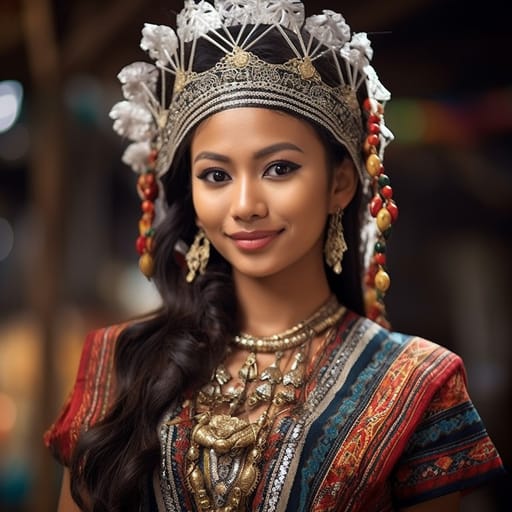
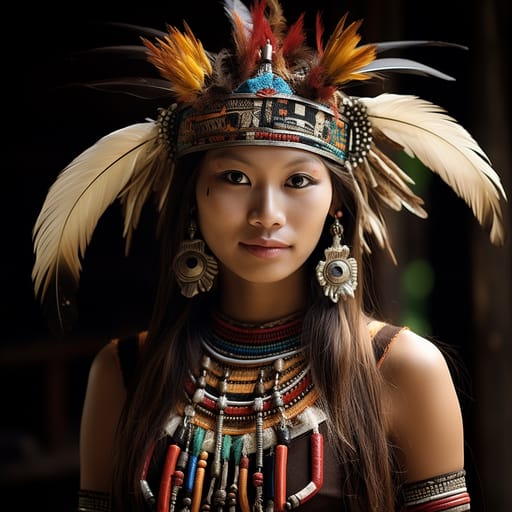
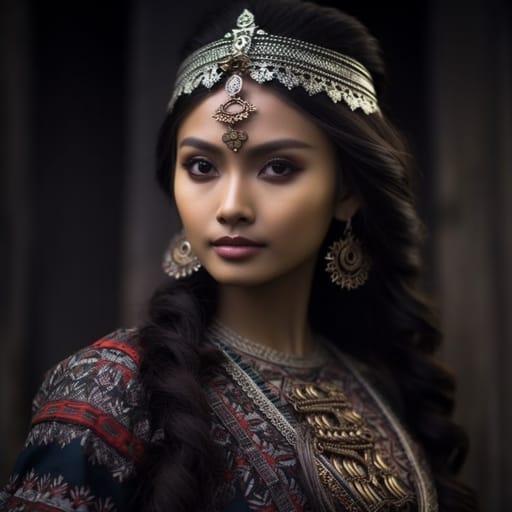
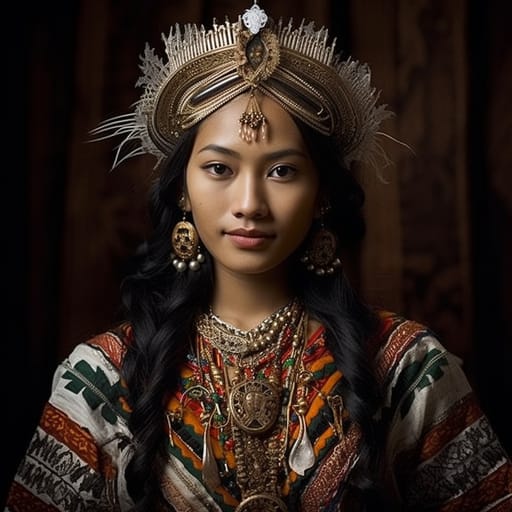
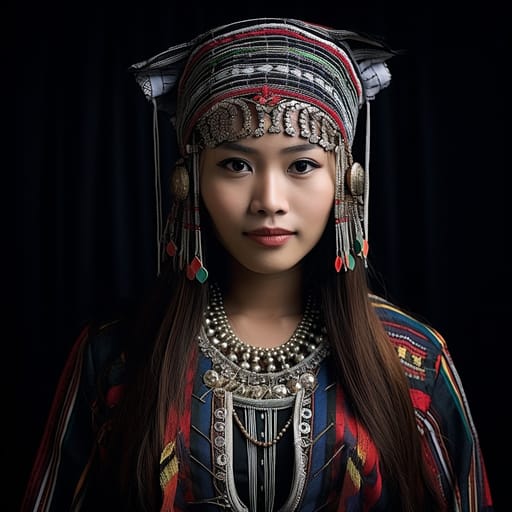
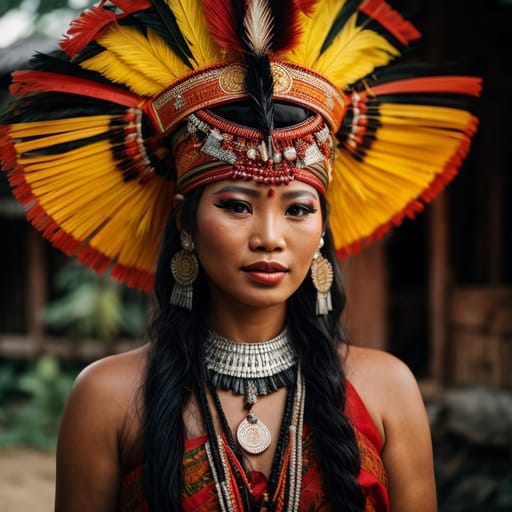
Typical Ngaju Phenotypes
Reference for AI generation: hair, eyes, skin, facial structure, build
The Ngaju are a Dayak people of Central Kalimantan's river basins, and their phenotype reflects long Austronesian settlement in equatorial Borneo with measurable admixture from earlier Australo-Melanesian populations of the interior. Hair is almost universally black or near-black, thick, and coarse in texture — predominantly straight, but a meaningful minority show loose waves or soft curls, more often among Meratus highlanders of the Bukit range than among lowland riverine Ngaju and Bakumpai. Greying tends to come late.
Eyes are dark brown to near-black. The epicanthic fold is present in most individuals but is generally lighter and less pronounced than in northern East Asian populations — many Ngaju show only a partial fold or a soft inner crease, and a sizeable share have an open, almond-shaped eye with a visible upper lid. Brows are moderate, not heavy.
Skin sits in the Fitzpatrick III–V band, with warm golden-brown to deep coppery-brown undertones. Riverine Bakumpai, more exposed to sun and water reflection, tend to read darker and more reddish; Meratus skin tones span a wider range, with some highland individuals noticeably lighter. True pallor is uncommon; ashen or olive undertones are rare.
Facial structure is the most distinctive register. Cheekbones are broad and high but softly modeled rather than sharp. Noses are short to medium, with a low-to-moderate bridge and moderately wide alae — wider and flatter than typical Javanese or Malay noses, narrower than Papuan. Lips are medium-full, often with a well-defined cupid's bow. Jaws are squared but not heavy; the overall face shape trends round-to-oval.
Build is compact and wiry. Average male stature runs roughly 160–168 cm and female 150–158 cm, with low body fat, narrow hips, and proportionally long torsos relative to limb length — a body composition shaped by generations of riverine and forest labor. The Meratus subgroup, more isolated in the Bukit highlands, shows the clearest phenotype drift: slightly wavier hair, occasional lighter skin, and a higher incidence of deeper-set eyes.
Ngaju Body & Anatomy Reference
Per-feature anatomical profile for AI nude generation: Southeast Asian Austronesian / Austroasiatic phenotype
Ngaju Boobs & Breasts
Bust reference for Ngaju women: small-to-medium cup, modest projection, which is typical of Southeast Asian Austronesian / Austroasiatic ancestry. Areolas measure about 26-38mm across, with medium-brown to dark-brown pigmentation. Body type (ectomorph, petite frame) shapes the bust as well, so Ngaju tits are usually firm, modest projection. In AI imagery, keep the forward-set shape rather than drifting toward the fuller South Asian or Polynesian bust.
Ngaju Ass & Hips
The Ngaju ass is typically small-to-medium, modest projection, narrower hip profile, which sets it apart from the fuller glutes of the Pacific Islander phenotype. Underneath, the pelvis shows narrow-to-medium iliac crests, part of the Southeast Asian Austronesian / Austroasiatic skeletal pattern. For Ngaju butt pics and AI renders, match that silhouette and the overall build (ectomorph, petite frame).
Ngaju Vagina & Pussy
Ngaju pussy and vulvar anatomy presents medium-brown to dark-brown labial pigmentation, consistent with the Southeast Asian Austronesian / Austroasiatic phenotype's pigmentation pattern. Ngaju pubic hair is typically straight-to-wavy fine-to-medium texture, in the inverted-triangle pattern. For anatomically accurate Ngaju pussy renders the labial coloration should match the surrounding tan to medium-brown skin tone with a continuous gradient, and the hair should keep its straight-to-wavy fine-to-medium texture.
Ngaju Dicks & Penis
Ngaju dicks follow the Southeast Asian Austronesian / Austroasiatic reference data: regional mean ~11cm erect; moderate girth; medium-brown shaft pigmentation. Shaft color should track the tan to medium-brown skin tone with a smooth change toward the glans, and Ngaju pubic hair keeps its straight-to-wavy fine-to-medium texture.
Ngaju Body, Curves & Build
Ngaju body type and overall build presents as ectomorph, petite frame, with mean adult female BMI 20-23: the characteristic Southeast Asian Austronesian / Austroasiatic habitus. Ngaju curves and proportions should keep the regional skeletal frame (height, shoulder-to-hip ratio, limb proportions) rather than a generic mesomorph default.
Ngaju Skin Tone & Hair Texture
Ngaju skin sits in the tan to medium-brown (Fitzpatrick III-V) band. Hair is typically straight-to-wavy 1A-2A, dark-brown to black, in keeping with the Southeast Asian Austronesian / Austroasiatic phenotype. In nude renders the skin should stay one even tone from face to body, and body, pubic and head hair should match.
Data depth
16/100Coverage of image-grounded phenotype observations · drives AI generation diversity
- Sample size
- 6/40· 2 images
- Image quality
- 0/30· 0% high
- Confidence
- 10/20· mean 0.58
- Source diversity
- 0/10· wikipedia
- ·No image observations yet
- ·Wikipedia-only source, not population-representative
Explore phenotype categories
Structured taxonomy with peer-reviewed scales · 22 anatomical categories
Notable Ngaju People
2 reference figures, sourced from Wikipedia
- Hausman Baboe, a prominent figure in the Central Kalimantan press and founder of the first d…
- Tjilik Riwut, a National Hero of Indonesia, founder of Central Kalimantan, a writer, a Cent…
Erotic Poses & Sex Positions
From the pose catalog: 219 named positions with reference skeletons
Frequently asked questions about Ngaju people
Where is the Ngaju homeland?
The Ngaju homeland is Central Kalimantan (Indonesia) in Southeast Asia.
What language do Ngaju people speak?
Ngaju people primarily speak Austronesian / Malayo-Polynesian / Barito / Ngaju.
What religion do Ngaju people practice?
The predominant religion among Ngaju people is Kaharingan.






Make your own Ngaju images
Five a day, free, no credits to buy. The studio starts from this group's phenotype data, so you can set body type, pose and style and keep the traits accurate.
Start with Ngaju