No portrait yet
Nunivak Cup'ig Erotic
Nunivak Island in the Bering Sea, off the Yukon-Kuskokwim Delta of southwest Alaska, United States; the one permanent village today is Mekoryuk.
Cup'ig, the Nunivak dialect of Central Alaskan Yup'ik (Yupik branch, Eskimo-Aleut family); English is now the everyday language for most.
Christian, mainly Evangelical Covenant Church; before the 1930s, a shamanic tradition centered on animal spirits and seasonal ceremonies such as the Bladder Festival.
An island branch of the Central Alaskan Yup'ik, part of the wider Yupik peoples of Alaska and Siberia; self-name Nuniwarmiut. Distinct from the Cup'ik of Chevak on the mainland.
About Nunivak Cup'ig People
The Nunivak Cup'ig are the people of a single island. Nunivak sits in the Bering Sea about thirty miles off the Yukon-Kuskokwim Delta of southwest Alaska, across Etolin Strait, and its people call themselves Nuniwarmiut, the people of Nunivak. They are kin to the mainland Yup'ik, but the water made a difference. Their speech, Cup'ig, is the most divergent form of Central Alaskan Yup'ik, far enough from the mainland dialects that some linguists treat it as a language of its own. The initial c sounds like English ch. Fluent speakers today are mostly elders, and the school in Mekoryuk, the island's one remaining year-round village, teaches Cup'ig to children who grow up in English.
Shoals around the island kept trading ships at a distance for much of the nineteenth century, so Nunivak held on to older ways well after the mainland coast had changed. Russian expeditions reached it in 1821, yet Edward Curtis, arriving with a camera in 1927, still found people wearing labrets, families in sod houses, and a winter ceremonial cycle still running, including the Bladder Festival, which returned the souls of hunted seals to the sea. The anthropologist Margaret Lantis recorded that world in 1939 and 1940, just as it was closing. Epidemics, beginning with the great sickness of 1900, had already emptied many of the island's villages. A Covenant missionary who arrived in the 1930s brought the old ceremonies to an end within a few years, and the Evangelical Covenant Church remains the center of community life. Mekoryuk is also dry: alcohol is banned by local law.
About two hundred people live in Mekoryuk now. The economy mixes subsistence and cash: seal, walrus, halibut, salmon, seabirds and their eggs from the cliffs, berries and greens from the tundra, along with commercial halibut fishing and a reindeer herd introduced in 1920. Musk oxen brought from Greenland were released on the island in the 1930s, and the Nunivak herd later supplied animals to restock other parts of Alaska. Women knit the underwool, qiviut, into scarves and caps for a statewide cooperative, and Mekoryuk's signature pattern is drawn from an old ivory harpoon head. Collectors know the island for its wide, sturdy kayaks, painted wooden masks and carved walrus ivory. A local heritage program, Nuniwarmiut Piciryarata Tamaryalkuti, documents the language and the island's place names, and the Cup'ig dictionary published in 2003 was compiled by islanders themselves.
Related ethnic groups
Groups that share Nunivak Cup'ig's homeland, region, language, or religious tradition. These are likely candidates for comparative phenotype reference.
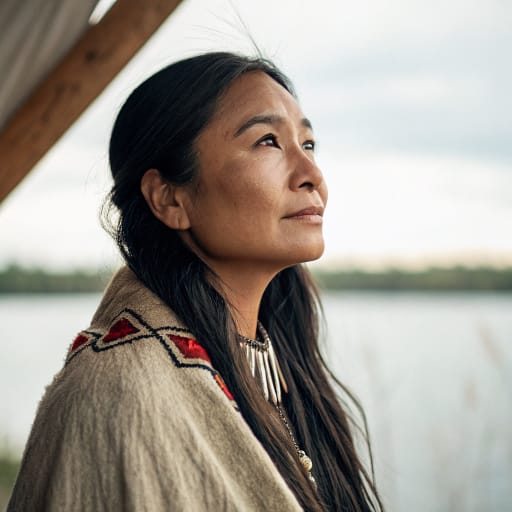
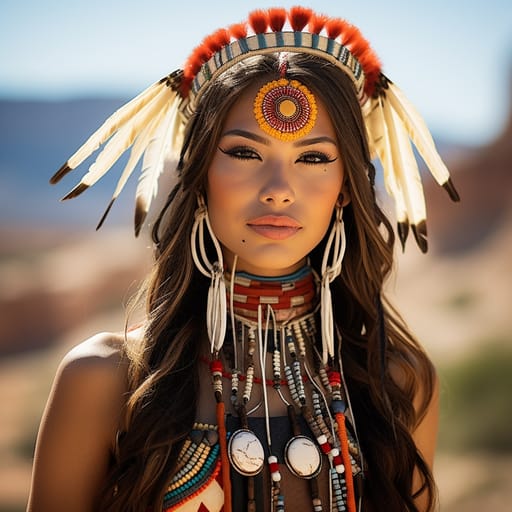
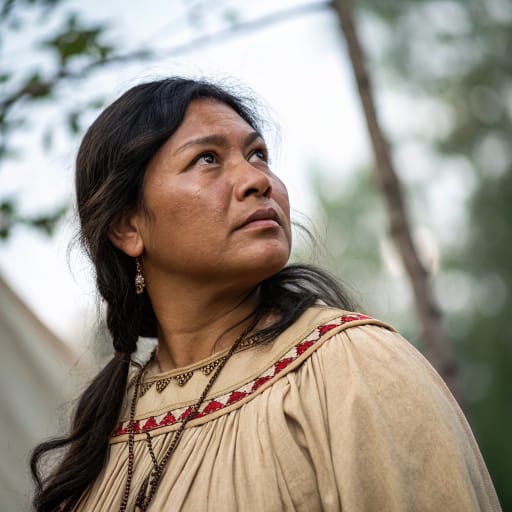
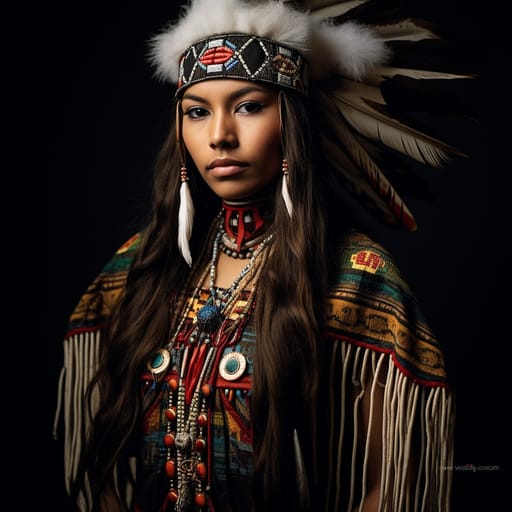
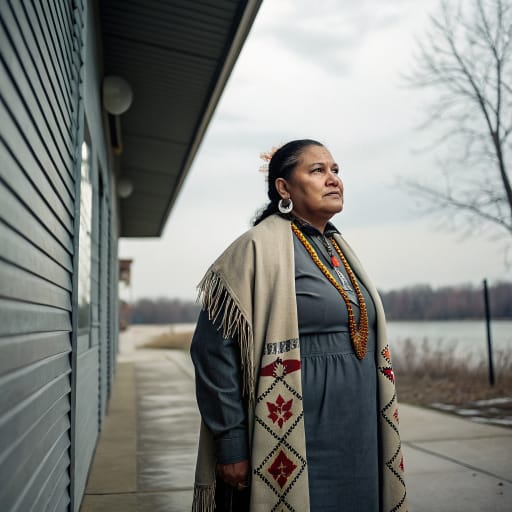
Typical Nunivak Cup'ig Phenotypes
Reference for AI generation: hair, eyes, skin, facial structure, build
Nunivak Cup'ig Body & Anatomy Reference
Anatomy by feature, Indigenous Northern American / Algonquian-Iroquoian phenotype
Nunivak Cup'ig Boobs & Breasts
The typical Nunivak Cup'ig bust is medium cup, moderate projection, in line with the wider Indigenous Northern American / Algonquian-Iroquoian pattern. Areolas usually fall in the 30-44mm range, with medium-brown areolar pigmentation against the copper-to-medium-brown skin tone. Compared with the smaller East Asian bust, Nunivak Cup'ig breasts sit forward and are generally full and moderate projection. A faithful AI render of Nunivak Cup'ig tits keeps that shape and areola size.
Nunivak Cup'ig Ass & Hips
Butt shape among Nunivak Cup'ig women: medium, moderate-to-full projection, over medium iliac crests. This follows Indigenous Northern American / Algonquian-Iroquoian ancestry and looks quite unlike the slim East Asian narrow-hip profile. An accurate Nunivak Cup'ig ass in adult AI imagery keeps both the silhouette and the overall build (mesomorph, broader frame in northern Indigenous populations) instead of a generic average.
Nunivak Cup'ig Vagina & Pussy
Vulvar anatomy among Nunivak Cup'ig women: medium-brown labial pigmentation. Pubic hair tends to be straight medium-coarse texture, in the usual inverted-triangle pattern. Both follow Indigenous Northern American / Algonquian-Iroquoian pigmentation, which is why Nunivak Cup'ig pussy renders should not fall back on a pale, sparse Western template.
Nunivak Cup'ig Dicks & Penis
The Nunivak Cup'ig cock profile, from Indigenous Northern American / Algonquian-Iroquoian anthropometric data: regional mean ~13cm erect; moderate girth; medium-brown shaft pigmentation. Pubic hair has a straight medium-coarse texture and forms the usual inverted-V pattern. Whether Nunivak Cup'ig men are circumcised follows religious and cultural practice rather than phenotype.
Nunivak Cup'ig Body, Curves & Build
Build and curves among Nunivak Cup'ig women follow the Indigenous Northern American / Algonquian-Iroquoian pattern: mesomorph, broader frame in northern Indigenous populations, mean adult female BMI 25-28. Proportions matter as much as skin tone, so Nunivak Cup'ig figures should keep their regional height and limb ratios.
Nunivak Cup'ig Skin Tone & Hair Texture
The Nunivak Cup'ig skin range is copper to medium-brown (Fitzpatrick III-V), and hair tends to be straight 1A, dark-brown to black, often thick and dense. That combination marks the Indigenous Northern American / Algonquian-Iroquoian phenotype, and skin tone is the trait AI generators most often get wrong for Nunivak Cup'ig women.
Explore phenotype categories
Structured taxonomy with peer-reviewed scales · 22 anatomical categories
Erotic Poses & Sex Positions
From the pose catalog: 219 named positions with reference skeletons
Frequently asked questions about Nunivak Cup'ig people
Where is the Nunivak Cup'ig homeland?
The Nunivak Cup'ig homeland is Nunivak Island in the Bering Sea, off the Yukon-Kuskokwim Delta of southwest Alaska, United States; the one permanent village today is Mekoryuk. in North America.
What language do Nunivak Cup'ig people speak?
Nunivak Cup'ig people primarily speak Cup'ig, the Nunivak dialect of Central Alaskan Yup'ik (Yupik branch, Eskimo-Aleut family); English is now the everyday language for most..
What religion do Nunivak Cup'ig people practice?
The predominant religion among Nunivak Cup'ig people is Christian, mainly Evangelical Covenant Church; before the 1930s, a shamanic tradition centered on animal spirits and seasonal ceremonies such as the Bladder Festival..






Make your own Nunivak Cup'ig images
Five a day, free, no credits to buy. The studio starts from this group's phenotype data, so you can set body type, pose and style and keep the traits accurate.
Start with Nunivak Cup'ig