No portrait yet
Ndaka Erotic
Mambasa Territory, Ituri Province, northeastern Democratic Republic of the Congo: roadside villages around Nia-Nia and toward Epulu, inside the Ituri rainforest.
Ndaka (Bantu, Niger-Congo), closely related to Mbo, Budu, Nyali and Vanuma; Congo Swahili as the regional lingua franca, French in school and administration.
Mostly Christian, with ancestor veneration and traditional healing persisting alongside.
Part of the Budu-Ndaka cluster of northeastern Bantu peoples, with the Mbo, Budu, Nyali and Vanuma; one of the Ituri forest farming peoples tied by long-standing exchange to Mbuti foragers.
About Ndaka People
The Ndaka are forest farmers of the central Ituri, in the northeast of the Democratic Republic of the Congo, and they are best understood through two relationships: the one with their linguistic cousins and the one with the Mbuti. Their villages sit in Mambasa Territory of Ituri Province, around Nia-Nia and along the road that runs east through the rainforest toward Epulu, where the Bandaka chiefdom carries their name. The figure usually quoted is about 25,000 people, from a 1990s language survey nobody has properly updated.
Their language, Ndaka, is Bantu and belongs to a tight cluster with Budu, Mbo, Nyali and Vanuma. The kinship is close enough that speakers recognize it, and the five groups tell of having once been a single people. This matters because the Ituri is a linguistic frontier: Bantu farmers like the Ndaka and Bila live beside Central Sudanic speakers such as the Lese and Mamvu. For talking across those lines, and for the market, people use Congo Swahili, with French kept for school and officialdom.
Daily life runs on shifting cultivation: plots of cassava, plantain, rice and peanuts cut from the forest, farmed for a few years, then left to grow back, with oil palm, fishing and trapping filling the gaps. Around this sits the old exchange with Mbuti net hunters, whose bands attach themselves to particular Ndaka families across generations. Forest meat, honey and field labor go one way; farm food, iron, cloth and tobacco go the other. Villagers have tended to describe the arrangement as ownership, the Mbuti as something far looser, and Colin Turnbull, who worked around Epulu in the 1950s among Mbuti tied to Bira and Ndaka villages, built much of his writing on that gap. The two sides also share ritual, notably the nkumbi, the boys' circumcision initiation that village and forest youths go through together.
The last century and a half has been rough. Zanzibari ivory and slave raiders reached the Ituri in the late 1800s, followed by the rubber and ivory demands of the Congo Free State. Belgian administrators then pulled scattered forest hamlets out to the new roads, where people could be counted, taxed and made to grow cash crops. That roadside pattern is still the shape of Ndaka country. Since the 1990s the pressures have been war, artisanal gold digging, incoming traders and farmers from the Kivu highlands, and the Okapi Wildlife Reserve, created in 1992, which restricts hunting and clearing on land the Ndaka consider theirs. Most Ndaka today are Christian, while ancestors, healers and the suspicion of witchcraft remain live parts of how misfortune gets explained.
Related ethnic groups
Groups that share Ndaka's homeland, region, language, or religious tradition. These are likely candidates for comparative phenotype reference.
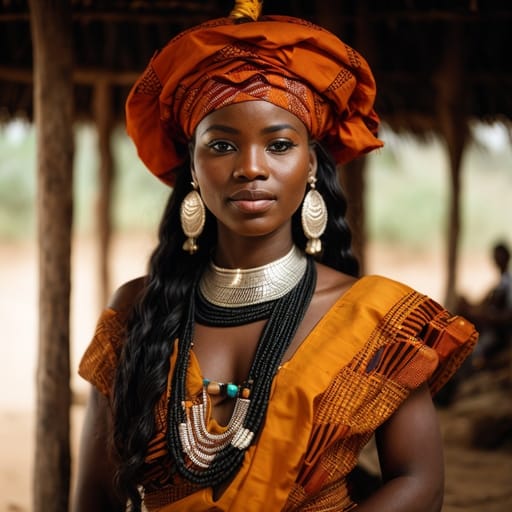
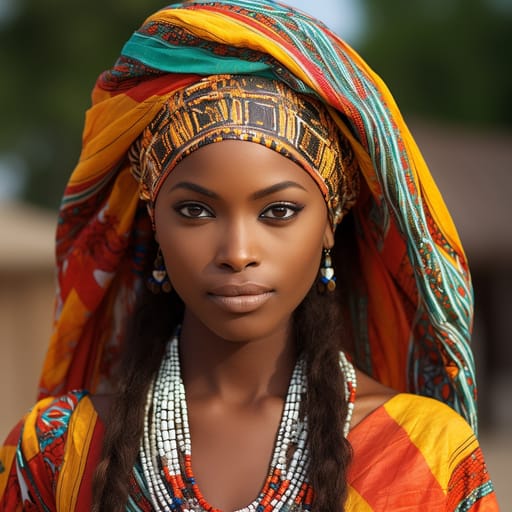
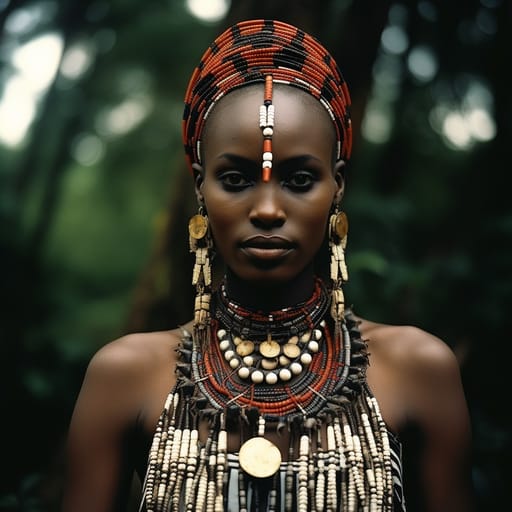
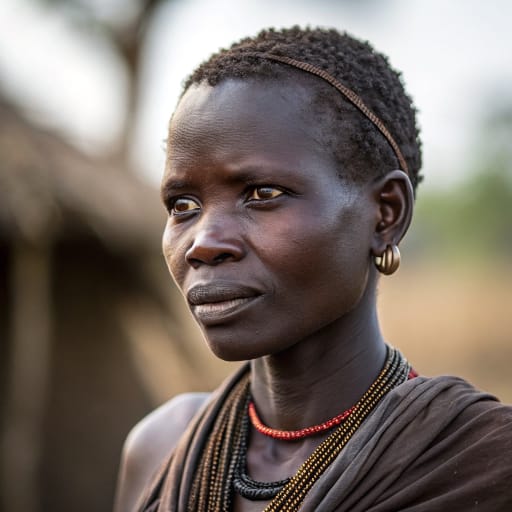
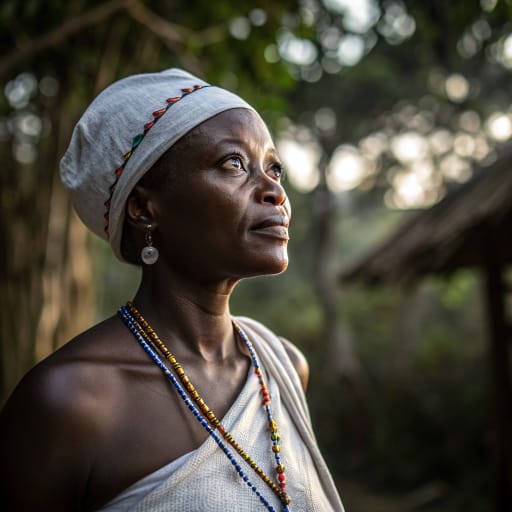
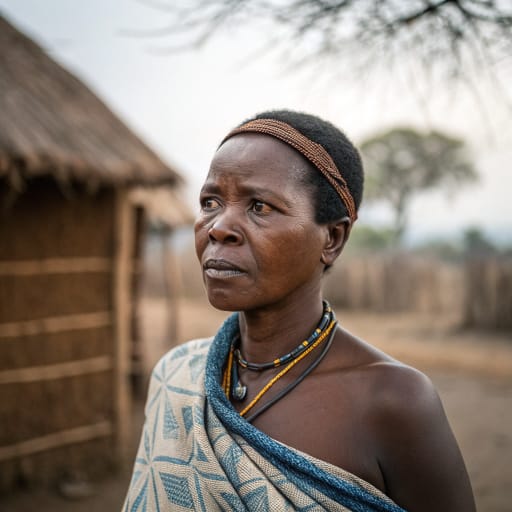
Typical Ndaka Phenotypes
Reference for AI generation: hair, eyes, skin, facial structure, build
Ndaka Body & Anatomy Reference
Per-feature anatomical profile for AI nude generation: Bantu / Central African Niger-Congo phenotype
Ndaka Boobs & Breasts
The typical Ndaka bust is medium-to-large cup, full, projecting, in line with the wider Bantu / Central African Niger-Congo pattern. Areolas usually fall in the 32-48mm range, with deep-brown areolar pigmentation against the deep-brown skin tone. Compared with the smaller East African conical profile, Ndaka breasts sit forward and are generally fuller projection than East African; comparable to West African norm. A faithful AI render of Ndaka tits keeps that shape and areola size.
Ndaka Ass & Hips
Butt shape among Ndaka women: full, projected, wide-set glutes, over broad iliac crests, gynoid pelvic pattern. This follows Bantu / Central African Niger-Congo ancestry and looks quite unlike the slim narrow-hip Cushitic East African profile. An accurate Ndaka ass in adult AI imagery keeps both the silhouette and the overall build (mesomorph with strong gluteal-femoral fat deposition) instead of a generic average.
Ndaka Vagina & Pussy
Vulvar anatomy among Ndaka women: deep-brown labial pigmentation, fuller labia minora. Pubic hair tends to be tightly-coiled coarse texture, dense distribution, in the usual inverted-triangle pattern. Both follow Bantu / Central African Niger-Congo pigmentation, which is why Ndaka pussy renders should not fall back on a pale, sparse Western template.
Ndaka Dicks & Penis
The Ndaka cock profile, from Bantu / Central African Niger-Congo anthropometric data: regional mean ~14cm erect; above-average girth; deep-brown shaft pigmentation. Pubic hair has a tightly-coiled coarse texture and forms the usual inverted-V pattern. Whether Ndaka men are circumcised follows religious and cultural practice rather than phenotype.
Ndaka Body, Curves & Build
Build and curves among Ndaka women follow the Bantu / Central African Niger-Congo pattern: mesomorph with strong gluteal-femoral fat deposition, mean adult female BMI 23-26. Proportions matter as much as skin tone, so Ndaka figures should keep their regional height and limb ratios.
Ndaka Skin Tone & Hair Texture
The Ndaka skin range is deep-brown (Fitzpatrick VI), and hair tends to be tight 4A-4C coil. That combination marks the Bantu / Central African Niger-Congo phenotype, and skin tone is the trait AI generators most often get wrong for Ndaka women.
Explore phenotype categories
Structured taxonomy with peer-reviewed scales · 22 anatomical categories
Erotic Poses & Sex Positions
From the pose catalog: 219 named positions with reference skeletons
Frequently asked questions about Ndaka people
Where is the Ndaka homeland?
The Ndaka homeland is Mambasa Territory, Ituri Province, northeastern Democratic Republic of the Congo: roadside villages around Nia-Nia and toward Epulu, inside the Ituri rainforest. in Central Africa.
What language do Ndaka people speak?
Ndaka people primarily speak Ndaka (Bantu, Niger-Congo), closely related to Mbo, Budu, Nyali and Vanuma; Congo Swahili as the regional lingua franca, French in school and administration..
What religion do Ndaka people practice?
The predominant religion among Ndaka people is Mostly Christian, with ancestor veneration and traditional healing persisting alongside..






Make your own Ndaka images
Five a day, free, no credits to buy. The studio starts from this group's phenotype data, so you can set body type, pose and style and keep the traits accurate.
Start with Ndaka