Help us get this right
Does this portrait look right for Lamba?
Nobody has judged this one yet. You would be the first.
Lamba Erotic
Copperbelt Province of Zambia, especially the rural areas around Ndola, Kitwe, Luanshya, Masaiti, Mpongwe and Lufwanyama, and adjacent southern Haut-Katanga, Democratic Republic of the Congo
Chilamba, including the Lima dialect (Bantu, Niger-Congo; Bisa-Lamba group, related to Lala and Bemba); Bemba and English widely spoken
Mainly Christian (Catholic, Protestant and Pentecostal), with lasting belief in Lesa as creator and in ancestral spirits
Bantu people of the Bisa-Lamba cluster, related to the Lala, Swaka and Seba; includes the Lima; organized in matrilineal clans under chiefs such as Mushili and Nkana
About Lamba People
The Lamba are the people whose land became the Copperbelt. Before Ndola, Kitwe and Luanshya were mining towns, the miombo woodland between the upper Kafue River and the Congo border was Lamba country: villages scattered across a flat plateau, each under a hereditary chief. Outside the towns, much of it still is. Their homeland runs across Zambia's Copperbelt Province and into the southern tip of Haut-Katanga in the Democratic Republic of the Congo. A colonial boundary fixed in the 1890s cuts it in two.
Their language, Chilamba, is a Bantu language grouped with Lala, Swaka and Seba and closely related to Bemba. That closeness to Bemba shaped modern Lamba history in an awkward way. When large-scale copper mining took off in the late 1920s, the mines recruited labor from across Northern Rhodesia, especially Bemba speakers from the northeast, and Bemba became the everyday language of the new towns. Many Lamba stayed on the land. They grew food and sold it to the mining compounds instead of going underground, and the newcomers who now outnumbered them called them lazy and backward. Mining concessions and townships took large parts of their territory, and land has been a sore point ever since.
Lamba society is matrilineal. People take their clan from their mother, and a chief's title has traditionally passed to his sister's son, not his own children. Senior Chief Mushili and Chief Nkana are among the best-known titles, and the Nkana mine at Kitwe carries the second name. Village farming grew out of chitemene, the regional practice of lopping woodland branches, burning them and sowing finger millet in the ash. Cassava and maize are now common alongside it.
Christianity arrived early. Baptist missionaries set up at Kafulafuta in the early twentieth century, and one of them, Clement Doke, became a leading scholar of Bantu languages. He wrote on Lamba grammar and pronunciation and collected Lamba folktales, riddles and proverbs, so Chilamba got unusually close attention for its time. Most Lamba today belong to Catholic, Protestant or Pentecostal churches. For many, older ideas sit alongside church life rather than against it: Lesa as the distant creator, ancestral spirits who expect to be remembered, and a suspicion that unexplained misfortune may have a human hand behind it.
Related ethnic groups
Groups that share Lamba's homeland, region, language, or religious tradition. These are likely candidates for comparative phenotype reference.
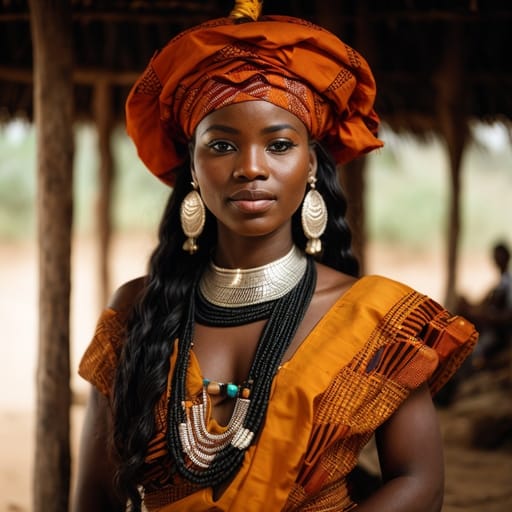
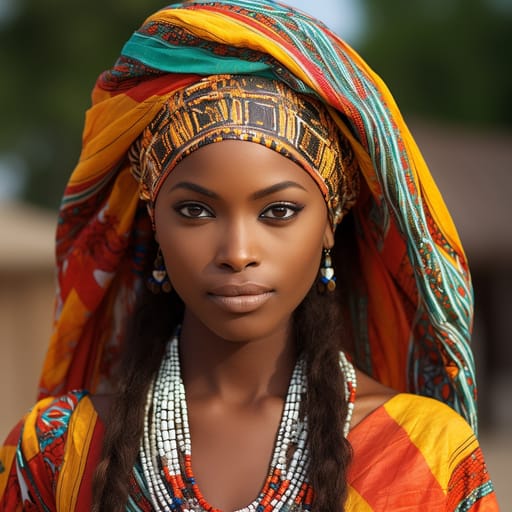
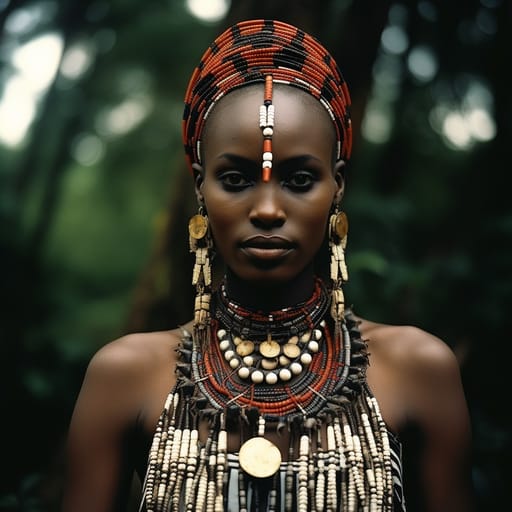
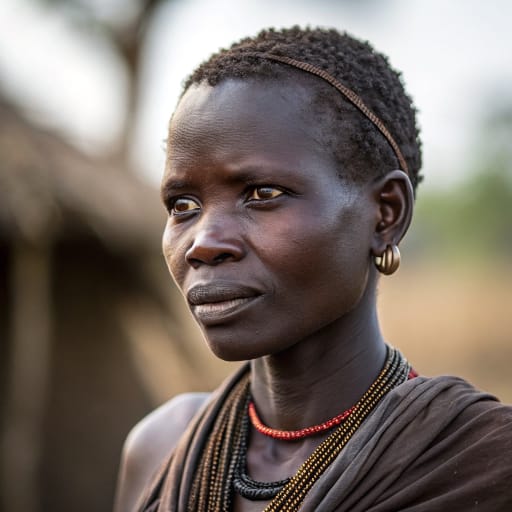
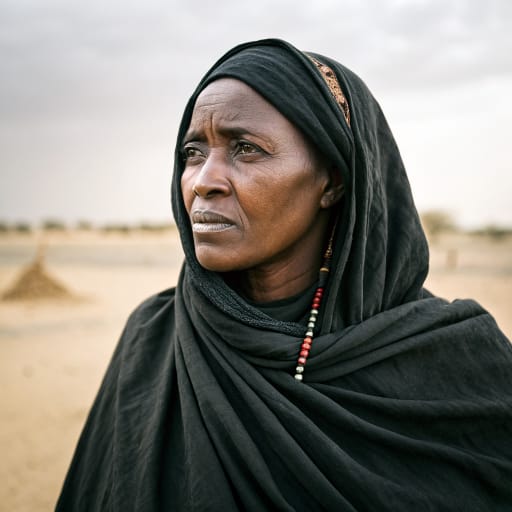
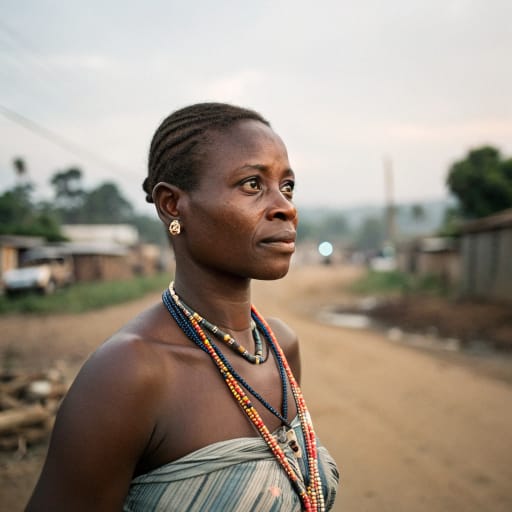
Typical Lamba Phenotypes
Reference for AI generation: hair, eyes, skin, facial structure, build
Lamba Body & Anatomy Reference
Anatomy by feature, Bantu / Central African Niger-Congo phenotype
Lamba Boobs & Breasts
Bust reference for Lamba women: medium-to-large cup, full, projecting, which is typical of Bantu / Central African Niger-Congo ancestry. Areolas measure about 32-48mm across, with deep-brown pigmentation. Body type (mesomorph with strong gluteal-femoral fat deposition) shapes the bust as well, so Lamba tits are usually fuller projection than East African; comparable to West African norm. In AI imagery, keep the forward-set shape rather than drifting toward the smaller East African conical profile.
Lamba Ass & Hips
The Lamba ass is typically full, projected, wide-set glutes, which sets it apart from the slim narrow-hip Cushitic East African profile. Underneath, the pelvis shows broad iliac crests, gynoid pelvic pattern, part of the Bantu / Central African Niger-Congo skeletal pattern. For Lamba butt pics and AI renders, match that silhouette and the overall build (mesomorph with strong gluteal-femoral fat deposition).
Lamba Vagina & Pussy
Lamba pussy and vulvar anatomy presents deep-brown labial pigmentation, fuller labia minora, consistent with the Bantu / Central African Niger-Congo phenotype's pigmentation pattern. Lamba pubic hair is typically tightly-coiled coarse texture, dense distribution, in the inverted-triangle pattern. For anatomically accurate Lamba pussy renders the labial coloration should match the surrounding deep-brown skin tone with a continuous gradient, and the hair should keep its tightly-coiled coarse texture.
Lamba Dicks & Penis
Lamba dicks follow the Bantu / Central African Niger-Congo reference data: regional mean ~14cm erect; above-average girth; deep-brown shaft pigmentation. Shaft color should track the deep-brown skin tone with a smooth change toward the glans, and Lamba pubic hair keeps its tightly-coiled coarse texture.
Lamba Body, Curves & Build
Lamba body type and overall build presents as mesomorph with strong gluteal-femoral fat deposition, with mean adult female BMI 23-26: the characteristic Bantu / Central African Niger-Congo habitus. Lamba curves and proportions should keep the regional skeletal frame (height, shoulder-to-hip ratio, limb proportions) rather than a generic mesomorph default.
Lamba Skin Tone & Hair Texture
Lamba skin sits in the deep-brown (Fitzpatrick VI) band. Hair is typically tight 4A-4C coil, in keeping with the Bantu / Central African Niger-Congo phenotype. In nude renders the skin should stay one even tone from face to body, and body, pubic and head hair should match.
Explore phenotype categories
Structured taxonomy with peer-reviewed scales · 22 anatomical categories
Erotic Poses & Sex Positions
From the pose catalog: 219 named positions with reference skeletons
Frequently asked questions about Lamba people
Where is the Lamba homeland?
The Lamba homeland is Copperbelt Province of Zambia, especially the rural areas around Ndola, Kitwe, Luanshya, Masaiti, Mpongwe and Lufwanyama, and adjacent southern Haut-Katanga, Democratic Republic of the Congo in Central Africa.
What language do Lamba people speak?
Lamba people primarily speak Chilamba, including the Lima dialect (Bantu, Niger-Congo; Bisa-Lamba group, related to Lala and Bemba); Bemba and English widely spoken.
What religion do Lamba people practice?
The predominant religion among Lamba people is Mainly Christian (Catholic, Protestant and Pentecostal), with lasting belief in Lesa as creator and in ancestral spirits.






Make your own Lamba images
Five a day, free, no credits to buy. The studio starts from this group's phenotype data, so you can set body type, pose and style and keep the traits accurate.
Start with Lamba