No portrait yet
Nacogdoche Erotic
East Texas, around present-day Nacogdoches in the Angelina River drainage, United States; descendants live mainly in Oklahoma.
Caddo, Hasinai dialect (Caddoan); descendants today mostly speak English
Traditional Hasinai religion built around a supreme being, a high priest (xinesi) and a perpetual temple fire; limited Spanish Catholic mission influence after 1716.
One of the tribes of the Hasinai confederacy of the Caddo, alongside the Hainai, Nabedache, Nasoni and Neche; descendants are enrolled in the Caddo Nation of Oklahoma.
About Nacogdoche People
The Nacogdoche were a Caddo people of the Hasinai confederacy who farmed the pine and hardwood country of East Texas, around the site of the present city of Nacogdoches, from well before Spanish contact until the early nineteenth century, when disease and displacement folded them into neighboring Caddo groups. Their descendants are citizens of the Caddo Nation of Oklahoma. They were never a large group, but they sat toward the eastern edge of the Hasinai world, on the trail that ran between the Spanish in Texas and the French at Natchitoches, and that position shaped nearly everything that happened to them.
Like other Hasinai, the Nacogdoche lived in scattered farmsteads rather than packed villages: tall, beehive-shaped houses of pole and grass thatch set among fields of corn, beans, squash and sunflowers. They spoke a Hasinai dialect of Caddo, the southern branch of the Caddoan family, distantly related to Wichita, Pawnee and Arikara out on the plains. Community affairs ran through a hereditary headman, the caddi, while the Hasinai as a whole looked to a high priest, the xinesi, who kept a perpetual fire in a temple and spoke with the supreme being on the people's behalf. An earthen mound that survives inside the modern city shows that Caddo ancestors were building ceremonial centers on that ground centuries before any European arrived.
In 1716 Spanish Franciscans founded Mission Nuestra Señora de Guadalupe among them, less to win converts, of which there were few, than to plant a flag against French Louisiana. The Nacogdoche took the gifts, kept their own religion, and went on trading with the French. The mission was abandoned briefly in 1719, restored in 1721, and closed for good in 1773, when Spain pulled out of East Texas. Settlers led by Antonio Gil Y'Barbo returned in 1779 and built the town of Nacogdoches on the old mission site. By then epidemics had done their work. The survivors drifted north and merged with other Hasinai, and the remaining Texas Caddo were pushed onto the Brazos Reserve in the 1850s, then marched to Indian Territory in 1859.
Their name outlived them as a separate people. It sits on a county and on a city that bills itself as the oldest town in Texas, and the word Texas itself comes from taysha, the Hasinai word for friend or ally. The living inheritance is in Oklahoma, where Caddo people still sing the Turkey Dance, whose songs carry tribal history, and keep the Hasinai name in use.
Related ethnic groups
Groups that share Nacogdoche's homeland, region, language, or religious tradition. These are likely candidates for comparative phenotype reference.
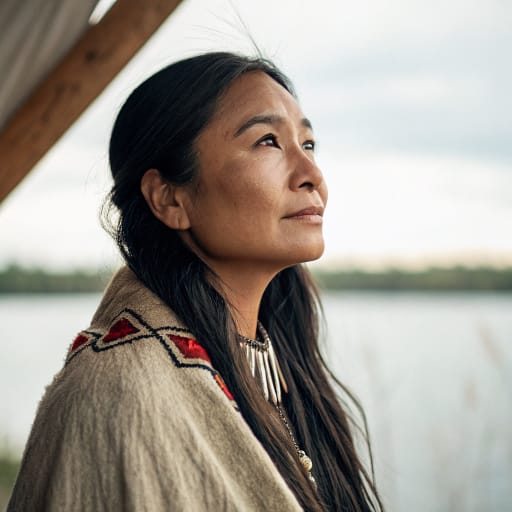
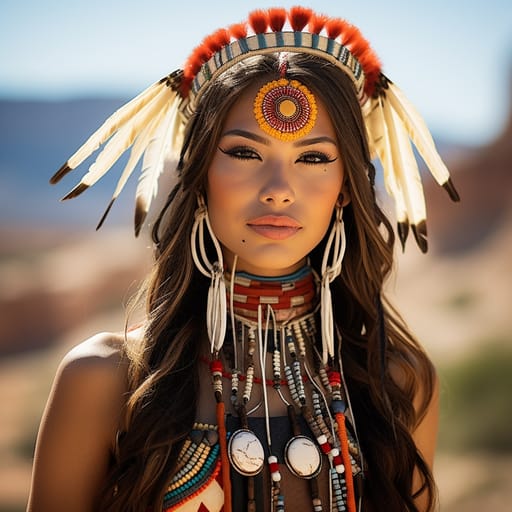
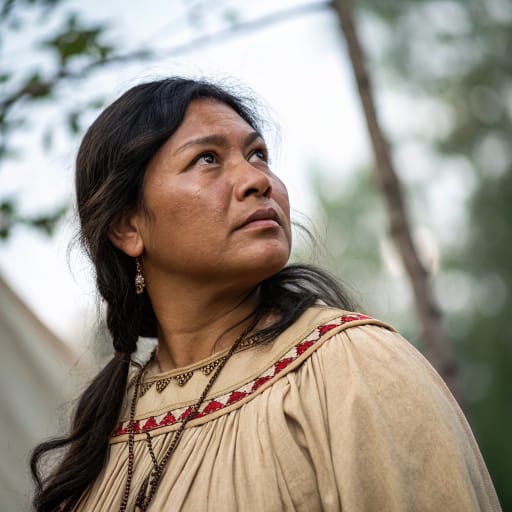
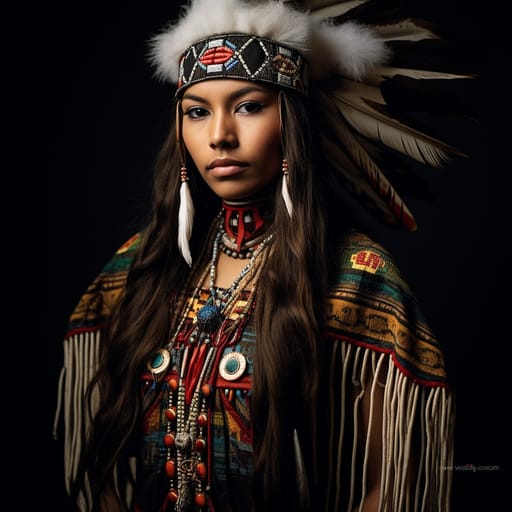
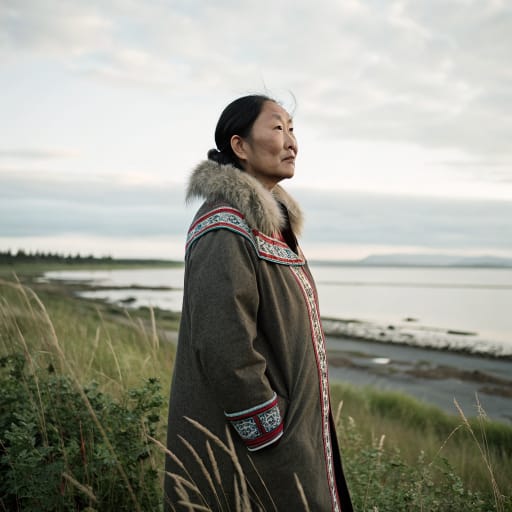
Typical Nacogdoche Phenotypes
Reference for AI generation: hair, eyes, skin, facial structure, build
Nacogdoche Body & Anatomy Reference
Per-feature anatomical profile for AI nude generation: Indigenous Northern American / Algonquian-Iroquoian phenotype
Nacogdoche Boobs & Breasts
Bust reference for Nacogdoche women: medium cup, moderate projection, which is typical of Indigenous Northern American / Algonquian-Iroquoian ancestry. Areolas measure about 30-44mm across, with medium-brown pigmentation. Body type (mesomorph, broader frame in northern Indigenous populations) shapes the bust as well, so Nacogdoche tits are usually full and moderate projection. In AI imagery, keep the forward-set shape rather than drifting toward the smaller East Asian bust.
Nacogdoche Ass & Hips
The Nacogdoche ass is typically medium, moderate-to-full projection, which sets it apart from the slim East Asian narrow-hip profile. Underneath, the pelvis shows medium iliac crests, part of the Indigenous Northern American / Algonquian-Iroquoian skeletal pattern. For Nacogdoche butt pics and AI renders, match that silhouette and the overall build (mesomorph, broader frame in northern Indigenous populations).
Nacogdoche Vagina & Pussy
Nacogdoche pussy and vulvar anatomy presents medium-brown labial pigmentation, consistent with the Indigenous Northern American / Algonquian-Iroquoian phenotype's pigmentation pattern. Nacogdoche pubic hair is typically straight medium-coarse texture, in the inverted-triangle pattern. For anatomically accurate Nacogdoche pussy renders the labial coloration should match the surrounding copper to medium-brown skin tone with a continuous gradient, and the hair should keep its straight medium-coarse texture.
Nacogdoche Dicks & Penis
Nacogdoche dicks follow the Indigenous Northern American / Algonquian-Iroquoian reference data: regional mean ~13cm erect; moderate girth; medium-brown shaft pigmentation. Shaft color should track the copper to medium-brown skin tone with a smooth change toward the glans, and Nacogdoche pubic hair keeps its straight medium-coarse texture.
Nacogdoche Body, Curves & Build
Nacogdoche body type and overall build presents as mesomorph, broader frame in northern Indigenous populations, with mean adult female BMI 25-28: the characteristic Indigenous Northern American / Algonquian-Iroquoian habitus. Nacogdoche curves and proportions should keep the regional skeletal frame (height, shoulder-to-hip ratio, limb proportions) rather than a generic mesomorph default.
Nacogdoche Skin Tone & Hair Texture
Nacogdoche skin sits in the copper to medium-brown (Fitzpatrick III-V) band. Hair is typically straight 1A, dark-brown to black, often thick and dense, in keeping with the Indigenous Northern American / Algonquian-Iroquoian phenotype. In nude renders the skin should stay one even tone from face to body, and body, pubic and head hair should match.
Explore phenotype categories
Structured taxonomy with peer-reviewed scales · 22 anatomical categories
Erotic Poses & Sex Positions
From the pose catalog: 219 named positions with reference skeletons
Frequently asked questions about Nacogdoche people
Where is the Nacogdoche homeland?
The Nacogdoche homeland is East Texas, around present-day Nacogdoches in the Angelina River drainage, United States; descendants live mainly in Oklahoma. in North America.
What language do Nacogdoche people speak?
Nacogdoche people primarily speak Caddo, Hasinai dialect (Caddoan); descendants today mostly speak English.
What religion do Nacogdoche people practice?
The predominant religion among Nacogdoche people is Traditional Hasinai religion built around a supreme being, a high priest (xinesi) and a perpetual temple fire; limited Spanish Catholic mission influence after 1716..






Make your own Nacogdoche images
Five a day, free, no credits to buy. The studio starts from this group's phenotype data, so you can set body type, pose and style and keep the traits accurate.
Start with Nacogdoche