Help us get this right
Does this portrait look right for Mongo?
Nobody has judged this one yet. You would be the first.
Mongo Erotic
Democratic Republic of the Congo (Équateur, Tshuapa, Mongala, Nord-Ubangi, Sud-Ubangi)
Christianity
Bolia, Ntomba, Ngando, Iyaelima, Mbole, Mpama, Nkutu, Sengele, Hendo, Dengese, Tetela
About Mongo People
The Mongo are one of the largest single ethnic groupings in the Democratic Republic of the Congo, spread across the great forested basin that the Congo River draws around itself — a territory of slow brown water, flooded woodland, and villages reached more easily by pirogue than by road. They are not a tribe in the tight sense so much as a cluster of related peoples — Bolia, Ntomba, Ngando, Mbole, Tetela, Dengese, Sengele and a dozen more — who share descent traditions, a closely related set of Bantu languages, and a way of life shaped by the equatorial forest rather than the savanna. Outsiders have sometimes lumped them together as "Bamongo"; the people themselves tend to identify first by the smaller branch.
Their language, Lomongo (with regional variants like Lonkundo and Losakata), sits in the central Bantu zone and functions as a lingua franca across much of Équateur and Tshuapa, even as Lingala has overtaken it in towns and on the rivers. Social organization is patrilineal and built around the etuka, the lineage segment that owns land and arbitrates marriage; brideprice, traditionally paid in copper rods or livestock, anchors alliances between these lineages. Forest economy still matters — cassava, plantain, fish from blackwater streams, palm wine, bushmeat where it remains legal — though decades of conflict and the collapse of river transport have pushed many Mongo into harder subsistence than their grandparents knew.
Christianity, mostly Catholic with a strong Protestant minority and a growing pentecostal presence, arrived through Belgian missions in the late nineteenth and early twentieth centuries and is now the dominant religious frame, though older beliefs about ancestors, forest spirits and the moral weight of the lineage have not so much disappeared as been folded underneath. The colonial period was brutal here: the Équateur forests were the heartland of Leopold II's rubber regime, and the demographic and cultural damage of that era is still legible in the historiography Mongo writers themselves have produced. Post-independence, intellectuals like the historian-priest Eugène Mumbanza ya Bawele and the politician Patrice Lumumba — Tetela by birth, and therefore claimed by Mongo on a generous reading — have given the group an outsized presence in Congolese national memory relative to its remote, river-fed homeland.
Related ethnic groups
Groups that share Mongo's homeland, region, language, or religious tradition. These are likely candidates for comparative phenotype reference.
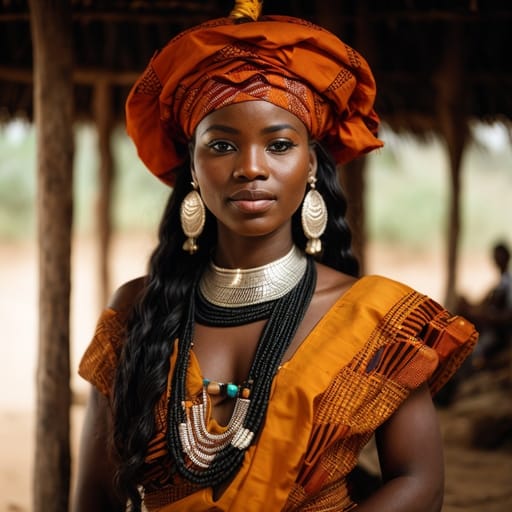
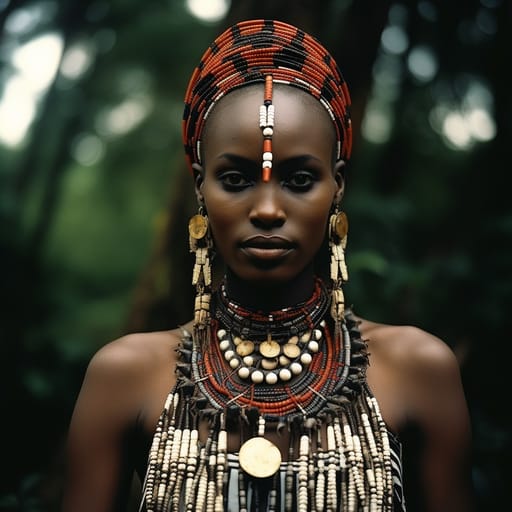
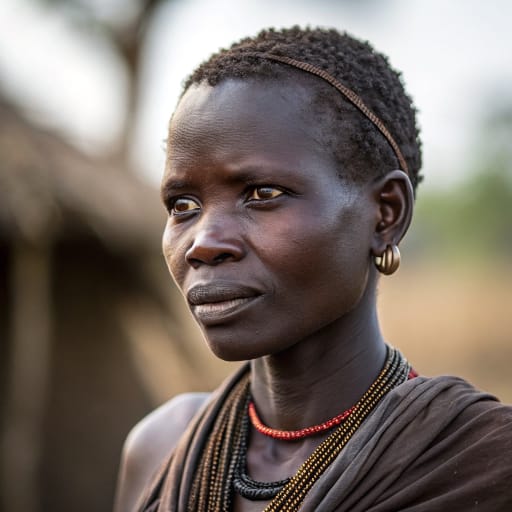
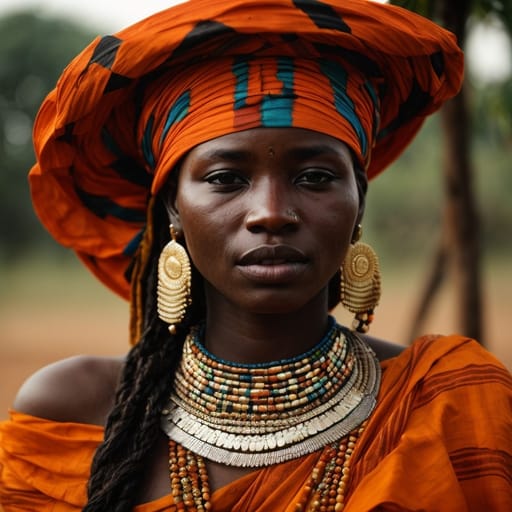
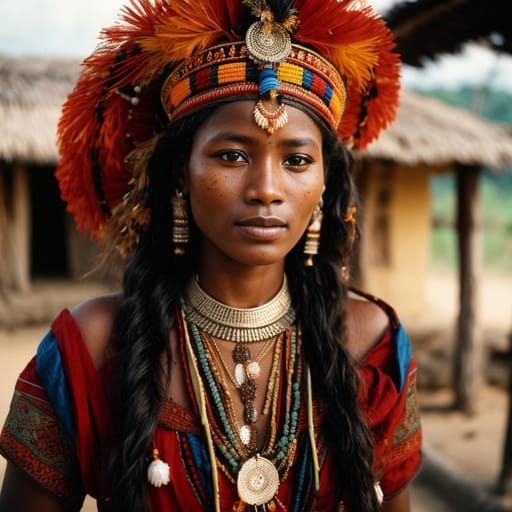
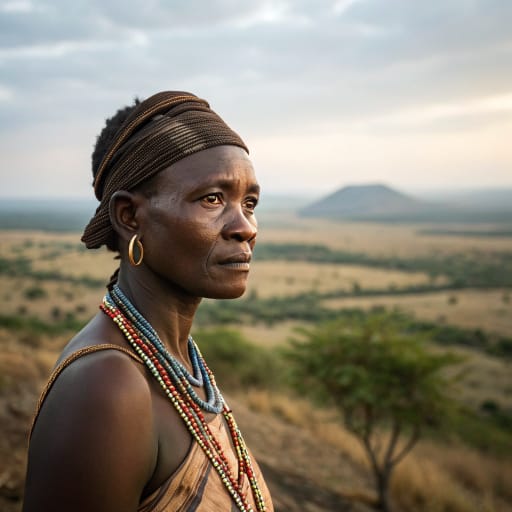
Geographic Distribution: Mongo populations across 1 country
Each row is ranked by the group's share of that country's population, with the source citation drawn from published census and demographic surveys. Click through for the full per-country phenotype profile.
| Country | Share | Source |
|---|---|---|
| Democratic Republic of the Congo | 17.0% | DRC demographic estimates; Mongo (~17%); Bantu, concentrated in central DRC equatorial forest |
Typical Mongo Phenotypes
Reference for AI generation: hair, eyes, skin, facial structure, build
The Mongo are a large Bantu cluster living across the equatorial rainforest basin of central DRC, and their phenotype reflects long adaptation to that environment rather than the savanna or Sahel. Skin sits firmly in Fitzpatrick VI — deep brown to near-black, with cool to neutral undertones and a characteristic satiny sheen that comes from high humidity rather than sun exposure. Tonal range is narrower than in groups straddling forest-savanna ecotones; you rarely see the warmer, lighter browns common further north or east.
Hair is tightly coiled Type 4, predominantly 4B–4C, with dense follicular packing and a soft matte texture. Color is uniformly black-brown; natural lightening is uncommon outside age-related greying. Hairlines tend to be relatively low and rounded rather than peaked.
Eyes are dark brown to near-black, set under a moderately developed brow ridge. The eye opening is typically almond-shaped with a slight downward tilt at the outer canthus; epicanthic folds are absent. Sclera contrast is high against the surrounding skin.
Facial structure trends toward what anthropologists describe as equatorial forest morphology — broad alar base with a low, soft nasal bridge, full lips with everted vermilion borders (upper lip often as full as the lower), and a relatively short mid-face. Cheekbones are present but rounded rather than sharply projected, and the jaw is moderate, neither markedly prognathic nor recessed. Foreheads are typically high and smooth.
Build is the most distinctive feature regionally: Mongo populations tend to be shorter and more gracile than their Luba or Kongo neighbors, with men commonly in the 165–172 cm range and women 155–162 cm. Limb proportions are relatively long for stature, shoulders narrow to medium, and natural body composition lean — the heavy musculature of pastoralist East African groups is uncommon. Sub-group variation is modest: Tetela and Hendo branches on the eastern edge of Mongo territory show slightly taller average stature and somewhat sharper facial features from historical contact with Luba populations, while the deep-forest Iyaelima and Ntomba retain the most uniformly gracile build.
Mongo Body & Anatomy Reference
Bantu / Central African Niger-Congo phenotype: anatomy reference for AI nude generation
Mongo Boobs & Breasts
Mongo tits and boobs run medium-to-large cup, full, projecting, the classic Bantu / Central African Niger-Congo bust profile. Mongo nipples and areolas show deep-brown areolar pigmentation against the deep-brown skin tone, with areolar diameter typically in the 32-48mm range and forward-set positioning rather than the smaller East African conical profile. Mongo breasts trend fuller projection than East African; comparable to West African norm, a function of the mesomorph with strong gluteal-femoral fat deposition body habitus and the mean adult female BMI 23-26. For anatomically accurate AI-generated Mongo nudes the render preserves the medium-to-large cup, full, projecting shape, 32-48mm areolas with deep-brown pigmentation, and the torso proportions of the Bantu / Central African Niger-Congo phenotype.
Mongo Ass & Hips
Mongo hips and butt usually read as full, projected, wide-set glutes. The skeletal base is broad iliac crests, gynoid pelvic pattern, the Bantu / Central African Niger-Congo pattern. Set against the slim narrow-hip Cushitic East African profile, the difference is easy to see, and the hip-to-waist ratio is often what identifies Mongo women in photos.
Mongo Vagina & Pussy
Expect deep-brown labial pigmentation, fuller labia minora on Mongo women, in keeping with Bantu / Central African Niger-Congo ancestry. The pubic hair is tightly-coiled coarse texture, dense distribution. Coloring should run evenly from the deep-brown skin of the thighs to the labia, and Mongo nude imagery should keep the hair's tightly-coiled coarse texture.
Mongo Dicks & Penis
Mongo dick and penile anatomy in adult AI generation should anchor on the regional reference data: regional mean ~14cm erect, above-average girth, and deep-brown shaft pigmentation. The Mongo cock profile reflects the Bantu / Central African Niger-Congo population's anthropometric measurements. The shaft pigmentation should track the surrounding deep-brown skin tone, and the pubic hair should keep its tightly-coiled coarse texture in the typical inverted-V escutcheon.
Mongo Body, Curves & Build
Mongo body type: mesomorph with strong gluteal-femoral fat deposition, with mean adult female BMI 23-26. This is the typical Bantu / Central African Niger-Congo build. Height range, shoulder-to-hip ratio and fat distribution all follow from it, which is what an accurate Mongo nude body should show.
Mongo Skin Tone & Hair Texture
Mongo skin tone falls in the deep-brown (Fitzpatrick VI) band, the surface signal most often miscalibrated by generic AI nude generators. Mongo hair texture is typically tight 4A-4C coil, characteristic of the Bantu / Central African Niger-Congo phenotype. In Mongo nude renders the skin should hold that band consistently across the body.
Data depth
0/100Coverage of image-grounded phenotype observations · drives AI generation diversity
- Sample size
- 0/40· 0 images
- Image quality
- 0/30· 0% high
- Confidence
- 0/20
- Source diversity
- 0/10
- ·No image observations yet
Explore phenotype categories
Structured taxonomy with peer-reviewed scales · 22 anatomical categories
Erotic Poses & Sex Positions
From the pose catalog: 219 named positions with reference skeletons
Frequently asked questions about Mongo people
Where is the Mongo homeland?
The Mongo homeland is Democratic Republic of the Congo (Équateur, Tshuapa, Mongala, Nord-Ubangi, Sud-Ubangi) in Central Africa.
What countries do Mongo people live in?
Mongo populations are documented across 1 country: Democratic Republic of the Congo.
What language do Mongo people speak?
Mongo people primarily speak Niger-Congo / Bantu / Mongo.
What religion do Mongo people practice?
The predominant religion among Mongo people is Christianity.






Make your own Mongo images
Five a day, free, no credits to buy. The studio starts from this group's phenotype data, so you can set body type, pose and style and keep the traits accurate.
Start with Mongo