Help us get this right
Does this portrait look right for Maniq?
Nobody has judged this one yet. You would be the first.
Maniq Erotic
Rainforests of the Banthat mountain range in southern Thailand (Trang, Satun, Phatthalung and Songkhla provinces), with a settled Kensiu-speaking community in Yala province.
Ten'edn (also called Tonga' or Mos) and Kensiu (Austroasiatic, Aslian branch); many also speak Southern Thai.
Animist, with beliefs centered on the spirits of the forest.
The Thai branch of the Semang, the Aslian-speaking forest foragers of the Malay Peninsula. Ten'edn speakers live in the Banthat range and Kensiu speakers in Yala.
About Maniq People
Southern Thai villagers have long called the Maniq Ngo Pa, "forest rambutan," a nickname that comes from their tightly curled hair. They have also been called Sakai, a word many now hear as an insult. The Maniq number only a few hundred, and they are one of very few peoples in Thailand who still live, for at least part of the year, by moving camp through the rainforest. Their home is the Banthat range, the hills where Trang, Satun, Phatthalung and Songkhla provinces meet. A smaller community that settled long ago lives farther south in Yala. They are the Thai branch of the Semang, the forest foragers of the Malay Peninsula, whose roots there go deeper than those of their Thai and Malay neighbors.
Language sets them apart. In the Banthat hills the Maniq speak Ten'edn, also known as Tonga' or Mos. In Yala they speak Kensiu. Both are Aslian languages of the Austroasiatic family, which makes them distant relatives of Khmer and Vietnamese, even though everyone around them speaks Southern Thai or Malay. Most Maniq also get by in Southern Thai when they trade.
Camp life is built to move. A band puts up lean-to shelters of bamboo and broad leaves and stays as long as game, wild yams and fruit hold out. Then it walks on and leaves the old site to the forest. Hunters take monkeys, squirrels and birds with bamboo blowpipes and poisoned darts, a skill still passed from one generation to the next. Rattan, honey and medicinal plants go out to Thai markets in exchange for rice, tobacco, cloth and metal tools. Their animist beliefs are tied to the same ground: the forest holds spirits that must be respected, and daily choices about where to camp and what to take are made with them in mind.
In 1905 an odd episode tied the Maniq to the Thai court. King Chulalongkorn brought a Maniq boy named Khanung from the south to Bangkok and raised him in the palace. The king then wrote Ngo Pa, a verse drama about love and jealousy among the forest people, which fixed the Maniq in the Thai imagination for generations.
The pressures on them now are ordinary and relentless. Rubber and oil palm plantations have eaten into the forest, and many families spend long stretches near villages, taking wage work or settling in fixed communities. Many Maniq received Thai identity cards only in recent years. The cards bring schools and clinics within reach, and they also pull the camps a little closer to the road.
Related ethnic groups
Groups that share Maniq's homeland, region, language, or religious tradition. These are likely candidates for comparative phenotype reference.
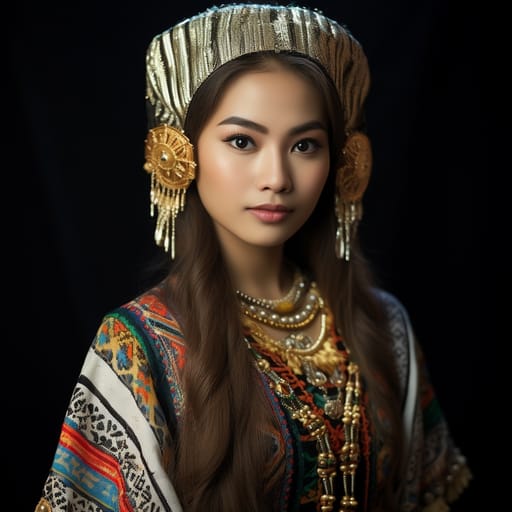
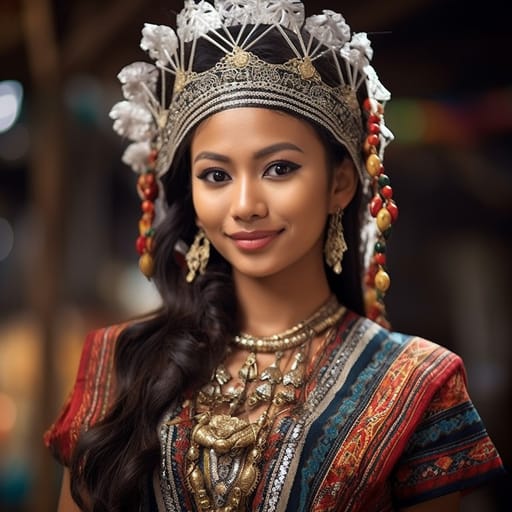
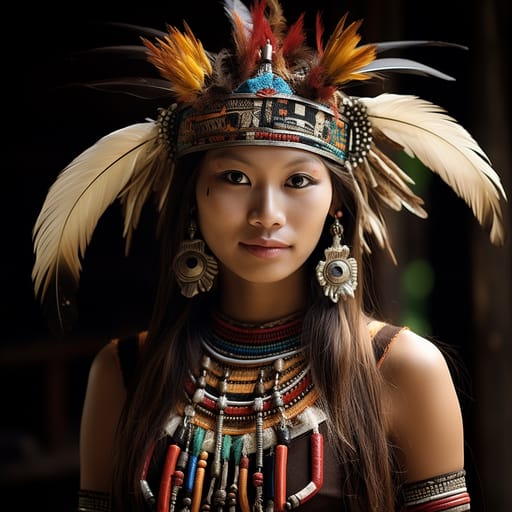
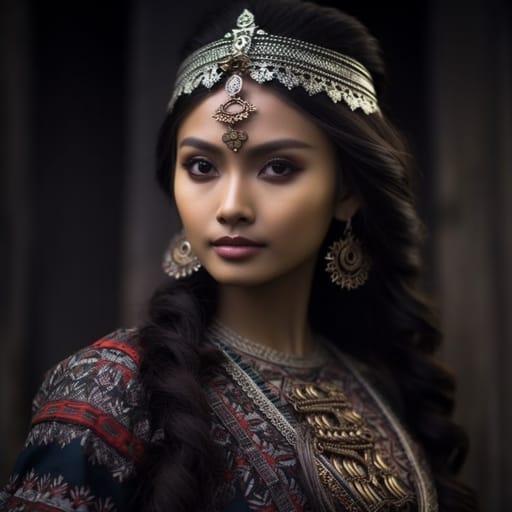
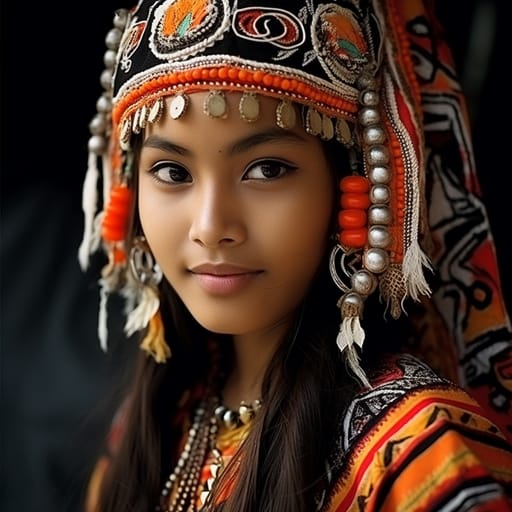
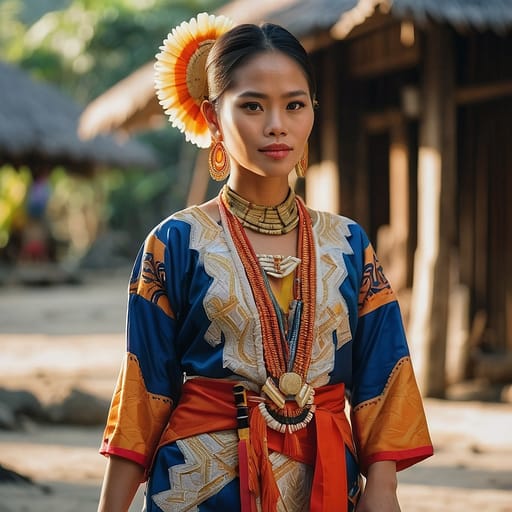
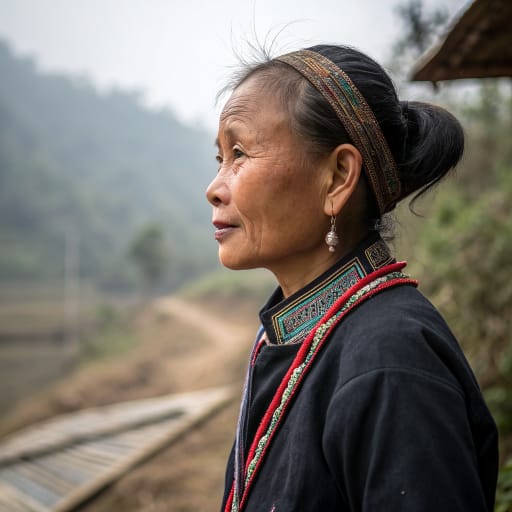
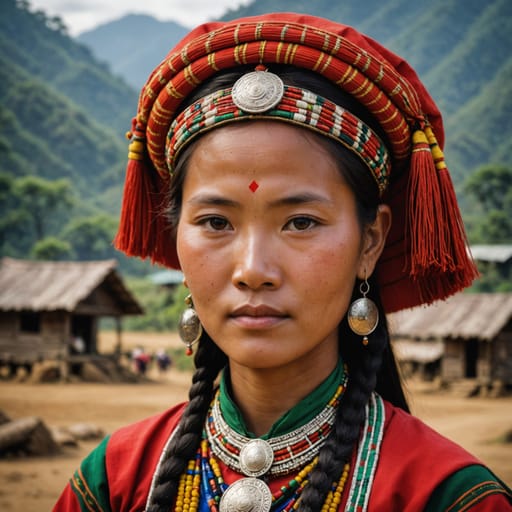
Typical Maniq Phenotypes
Reference for AI generation: hair, eyes, skin, facial structure, build
Maniq Body & Anatomy Reference
Anatomy by feature, Southeast Asian Austronesian / Austroasiatic phenotype
Maniq Boobs & Breasts
Maniq boobs follow the Southeast Asian Austronesian / Austroasiatic profile: small-to-medium cup, modest projection. Areolar diameter is usually 26-38mm, and the coloring is medium-brown to dark-brown areolar pigmentation against the tan-to-medium-brown skin tone. Breast shape tracks body composition (ectomorph, petite frame, mean adult female BMI 20-23), so Maniq breasts tend to be firm, modest projection. Expect a forward-set shape, not the fuller South Asian or Polynesian bust.
Maniq Ass & Hips
Maniq ass and hip morphology presents as small-to-medium, modest projection, narrower hip profile, distinctly different from the fuller glutes of the Pacific Islander phenotype. The Maniq pelvic profile shows narrow-to-medium iliac crests, anchored in the Southeast Asian Austronesian / Austroasiatic skeletal pattern. Maniq butt shots in adult AI imagery should render the small-to-medium, modest projection, narrower hip profile silhouette with the overall build (ectomorph, petite frame) and the fat distribution typical of the Southeast Asian Austronesian / Austroasiatic phenotype.
Maniq Vagina & Pussy
Maniq pussy anatomy typically shows medium-brown to dark-brown labial pigmentation. Pubic hair is usually straight-to-wavy fine-to-medium texture. In AI-generated Maniq nudes, labial color should blend into the tan to medium-brown skin with a gradual transition, and the hair should keep its straight-to-wavy fine-to-medium texture.
Maniq Dicks & Penis
Penis reference for Maniq men: regional mean ~11cm erect, moderate girth. Coloring: medium-brown shaft pigmentation. An accurate Maniq cock in AI imagery matches the surrounding tan to medium-brown skin rather than a generic porn default. Circumcision depends on religion and custom, not ancestry.
Maniq Body, Curves & Build
The Maniq figure is generally ectomorph, petite frame, with mean adult female BMI 20-23, characteristic of Southeast Asian Austronesian / Austroasiatic ancestry. AI image tools tend to flatten regional body types into a few stock shapes; here the Maniq build is kept as its own reference.
Maniq Skin Tone & Hair Texture
Skin: tan to medium-brown (Fitzpatrick III-V). Hair: straight-to-wavy 1A-2A, dark-brown to black. Both are typical of Southeast Asian Austronesian / Austroasiatic ancestry. The most common mistake in AI nudes of Maniq women is a body rendered lighter than the face.
Explore phenotype categories
Structured taxonomy with peer-reviewed scales · 22 anatomical categories
Erotic Poses & Sex Positions
From the pose catalog: 219 named positions with reference skeletons
Frequently asked questions about Maniq people
Where is the Maniq homeland?
The Maniq homeland is Rainforests of the Banthat mountain range in southern Thailand (Trang, Satun, Phatthalung and Songkhla provinces), with a settled Kensiu-speaking community in Yala province. in Southeast Asia.
What language do Maniq people speak?
Maniq people primarily speak Ten'edn (also called Tonga' or Mos) and Kensiu (Austroasiatic, Aslian branch); many also speak Southern Thai..
What religion do Maniq people practice?
The predominant religion among Maniq people is Animist, with beliefs centered on the spirits of the forest..






Make your own Maniq images
Five a day, free, no credits to buy. The studio starts from this group's phenotype data, so you can set body type, pose and style and keep the traits accurate.
Start with Maniq