Help us get this right
Does this portrait look right for Mandari?
Nobody has judged this one yet. You would be the first.
Mandari Erotic
Terekeka and the White Nile banks north of Juba, Central Equatoria, South Sudan.
Kutuk na Mandari, a dialect of Bari (Eastern Nilotic, Nilo-Saharan).
Mainly Christian, Catholic and Anglican, layered over traditional belief in a high god called Ngun, ancestral spirits and hereditary rainmakers.
One of the Bari-speaking Karo peoples, alongside the Bari, Pojulu, Kakwa, Kuku and Nyangwara.
About Mandari People
The Mandari are cattle people in the most literal sense: a herd is a bank account, a marriage contract, a family record and the reason for most arguments, and nearly everything an outsider notices about them starts there. They live in and around Terekeka, on the banks of the White Nile north of Juba in South Sudan, on grassland that floods and dries on a schedule the herds move to. In the dry season the camps spread across the riverside flats, hundreds of long-horned cattle tethered in rows, dung fires smoldering through the night against mosquitoes and tsetse. The white ash from those fires goes onto skin as sunblock and insect repellent, and cattle urine is used to wash hair, which bleaches it a rusty orange. Both are practical answers to real problems, and both have been photographed so often that the Mandari cattle camp has become a genre of travel photography in its own right.
Their language, Kutuk na Mandari, is close enough to Bari to be counted a dialect of it, which puts them in the Eastern Nilotic branch of Nilo-Saharan next to the Bari, Pojulu, Kakwa, Kuku and Nyangwara, a cluster usually grouped together as the Karo. Sorghum farming and Nile fishing do most of the actual feeding. Cattle are wealth rather than dinner, kept for milk and for what they settle: bridewealth runs to dozens of animals, and a man may carry a praise name taken from a favorite ox. Christianity, Catholic and Anglican, is the majority affiliation now, and it sits on top of an older frame rather than having replaced it, one with a high god called Ngun, ancestors who stay involved in family business, and rainmaking as an inherited office rather than a figure of speech.
The nineteenth century brought Turco-Egyptian ivory and slave raiding up the river, then Anglo-Egyptian rule, and through all of it the Mandari took in strangers: mid-century ethnography of the region is largely a study of how displaced families attached themselves to Mandari chiefs and, over a generation or two, became Mandari. That habit of absorption argues against thinking of them as a sealed group. Sudan's two civil wars emptied and refilled Terekeka, independence in 2011 arrived with expectations attached, and the fighting that began in 2013 returned armed cattle raiding to the area, where it has stayed. Young men still spend their seasons in the camps, now with phones and rifles among the herds, and go home to towns where nobody is dusted in ash.
Related ethnic groups
Groups that share Mandari's homeland, region, language, or religious tradition. These are likely candidates for comparative phenotype reference.
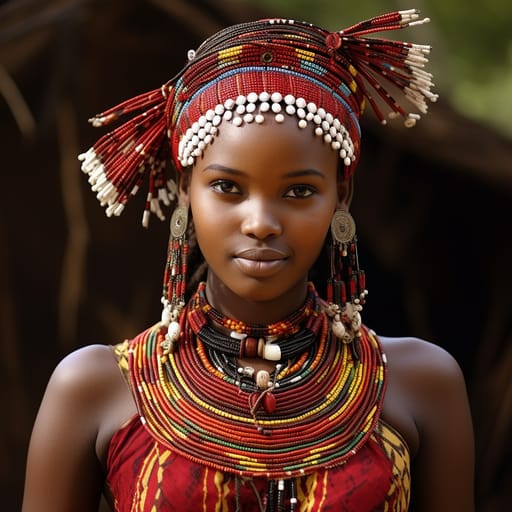
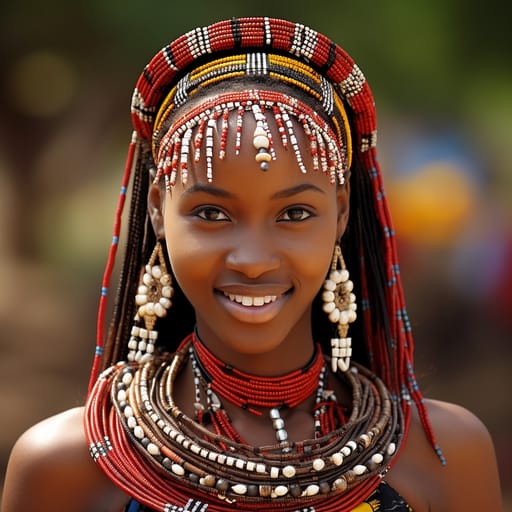
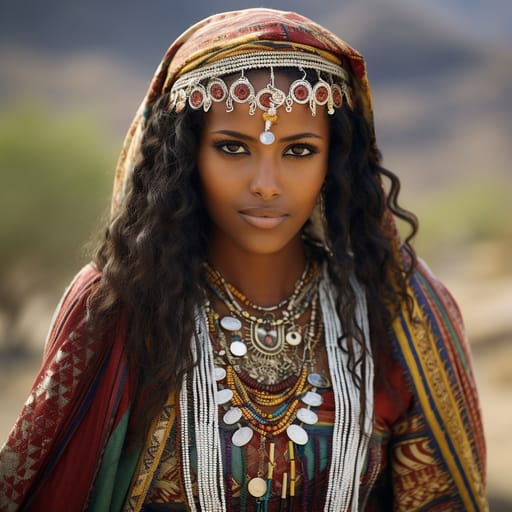
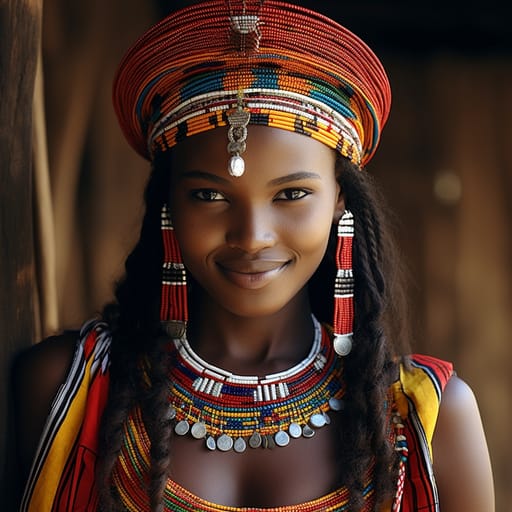
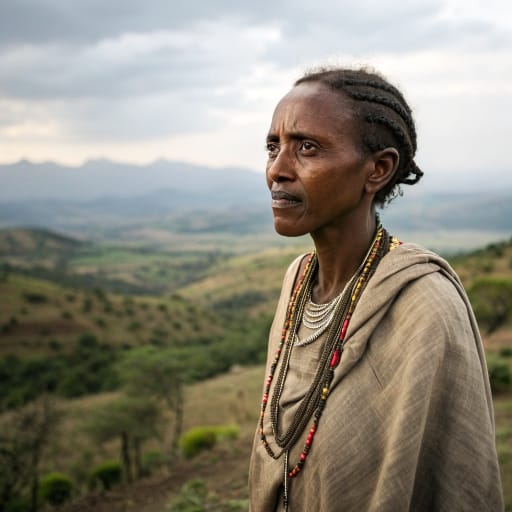
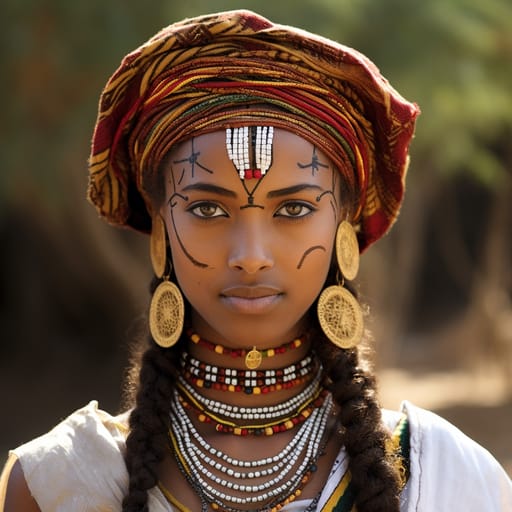
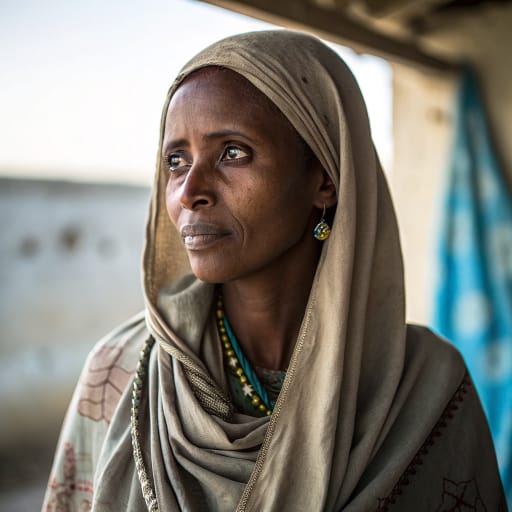
Typical Mandari Phenotypes
Reference for AI generation: hair, eyes, skin, facial structure, build
Mandari Body & Anatomy Reference
Per-feature anatomical profile for AI nude generation: Cushitic / Nilo-Cushitic East African phenotype
Mandari Boobs & Breasts
Mandari boobs follow the Cushitic / Nilo-Cushitic East African profile: small-to-medium-cup, high-set, conical. Areolar diameter is usually 28-38mm, and the coloring is moderate-to-high areolar pigmentation against the brown-to-deep-brown skin tone. Breast shape tracks body composition (lean ectomorph-to-mesomorph, mean adult female BMI 19-22), so Mandari breasts tend to be firmer and less projecting than the African-American or West African norm. Expect a forward-set shape, not the lateral spread of the West African phenotype.
Mandari Ass & Hips
Mandari ass and hip morphology presents as small-to-medium, high-set, rounded, distinctly different from the wide-set heavy-projection West African or African-American norm. The Mandari pelvic profile shows narrow-to-medium iliac crests, longer torso-to-leg ratio, anchored in the Cushitic / Nilo-Cushitic East African skeletal pattern. Mandari butt shots in adult AI imagery should render the small-to-medium, high-set, rounded silhouette with the overall build (lean ectomorph-to-mesomorph) and the fat distribution typical of the Cushitic / Nilo-Cushitic East African phenotype.
Mandari Vagina & Pussy
Mandari pussy anatomy typically shows brown-to-deep-brown labial pigmentation, narrow-to-medium labia minora projection. Pubic hair is usually tightly-coiled coarse texture, densely distributed. In AI-generated Mandari nudes, labial color should blend into the brown to deep brown skin with a gradual transition, and the hair should keep its tightly-coiled coarse texture.
Mandari Dicks & Penis
Penis reference for Mandari men: regional mean ~13.5cm erect, moderate girth, ~12cm circumference. Coloring: deeper-pigmented than the West African norm. An accurate Mandari cock in AI imagery matches the surrounding brown to deep brown skin rather than a generic porn default. Circumcision depends on religion and custom, not ancestry.
Mandari Body, Curves & Build
The Mandari figure is generally lean ectomorph-to-mesomorph, with mean adult female BMI 19-22, characteristic of Cushitic / Nilo-Cushitic East African ancestry. AI image tools tend to flatten regional body types into a few stock shapes; here the Mandari build is kept as its own reference.
Mandari Skin Tone & Hair Texture
Skin: brown to deep brown (Fitzpatrick V-VI). Hair: tight 4A-4C coil, often worn natural or in braided/twisted protective styles. Both are typical of Cushitic / Nilo-Cushitic East African ancestry. The most common mistake in AI nudes of Mandari women is a body rendered lighter than the face.
Explore phenotype categories
Structured taxonomy with peer-reviewed scales · 22 anatomical categories
Erotic Poses & Sex Positions
From the pose catalog: 219 named positions with reference skeletons
Frequently asked questions about Mandari people
Where is the Mandari homeland?
The Mandari homeland is Terekeka and the White Nile banks north of Juba, Central Equatoria, South Sudan. in Eastern Africa.
What language do Mandari people speak?
Mandari people primarily speak Kutuk na Mandari, a dialect of Bari (Eastern Nilotic, Nilo-Saharan)..
What religion do Mandari people practice?
The predominant religion among Mandari people is Mainly Christian, Catholic and Anglican, layered over traditional belief in a high god called Ngun, ancestral spirits and hereditary rainmakers..






Make your own Mandari images
Five a day, free, no credits to buy. The studio starts from this group's phenotype data, so you can set body type, pose and style and keep the traits accurate.
Start with Mandari