No portrait yet
Mandan Erotic
Upper Missouri River valley around the Heart and Knife rivers, now the Fort Berthold Reservation, North Dakota, United States.
Mandan (Siouan, its own branch), in revitalization after the last fluent speaker died in 2016; English is the everyday language.
Christianity (Catholic and Protestant) alongside revived traditional religion of sacred bundles and ceremony.
Historic village and dialect divisions including Nuptare and Nuetare; today one of the Three Affiliated Tribes (MHA Nation) with the Hidatsa and Arikara.
About Mandan People
The Mandan built towns. On a plains landscape where most nations followed the bison, they lived for centuries in permanent villages of domed earth lodges on bluffs above the Missouri River, ringed by ditches and palisades, with the women working fields of corn, beans, squash and sunflowers on the bottomlands below. That settled life made their villages near the mouths of the Heart and Knife rivers, in what is now North Dakota, the trading floor of the northern Plains. Lakota, Cheyenne, Crow, Assiniboine and Cree came in with meat and hides and left with corn, and later the traffic added horses moving north and guns moving south. Their own name for themselves is Nueta, or Numakiki, the people.
Mandan is a Siouan language, but a lonely one: it forms its own branch of the family and is not mutually intelligible with Hidatsa, the language of their closest neighbors and eventual partners. The last fluent speaker died in 2016, and it now survives through classes at the tribal college in New Town and in the mouths of learners. Society is matrilineal and organized by clans. The traditional religion centered on sacred bundles and the Okipa, a four-day summer ceremony that reenacted creation and a great flood. At the heart of every village stood a cedar post inside a small wooden palisade, the shrine of Lone Man, who was said to have built the wall that saved the people from the rising water. Young men in the Okipa fasted and hung from skewers through their skin, a rite that unsettled George Catlin when he painted it in 1832 and that federal agents suppressed by the 1890s.
Their history turns on disease. Smallpox in 1781 collapsed roughly nine villages into two. Lewis and Clark wintered beside those two in 1804 and 1805, and the chief Sheheke went east to meet Jefferson. Then the 1837 epidemic came upriver on a fur company steamboat and killed about nine in ten; the second chief Four Bears, painted by Catlin and Karl Bodmer, died cursing the whites he had befriended. Perhaps 125 Mandan survived. They pooled with the Hidatsa at Like-a-Fishhook Village in 1845, the Arikara joined in 1862, and the three became the Fort Berthold Reservation and eventually the MHA Nation. In 1953 the Garrison Dam drowned the river bottoms that held their farms, towns and cemeteries under Lake Sakakawea and scattered families to the uplands. The Bakken oil boom has since brought money and disruption in equal measure. Mandan identity today is chosen and worked at: a name kept, a ceremony reconstructed, a language relearned one class at a time.
Related ethnic groups
Groups that share Mandan's homeland, region, language, or religious tradition. These are likely candidates for comparative phenotype reference.
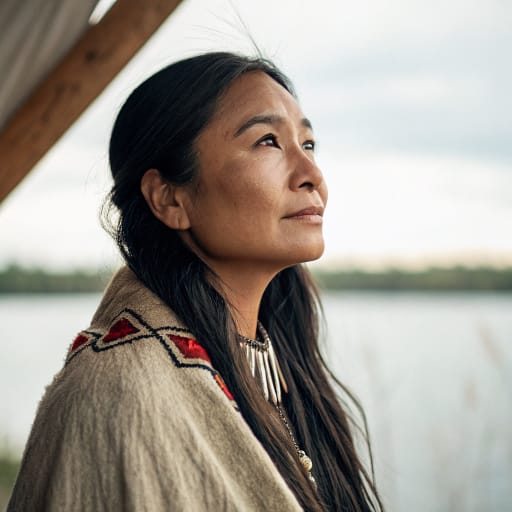
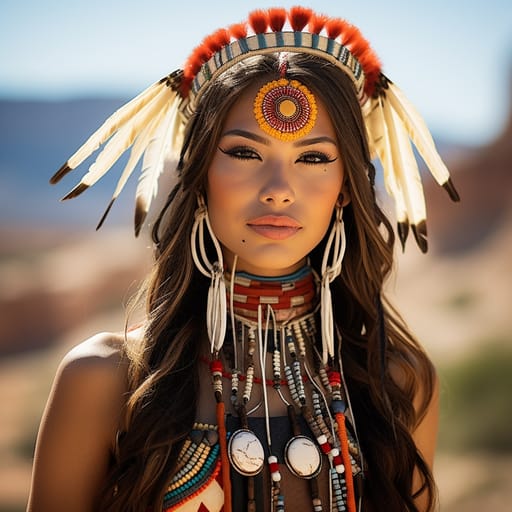
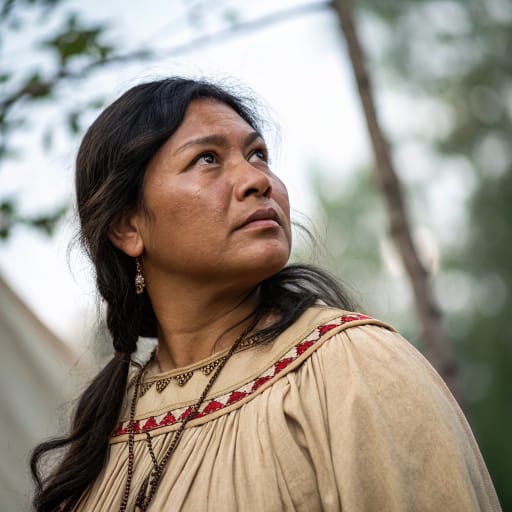
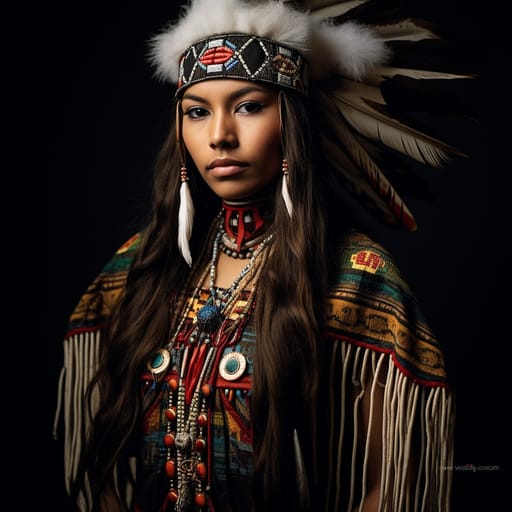
Typical Mandan Phenotypes
Reference for AI generation: hair, eyes, skin, facial structure, build
Mandan Body & Anatomy Reference
Per-feature anatomical profile for AI nude generation: Indigenous Northern American / Algonquian-Iroquoian phenotype
Mandan Boobs & Breasts
The typical Mandan bust is medium cup, moderate projection, in line with the wider Indigenous Northern American / Algonquian-Iroquoian pattern. Areolas usually fall in the 30-44mm range, with medium-brown areolar pigmentation against the copper-to-medium-brown skin tone. Compared with the smaller East Asian bust, Mandan breasts sit forward and are generally full and moderate projection. A faithful AI render of Mandan tits keeps that shape and areola size.
Mandan Ass & Hips
Butt shape among Mandan women: medium, moderate-to-full projection, over medium iliac crests. This follows Indigenous Northern American / Algonquian-Iroquoian ancestry and looks quite unlike the slim East Asian narrow-hip profile. An accurate Mandan ass in adult AI imagery keeps both the silhouette and the overall build (mesomorph, broader frame in northern Indigenous populations) instead of a generic average.
Mandan Vagina & Pussy
Vulvar anatomy among Mandan women: medium-brown labial pigmentation. Pubic hair tends to be straight medium-coarse texture, in the usual inverted-triangle pattern. Both follow Indigenous Northern American / Algonquian-Iroquoian pigmentation, which is why Mandan pussy renders should not fall back on a pale, sparse Western template.
Mandan Dicks & Penis
The Mandan cock profile, from Indigenous Northern American / Algonquian-Iroquoian anthropometric data: regional mean ~13cm erect; moderate girth; medium-brown shaft pigmentation. Pubic hair has a straight medium-coarse texture and forms the usual inverted-V pattern. Whether Mandan men are circumcised follows religious and cultural practice rather than phenotype.
Mandan Body, Curves & Build
Build and curves among Mandan women follow the Indigenous Northern American / Algonquian-Iroquoian pattern: mesomorph, broader frame in northern Indigenous populations, mean adult female BMI 25-28. Proportions matter as much as skin tone, so Mandan figures should keep their regional height and limb ratios.
Mandan Skin Tone & Hair Texture
The Mandan skin range is copper to medium-brown (Fitzpatrick III-V), and hair tends to be straight 1A, dark-brown to black, often thick and dense. That combination marks the Indigenous Northern American / Algonquian-Iroquoian phenotype, and skin tone is the trait AI generators most often get wrong for Mandan women.
Explore phenotype categories
Structured taxonomy with peer-reviewed scales · 22 anatomical categories
Erotic Poses & Sex Positions
From the pose catalog: 219 named positions with reference skeletons
Frequently asked questions about Mandan people
Where is the Mandan homeland?
The Mandan homeland is Upper Missouri River valley around the Heart and Knife rivers, now the Fort Berthold Reservation, North Dakota, United States. in North America.
What language do Mandan people speak?
Mandan people primarily speak Mandan (Siouan, its own branch), in revitalization after the last fluent speaker died in 2016; English is the everyday language..
What religion do Mandan people practice?
The predominant religion among Mandan people is Christianity (Catholic and Protestant) alongside revived traditional religion of sacred bundles and ceremony..






Make your own Mandan images
Five a day, free, no credits to buy. The studio starts from this group's phenotype data, so you can set body type, pose and style and keep the traits accurate.
Start with Mandan