Help us get this right
Does this portrait look right for Kiskiack?
Nobody has judged this one yet. You would be the first.
Kiskiack Erotic
South bank of the York River on the Virginia Peninsula, present-day York County, Virginia, United States; after about 1630 the Piankatank River on Virginia's Middle Peninsula.
Powhatan, also called Virginia Algonquian (Algic, Eastern Algonquian branch); out of use since the late 18th century
Traditional Powhatan religion: priest-kept temples, offerings to the spirit Okeus, belief in a distant creator, Ahone
One of roughly thirty tributary peoples of the Powhatan paramount chiefdom (Tsenacommacah); Virginia Algonquians, within the wider Eastern Algonquian peoples
About Kiskiack People
The Kiskiack, also written Chiskiack, were an Algonquian-speaking people of the Powhatan paramount chiefdom who lived on the south bank of the York River in what is now York County, Virginia, until English expansion pushed them off the Virginia Peninsula around 1630. They last appear in colonial records in 1669, and their survivors were most likely absorbed into neighboring Virginia Indian communities, some of which endure as tribes today.
What set them apart was position. Of the thirty or so peoples who paid tribute to Wahunsenacawh, the man the English called Powhatan, the Kiskiack were the only ones seated on the York side of the lower Peninsula, across the water and a little downriver from his capital at Werowocomoco. Their name is usually glossed as wide land or broad place. John Smith reckoned them at forty or fifty fighting men, which implies a town of fewer than two hundred people living on corn, beans and squash, on deer, and heavily on the river's oysters and fish. Smith's party was held at the town by hard frost for several days in the winter of 1608 to 1609 on the way to bargain with Powhatan for corn, and he grumbled about their pride, which reads today as a people unimpressed by their visitors. Some historians place the failed Spanish Jesuit mission of 1570 in or near their territory, which would put them among the first people on the Chesapeake to deal with Europeans at close range.
Their speech was Powhatan, or Virginia Algonquian, part of the Eastern Algonquian branch that once ran along the Atlantic coast from North Carolina to the Canadian Maritimes. It fell out of use by the end of the eighteenth century. Religion followed the wider Powhatan pattern: priests who kept temple houses holding the preserved bodies of dead chiefs, offerings to the feared spirit Okeus, and a more distant benevolent creator, Ahone.
The break came after 1622, when Opechancanough's attack killed more than three hundred colonists and the English answered with years of raids on towns and cornfields. In 1630 the colonial government offered land to any settler willing to plant at Chiskiack, and within a few years a palisade across the Peninsula sealed the lower end off as English ground. The Kiskiack moved north to the Piankatank River, where a 1669 count found just fifteen bowmen. After that the records go quiet.
The name did not go with them. Their town site lies inside Naval Weapons Station Yorktown, where restricted access has spared it from the development that covered so much of the Peninsula and where archaeologists have been able to study it. An early colonial brick house on the base still carries the name Kiskiack.
Related ethnic groups
Groups that share Kiskiack's homeland, region, language, or religious tradition. These are likely candidates for comparative phenotype reference.
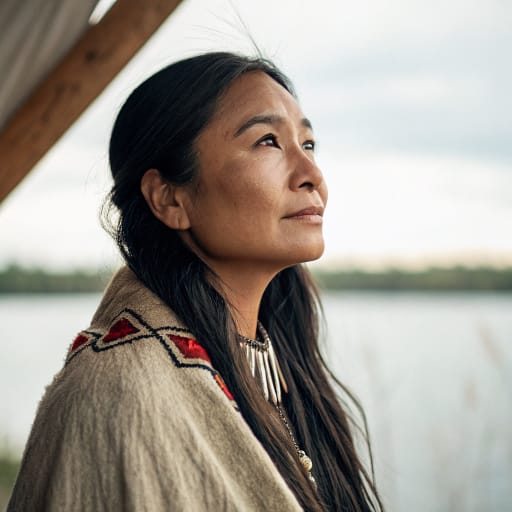
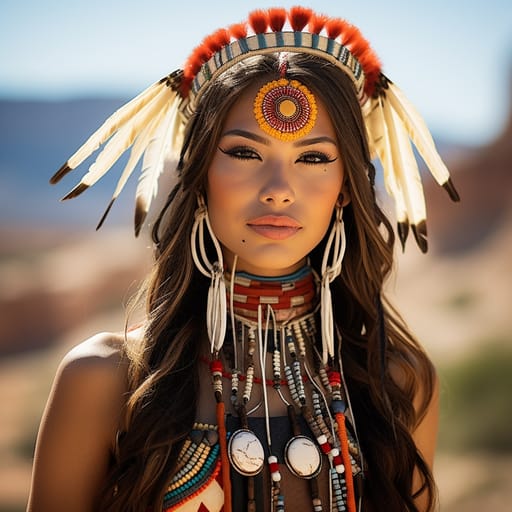
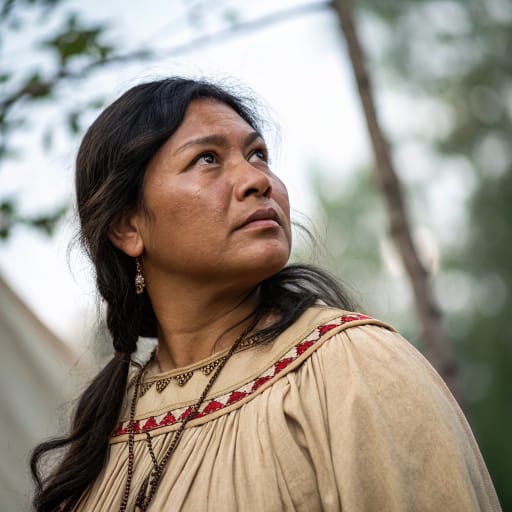
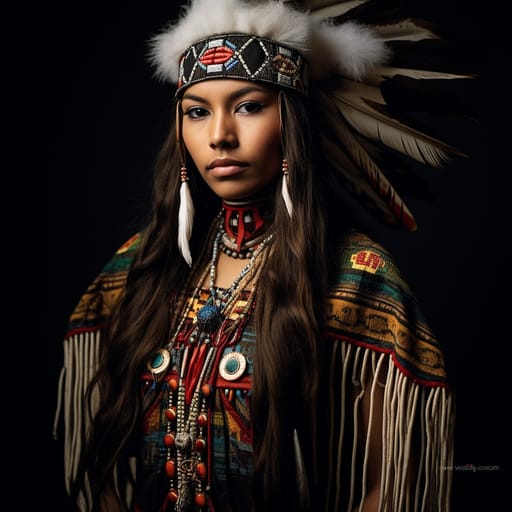
Typical Kiskiack Phenotypes
Reference for AI generation: hair, eyes, skin, facial structure, build
Kiskiack Body & Anatomy Reference
Per-feature anatomical profile for AI nude generation: Indigenous Northern American / Algonquian-Iroquoian phenotype
Kiskiack Boobs & Breasts
Kiskiack tits and boobs run medium cup, moderate projection, the classic Indigenous Northern American / Algonquian-Iroquoian bust profile. Kiskiack nipples and areolas show medium-brown areolar pigmentation against the copper-to-medium-brown skin tone, with areolar diameter typically in the 30-44mm range and forward-set positioning rather than the smaller East Asian bust. Kiskiack breasts trend full and moderate projection, a function of the mesomorph, broader frame in northern Indigenous populations body habitus and the mean adult female BMI 25-28. For anatomically accurate AI-generated Kiskiack nudes the render preserves the medium cup, moderate projection shape, 30-44mm areolas with medium-brown pigmentation, and the torso proportions of the Indigenous Northern American / Algonquian-Iroquoian phenotype.
Kiskiack Ass & Hips
Kiskiack hips and butt usually read as medium, moderate-to-full projection. The skeletal base is medium iliac crests, the Indigenous Northern American / Algonquian-Iroquoian pattern. Set against the slim East Asian narrow-hip profile, the difference is easy to see, and the hip-to-waist ratio is often what identifies Kiskiack women in photos.
Kiskiack Vagina & Pussy
Expect medium-brown labial pigmentation on Kiskiack women, in keeping with Indigenous Northern American / Algonquian-Iroquoian ancestry. The pubic hair is straight medium-coarse texture. Coloring should run evenly from the copper to medium-brown skin of the thighs to the labia, and Kiskiack nude imagery should keep the hair's straight medium-coarse texture.
Kiskiack Dicks & Penis
Kiskiack dick and penile anatomy in adult AI generation should anchor on the regional reference data: regional mean ~13cm erect, moderate girth, and medium-brown shaft pigmentation. The Kiskiack cock profile reflects the Indigenous Northern American / Algonquian-Iroquoian population's anthropometric measurements. The shaft pigmentation should track the surrounding copper to medium-brown skin tone, and the pubic hair should keep its straight medium-coarse texture in the typical inverted-V escutcheon.
Kiskiack Body, Curves & Build
Kiskiack body type: mesomorph, broader frame in northern Indigenous populations, with mean adult female BMI 25-28. This is the typical Indigenous Northern American / Algonquian-Iroquoian build. Height range, shoulder-to-hip ratio and fat distribution all follow from it, which is what an accurate Kiskiack nude body should show.
Kiskiack Skin Tone & Hair Texture
Kiskiack skin tone falls in the copper to medium-brown (Fitzpatrick III-V) band, the surface signal most often miscalibrated by generic AI nude generators. Kiskiack hair texture is typically straight 1A, dark-brown to black, often thick and dense, characteristic of the Indigenous Northern American / Algonquian-Iroquoian phenotype. In Kiskiack nude renders the skin should hold that band consistently across the body.
Explore phenotype categories
Structured taxonomy with peer-reviewed scales · 22 anatomical categories
Erotic Poses & Sex Positions
From the pose catalog: 219 named positions with reference skeletons
Frequently asked questions about Kiskiack people
Where is the Kiskiack homeland?
The Kiskiack homeland is South bank of the York River on the Virginia Peninsula, present-day York County, Virginia, United States; after about 1630 the Piankatank River on Virginia's Middle Peninsula. in North America.
What language do Kiskiack people speak?
Kiskiack people primarily speak Powhatan, also called Virginia Algonquian (Algic, Eastern Algonquian branch); out of use since the late 18th century.
What religion do Kiskiack people practice?
The predominant religion among Kiskiack people is Traditional Powhatan religion: priest-kept temples, offerings to the spirit Okeus, belief in a distant creator, Ahone.






Make your own Kiskiack images
Five a day, free, no credits to buy. The studio starts from this group's phenotype data, so you can set body type, pose and style and keep the traits accurate.
Start with Kiskiack