Help us get this right
Does this portrait look right for Kakwa?
Nobody has judged this one yet. You would be the first.
Kakwa Erotic
The tri-border area of northwestern Uganda (Koboko and Yumbe districts), Central Equatoria in South Sudan (Yei and Morobo), and Aru territory in Ituri, DR Congo.
Kakwa (Eastern Nilotic, Nilo-Saharan), very close to Bari; Juba Arabic, English, Swahili, Lingala, and French are used according to which state one lives in.
Christian, Catholic and Anglican, across most of the group, with a large Sunni Muslim community in Uganda's Koboko; older rainmaking and ancestral practice persists alongside both.
One of the Karo or Bari-speaking peoples, with the Bari, Kuku, Pojulu, Mundari, and Nyangwara; usually distinguished as Ugandan, South Sudanese, and Congolese Kakwa, and partly ancestral to Uganda's Nubi community.
About Kakwa People
The Kakwa live where three countries meet, on the rolling savanna and low hills around the corner shared by South Sudan, Uganda, and the Democratic Republic of the Congo. That position is not incidental to who they are. One people was cut into three pieces by colonial map making: part of their country sat inside the Lado Enclave, leased to Leopold II and run as an appendage of the Congo Free State, and when that arrangement lapsed after his death the boundaries were redrawn so that Kakwa found themselves answering to Khartoum, Entebbe, and Boma. They went on crossing regardless. Families in Koboko, Yei, and Aru are still the same families, and it is unremarkable for a Kakwa household to hold papers from more than one state, use the trade language of each, and treat the border as an inconvenience with a market attached to it.
Their language, Kakwa, is Eastern Nilotic and close enough to Bari that specialists still argue over whether it is a separate tongue or a dialect of one. That puts the Kakwa in the Karo cluster alongside the Bari, Kuku, Pojulu, Mundari, and Nyangwara, and it also puts them on a real linguistic frontier: their western neighbors, the Lugbara and Madi, speak Central Sudanic languages from another branch entirely, so the seam between two ancient language families runs through a day's walk of farmland. Most Kakwa farm it. Sorghum, cassava, sesame, maize, and tobacco, with goats and some cattle rather than the herding life of the Nilotes further north. Religion follows the border. Catholic and Anglican missions took hold on the Sudanese and Congolese sides, while Koboko has a large Muslim population descended in part from the nineteenth century Sudanese garrison soldiers who settled in West Nile and became the Nubi. Rainmaking lineages carried genuine authority before either faith arrived and are not entirely forgotten. The Kakwa name most outsiders recognize is Idi Amin, Kakwa through his father and raised in Koboko, whose eight years in power made the group briefly and unhappily famous and drove thousands into exile when the regime collapsed in 1979. Four decades later the traffic reversed, and Kakwa fleeing the fighting around Yei walked south into Ugandan refugee settlements built on ground their grandparents had left.
Related ethnic groups
Groups that share Kakwa's homeland, region, language, or religious tradition. These are likely candidates for comparative phenotype reference.
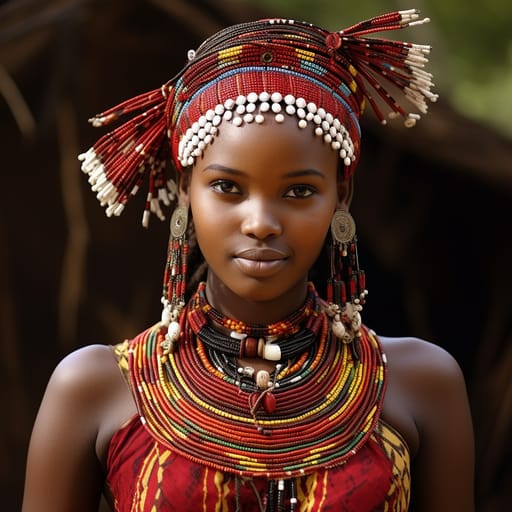
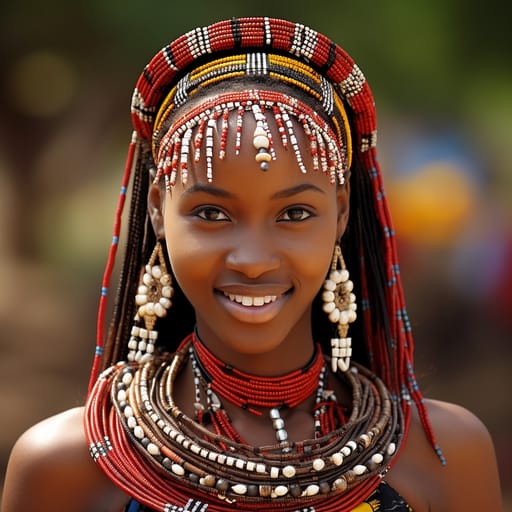
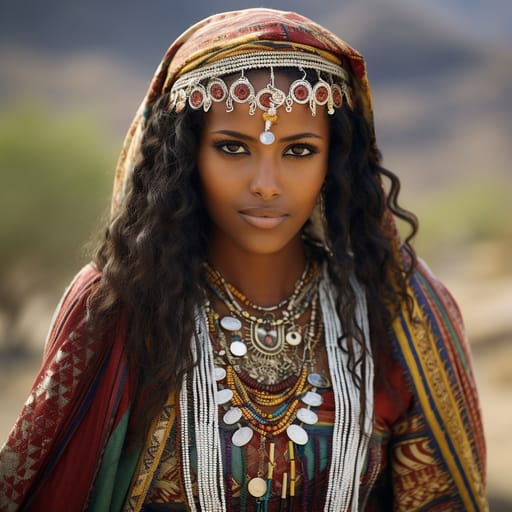
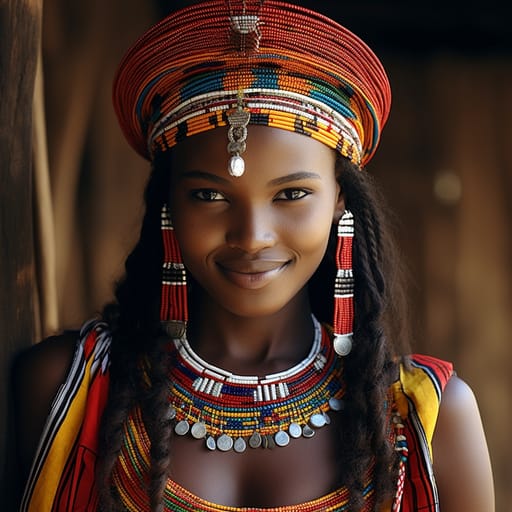
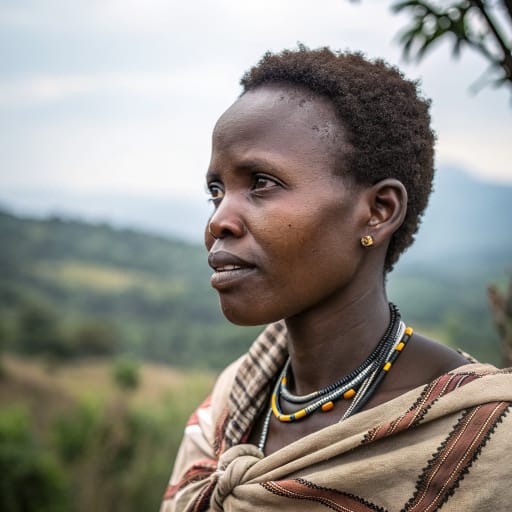
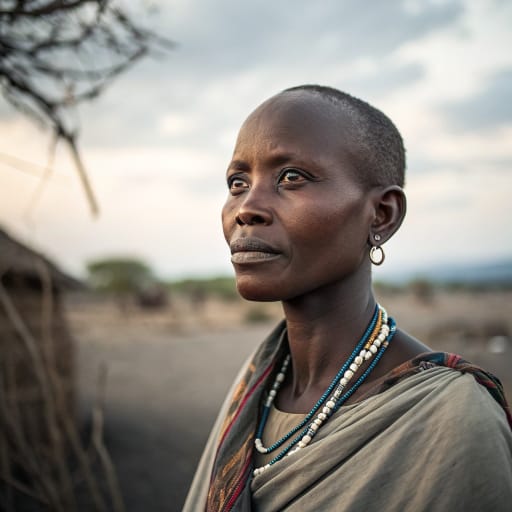
Typical Kakwa Phenotypes
Reference for AI generation: hair, eyes, skin, facial structure, build
Kakwa Body & Anatomy Reference
Anatomy by feature, Cushitic / Nilo-Cushitic East African phenotype
Kakwa Boobs & Breasts
The typical Kakwa bust is small-to-medium-cup, high-set, conical, in line with the wider Cushitic / Nilo-Cushitic East African pattern. Areolas usually fall in the 28-38mm range, with moderate-to-high areolar pigmentation against the brown-to-deep-brown skin tone. Compared with the lateral spread of the West African phenotype, Kakwa breasts sit forward and are generally firmer and less projecting than the African-American or West African norm. A faithful AI render of Kakwa tits keeps that shape and areola size.
Kakwa Ass & Hips
Butt shape among Kakwa women: small-to-medium, high-set, rounded, over narrow-to-medium iliac crests, longer torso-to-leg ratio. This follows Cushitic / Nilo-Cushitic East African ancestry and looks quite unlike the wide-set heavy-projection West African or African-American norm. An accurate Kakwa ass in adult AI imagery keeps both the silhouette and the overall build (lean ectomorph-to-mesomorph) instead of a generic average.
Kakwa Vagina & Pussy
Vulvar anatomy among Kakwa women: brown-to-deep-brown labial pigmentation, narrow-to-medium labia minora projection. Pubic hair tends to be tightly-coiled coarse texture, densely distributed, in the usual inverted-triangle pattern. Both follow Cushitic / Nilo-Cushitic East African pigmentation, which is why Kakwa pussy renders should not fall back on a pale, sparse Western template.
Kakwa Dicks & Penis
The Kakwa cock profile, from Cushitic / Nilo-Cushitic East African anthropometric data: regional mean ~13.5cm erect; moderate girth, ~12cm circumference; deeper-pigmented than the West African norm. Pubic hair has a tightly-coiled coarse texture and forms the usual inverted-V pattern. Whether Kakwa men are circumcised follows religious and cultural practice rather than phenotype.
Kakwa Body, Curves & Build
Build and curves among Kakwa women follow the Cushitic / Nilo-Cushitic East African pattern: lean ectomorph-to-mesomorph, mean adult female BMI 19-22. Proportions matter as much as skin tone, so Kakwa figures should keep their regional height and limb ratios.
Kakwa Skin Tone & Hair Texture
The Kakwa skin range is brown to deep brown (Fitzpatrick V-VI), and hair tends to be tight 4A-4C coil, often worn natural or in braided/twisted protective styles. That combination marks the Cushitic / Nilo-Cushitic East African phenotype, and skin tone is the trait AI generators most often get wrong for Kakwa women.
Explore phenotype categories
Structured taxonomy with peer-reviewed scales · 22 anatomical categories
Erotic Poses & Sex Positions
From the pose catalog: 219 named positions with reference skeletons
Frequently asked questions about Kakwa people
Where is the Kakwa homeland?
The Kakwa homeland is The tri-border area of northwestern Uganda (Koboko and Yumbe districts), Central Equatoria in South Sudan (Yei and Morobo), and Aru territory in Ituri, DR Congo. in Eastern Africa.
What language do Kakwa people speak?
Kakwa people primarily speak Kakwa (Eastern Nilotic, Nilo-Saharan), very close to Bari; Juba Arabic, English, Swahili, Lingala, and French are used according to which state one lives in..
What religion do Kakwa people practice?
The predominant religion among Kakwa people is Christian, Catholic and Anglican, across most of the group, with a large Sunni Muslim community in Uganda's Koboko; older rainmaking and ancestral practice persists alongside both..






Make your own Kakwa images
Five a day, free, no credits to buy. The studio starts from this group's phenotype data, so you can set body type, pose and style and keep the traits accurate.
Start with Kakwa