Coeur d'Alene Erotic
The Coeur d'Alene Reservation in Benewah and Kootenai counties, northern Idaho, United States, centered on Lake Coeur d'Alene, with historic territory reaching into eastern Washington and western Montana.
Coeur d'Alene, or Snchitsu'umshtsn (Salishan, Southern Interior branch), and English
Predominantly Roman Catholic since the 1840s, alongside continuing Schitsu'umsh ceremonial practice including sweat lodge and winter dance.
An Interior Salish people of the Columbia Plateau, closely tied to the Spokane, Kalispel, and Pend d'Oreille. One of five federally recognized tribes in Idaho.
About Coeur d'Alene People
The Coeur d'Alene call themselves Schitsu'umsh, usually translated as those who were found here. The name the rest of the world uses came from somewhere else: French-speaking fur traders called them coeur d'alene, heart of an awl, reportedly a remark about how sharply they bargained. Both names stuck, which says something about a people who have spent two centuries negotiating from a fixed position. Their country covered roughly four million acres of what is now the Idaho Panhandle, eastern Washington, and a corner of western Montana, organized around the lake that carries their name and the rivers that feed it: the Coeur d'Alene, the St. Joe, the Spokane. Their language, Snchitsu'umshtsn, belongs to Interior Salish and sits close to Spokane and Kalispel, while the Nez Perce immediately to the south speak something from an entirely different family. Winter meant pit houses and stored food. The rest of the year moved with camas, bitterroot, huckleberries, cutthroat trout, and the water potato, a marsh tuber pulled out of cold mud in late October and still dug today at an annual tribal holiday. Horses arrived early in the 1700s and carried them east over the mountains after bison, without ever loosening their grip on the lake.
Catholicism came in 1842 with the Jesuits, and the tribe tells it as fulfillment rather than conquest: the chief Circling Raven had foretold the arrival of men in black robes. Tribal labor raised the Mission of the Sacred Heart at Cataldo between 1850 and 1853, wattle and daub, not a nail in it, and it is still the oldest standing building in Idaho. Every August 15 members walk to it for the Feast of the Assumption, a pilgrimage older than the state. The rest of the inheritance is harder. In 1858 the Coeur d'Alene helped rout Colonel Steptoe's column near present-day Rosalia, and Colonel Wright's answer that fall included shooting some 800 captured horses on the bank of the Spokane River. Allotment opened the reservation to homesteaders in 1909 and cut it to a fraction of its size. Then a century of silver mining upstream sent lead, zinc, and cadmium down the Coeur d'Alene River into the lakebed. The tribe sued the mining companies in 1991 and forced one of the largest Superfund actions in the country, and in 2001 the Supreme Court confirmed its ownership of the southern lakebed. About 2,300 enrolled members now run a government at Plummer, a resort casino at Worley, a tribal school and a health center, and a language program rebuilding a Salish tongue that came very close to going silent.
Related ethnic groups
Groups that share Coeur d'Alene's homeland, region, language, or religious tradition. These are likely candidates for comparative phenotype reference.

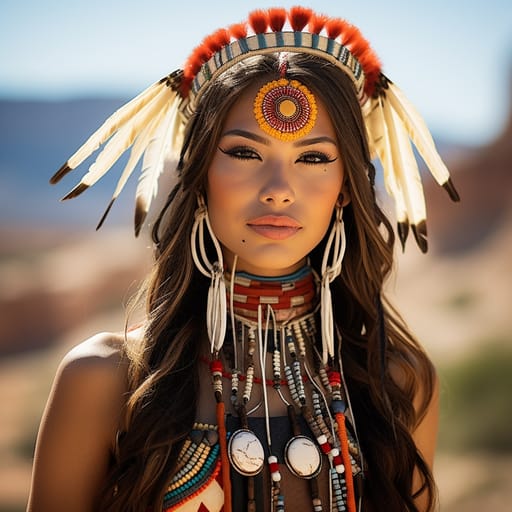
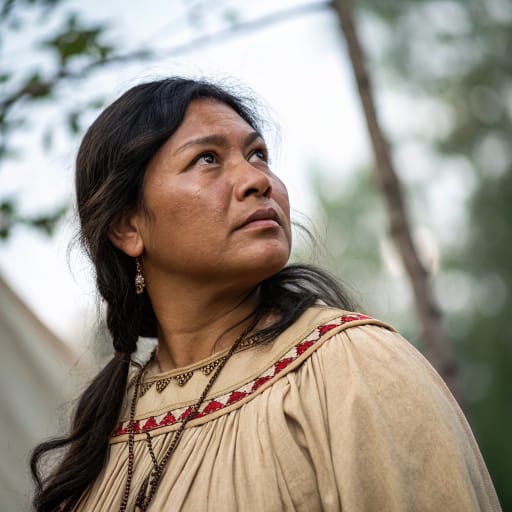
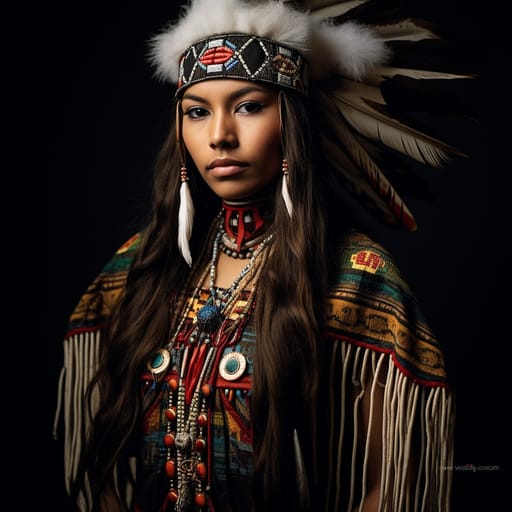

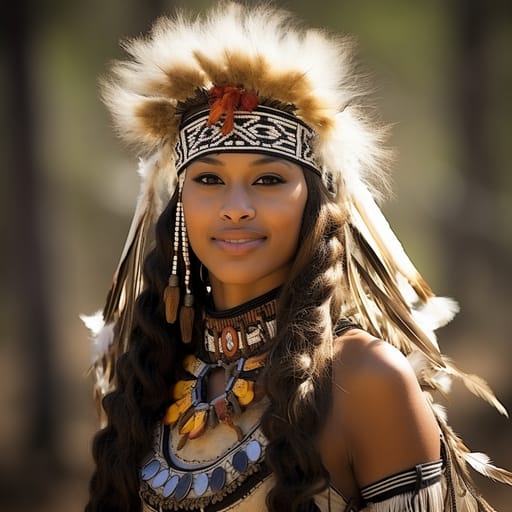
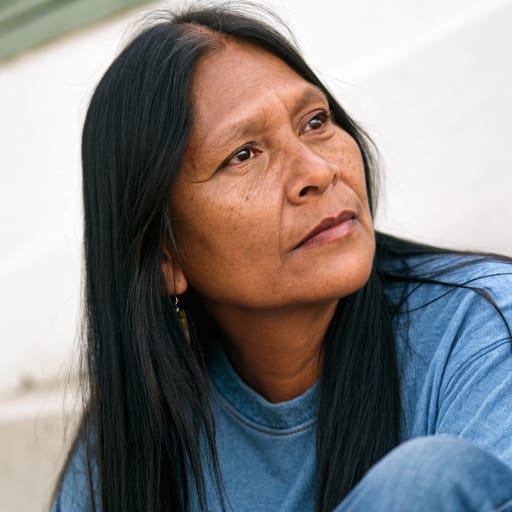
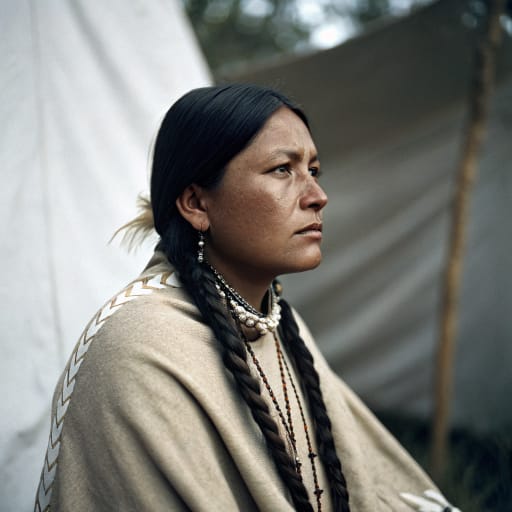
Typical Coeur d'Alene Phenotypes
Reference for AI generation: hair, eyes, skin, facial structure, build
Coeur d'Alene Body & Anatomy Reference
Indigenous Northern American / Algonquian-Iroquoian phenotype: anatomy reference for AI nude generation
Coeur d'Alene Boobs & Breasts
Coeur d'Alene tits and boobs run medium cup, moderate projection, the classic Indigenous Northern American / Algonquian-Iroquoian bust profile. Coeur d'Alene nipples and areolas show medium-brown areolar pigmentation against the copper-to-medium-brown skin tone, with areolar diameter typically in the 30-44mm range and forward-set positioning rather than the smaller East Asian bust. Coeur d'Alene breasts trend full and moderate projection, a function of the mesomorph, broader frame in northern Indigenous populations body habitus and the mean adult female BMI 25-28. For anatomically accurate AI-generated Coeur d'Alene nudes the render preserves the medium cup, moderate projection shape, 30-44mm areolas with medium-brown pigmentation, and the torso proportions of the Indigenous Northern American / Algonquian-Iroquoian phenotype.
Coeur d'Alene Ass & Hips
Coeur d'Alene hips and butt usually read as medium, moderate-to-full projection. The skeletal base is medium iliac crests, the Indigenous Northern American / Algonquian-Iroquoian pattern. Set against the slim East Asian narrow-hip profile, the difference is easy to see, and the hip-to-waist ratio is often what identifies Coeur d'Alene women in photos.
Coeur d'Alene Vagina & Pussy
Expect medium-brown labial pigmentation on Coeur d'Alene women, in keeping with Indigenous Northern American / Algonquian-Iroquoian ancestry. The pubic hair is straight medium-coarse texture. Coloring should run evenly from the copper to medium-brown skin of the thighs to the labia, and Coeur d'Alene nude imagery should keep the hair's straight medium-coarse texture.
Coeur d'Alene Dicks & Penis
Coeur d'Alene dick and penile anatomy in adult AI generation should anchor on the regional reference data: regional mean ~13cm erect, moderate girth, and medium-brown shaft pigmentation. The Coeur d'Alene cock profile reflects the Indigenous Northern American / Algonquian-Iroquoian population's anthropometric measurements. The shaft pigmentation should track the surrounding copper to medium-brown skin tone, and the pubic hair should keep its straight medium-coarse texture in the typical inverted-V escutcheon.
Coeur d'Alene Body, Curves & Build
Coeur d'Alene body type: mesomorph, broader frame in northern Indigenous populations, with mean adult female BMI 25-28. This is the typical Indigenous Northern American / Algonquian-Iroquoian build. Height range, shoulder-to-hip ratio and fat distribution all follow from it, which is what an accurate Coeur d'Alene nude body should show.
Coeur d'Alene Skin Tone & Hair Texture
Coeur d'Alene skin tone falls in the copper to medium-brown (Fitzpatrick III-V) band, the surface signal most often miscalibrated by generic AI nude generators. Coeur d'Alene hair texture is typically straight 1A, dark-brown to black, often thick and dense, characteristic of the Indigenous Northern American / Algonquian-Iroquoian phenotype. In Coeur d'Alene nude renders the skin should hold that band consistently across the body.
Explore phenotype categories
Structured taxonomy with peer-reviewed scales · 22 anatomical categories
Erotic Poses & Sex Positions
From the pose catalog: 219 named positions with reference skeletons
Frequently asked questions about Coeur d'Alene people
Where is the Coeur d'Alene homeland?
The Coeur d'Alene homeland is The Coeur d'Alene Reservation in Benewah and Kootenai counties, northern Idaho, United States, centered on Lake Coeur d'Alene, with historic territory reaching into eastern Washington and western Montana. in North America.
What language do Coeur d'Alene people speak?
Coeur d'Alene people primarily speak Coeur d'Alene, or Snchitsu'umshtsn (Salishan, Southern Interior branch), and English.
What religion do Coeur d'Alene people practice?
The predominant religion among Coeur d'Alene people is Predominantly Roman Catholic since the 1840s, alongside continuing Schitsu'umsh ceremonial practice including sweat lodge and winter dance..






Make your own Coeur d'Alene images
Five a day, free, no credits to buy. The studio starts from this group's phenotype data, so you can set body type, pose and style and keep the traits accurate.
Start with Coeur d'Alene