Help us get this right
Does this portrait look right for Bunda?
Nobody has judged this one yet. You would be the first.
Bunda Erotic
Kwilu Province, Democratic Republic of the Congo, centered on Idiofa between the Kwilu and Kasai rivers; sizable community in Kinshasa
Kimbuun or Mbuun (Bantu, Niger-Congo); Kituba, Lingala and French also widely used
Mostly Christian, largely Roman Catholic, with Protestant and revival churches; ancestral beliefs and traditional healing persist
Bantu peoples of Kwilu and the lower Kasai; linguistically closest to the Yansi and Ding; distinct from the Mbunda of Angola and Zambia
About Bunda People
Outsiders have long written the name as Bunda, Babunda or Bambunda, and older Congolese sources often say Mbunda. The people's own usage is closer to Mbuun, which is also the name of their language, Kimbuun. They are a Bantu farming people of Kwilu Province in the Democratic Republic of the Congo. Most live around the town of Idiofa, in the savanna and gallery forest between the Kwilu and Kasai rivers. The similar names cause constant confusion, but the Mbuun have no special link to the Mbunda of eastern Angola and western Zambia, who live far to the south.
Kimbuun belongs to a small group of Bantu languages along the lower Kasai that also includes Yansi and Ding. These languages have dropped many of the final vowels that give most Bantu speech its open rhythm, so Kimbuun sounds clipped and heavy on consonants. Few Mbuun get by in one language, though. Kimbuun is used at home and in the village. Kituba, the state's version of Kikongo, is the trade language across Kwilu, and Lingala and French take over in Kinshasa, in schools and in offices.
Rural life depends on cassava fields, oil palms, river fishing and the market towns where crops are sold. Under Belgian rule the region's economy was built around palm oil concessions, and Catholic missionaries became firmly established around Idiofa, which now has its own diocese. Most Mbuun today are Christian, mainly Catholic, though Protestant and newer revival churches exist too. Older beliefs are still around: ancestors, healers and suspicions of witchcraft still shape how many people explain illness and bad luck.
The Mbuun matter far more in Congolese political memory than their numbers would suggest. Pierre Mulele, a Mbuun from Kwilu, was education minister in Patrice Lumumba's short-lived 1960 government. After Lumumba was murdered, Mulele trained in China and came home to lead the Kwilu rebellion of 1964. His guerrilla bands recruited heavily among young Mbuun and Pende villagers. The army crushed the uprising within about two years, and the villages paid a heavy price. In 1968 Mulele accepted an offer of amnesty and returned to Kinshasa, where Mobutu's government executed him. Today many Mbuun live and work in Kinshasa, but the Idiofa countryside is still their homeland.
Related ethnic groups
Groups that share Bunda's homeland, region, language, or religious tradition. These are likely candidates for comparative phenotype reference.
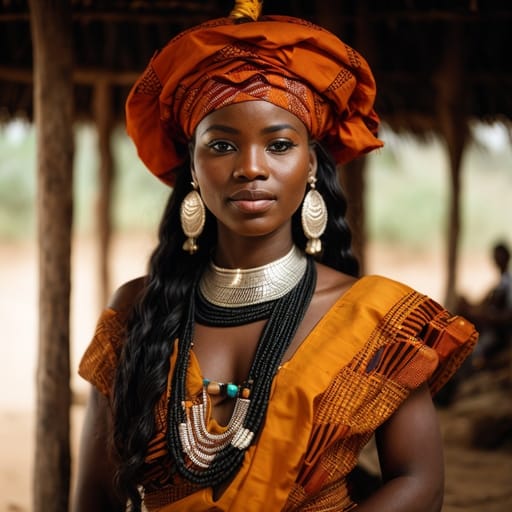
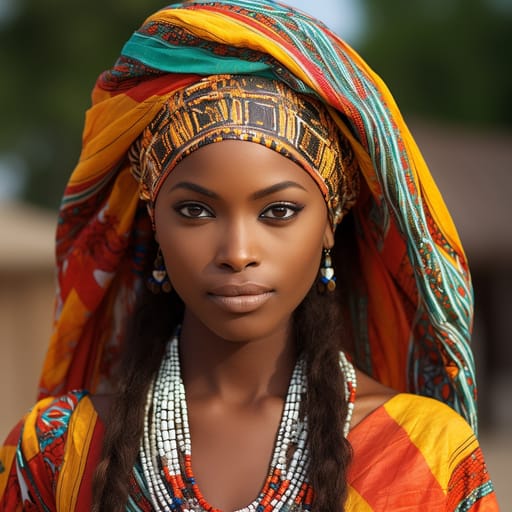
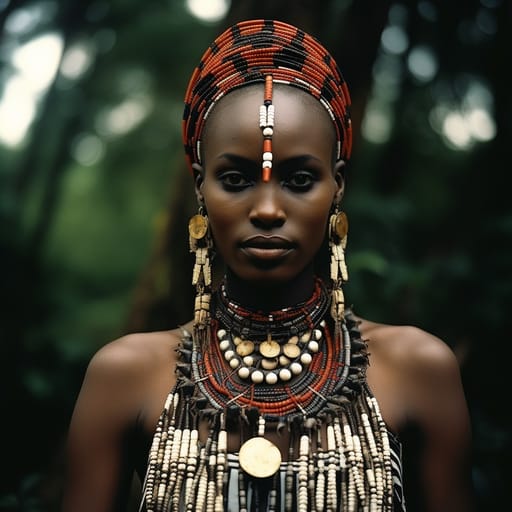
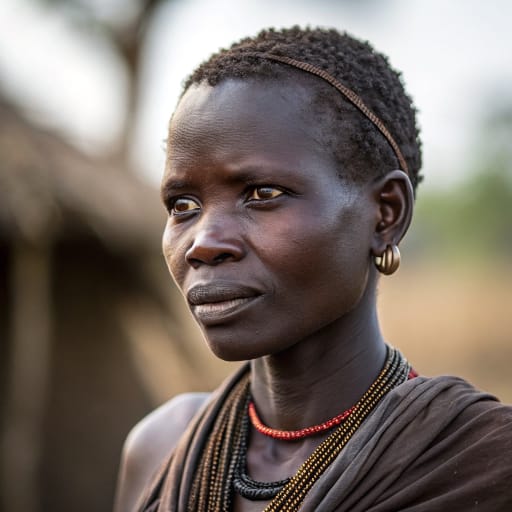
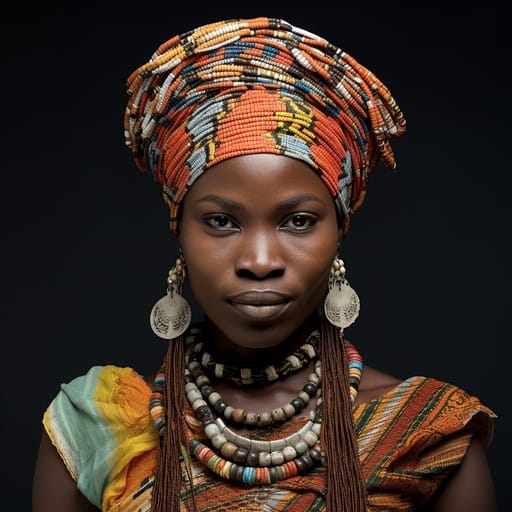
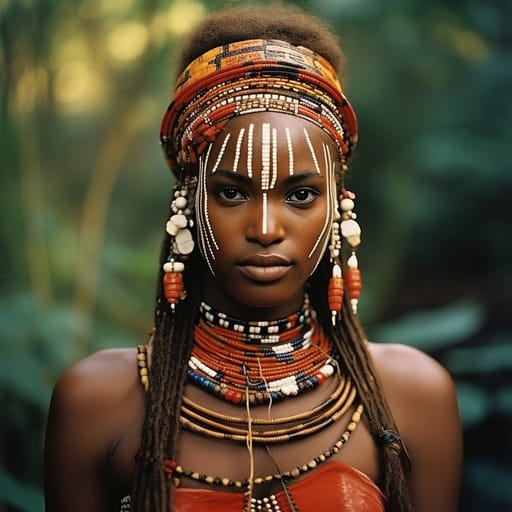
Typical Bunda Phenotypes
Reference for AI generation: hair, eyes, skin, facial structure, build
Bunda Body & Anatomy Reference
Per-feature anatomical profile for AI nude generation: Bantu / Central African Niger-Congo phenotype
Bunda Boobs & Breasts
Bunda boobs follow the Bantu / Central African Niger-Congo profile: medium-to-large cup, full, projecting. Areolar diameter is usually 32-48mm, and the coloring is deep-brown areolar pigmentation against the deep-brown skin tone. Breast shape tracks body composition (mesomorph with strong gluteal-femoral fat deposition, mean adult female BMI 23-26), so Bunda breasts tend to be fuller projection than East African; comparable to West African norm. Expect a forward-set shape, not the smaller East African conical profile.
Bunda Ass & Hips
Bunda ass and hip morphology presents as full, projected, wide-set glutes, distinctly different from the slim narrow-hip Cushitic East African profile. The Bunda pelvic profile shows broad iliac crests, gynoid pelvic pattern, anchored in the Bantu / Central African Niger-Congo skeletal pattern. Bunda butt shots in adult AI imagery should render the full, projected, wide-set glutes silhouette with the overall build (mesomorph with strong gluteal-femoral fat deposition) and the fat distribution typical of the Bantu / Central African Niger-Congo phenotype.
Bunda Vagina & Pussy
Bunda pussy anatomy typically shows deep-brown labial pigmentation, fuller labia minora. Pubic hair is usually tightly-coiled coarse texture, dense distribution. In AI-generated Bunda nudes, labial color should blend into the deep-brown skin with a gradual transition, and the hair should keep its tightly-coiled coarse texture.
Bunda Dicks & Penis
Penis reference for Bunda men: regional mean ~14cm erect, above-average girth. Coloring: deep-brown shaft pigmentation. An accurate Bunda cock in AI imagery matches the surrounding deep-brown skin rather than a generic porn default. Circumcision depends on religion and custom, not ancestry.
Bunda Body, Curves & Build
The Bunda figure is generally mesomorph with strong gluteal-femoral fat deposition, with mean adult female BMI 23-26, characteristic of Bantu / Central African Niger-Congo ancestry. AI image tools tend to flatten regional body types into a few stock shapes; here the Bunda build is kept as its own reference.
Bunda Skin Tone & Hair Texture
Skin: deep-brown (Fitzpatrick VI). Hair: tight 4A-4C coil. Both are typical of Bantu / Central African Niger-Congo ancestry. The most common mistake in AI nudes of Bunda women is a body rendered lighter than the face.
Explore phenotype categories
Structured taxonomy with peer-reviewed scales · 22 anatomical categories
Erotic Poses & Sex Positions
From the pose catalog: 219 named positions with reference skeletons
Frequently asked questions about Bunda people
Where is the Bunda homeland?
The Bunda homeland is Kwilu Province, Democratic Republic of the Congo, centered on Idiofa between the Kwilu and Kasai rivers; sizable community in Kinshasa in Central Africa.
What language do Bunda people speak?
Bunda people primarily speak Kimbuun or Mbuun (Bantu, Niger-Congo); Kituba, Lingala and French also widely used.
What religion do Bunda people practice?
The predominant religion among Bunda people is Mostly Christian, largely Roman Catholic, with Protestant and revival churches; ancestral beliefs and traditional healing persist.






Make your own Bunda images
Five a day, free, no credits to buy. The studio starts from this group's phenotype data, so you can set body type, pose and style and keep the traits accurate.
Start with Bunda