Help us get this right
Does this portrait look right for Bru?
Nobody has judged this one yet. You would be the first.
Bru Erotic
Savannakhet Province (Laos), Vietnam (Quảng Bình and Quảng Trị Provinces)
Animism
About Bru People
The Bru are highland farmers and forest people of the Annamite borderlands, scattered across the seam where eastern Laos meets central Vietnam. Their settlements cluster in Savannakhet Province and across the ridge into Quảng Bình and Quảng Trị, and the international border drawn through that mountain spine cuts directly through Bru territory rather than around it. This matters: families and lineages straddle the line, and "Bru" in Laos and "Bru-Vân Kiều" in Vietnam refer to branches of the same people separated by twentieth-century cartography more than by any meaningful cultural divide. Smaller affiliated groups — the Khua, the Makong, the Tri — sit under or beside the Bru label depending on who is doing the counting.
Linguistically they belong to the Katuic branch of Austroasiatic, which places them in a broad family alongside Vietnamese and Khmer but in a much closer relationship with neighbours like the Pacoh, Ta-Oi, and Katu of the same uplands. Bru is a tonal-register language with a written form developed relatively recently, primarily through missionary linguistic work; older generations remain predominantly oral. Religious life is animist at its core. The forest, particular trees, river bends, household thresholds, and the rice itself all have spirits that must be acknowledged, and ritual specialists handle the negotiations — divination, buffalo sacrifice for major village rites, smaller offerings for sickness or ill omens. Christian conversion has made inroads in some Vietnamese Bru communities since the mid-twentieth century, but the animist framework underneath tends to persist alongside it rather than being displaced.
The Bru farm hill rice on swiddened plots cleared from forest, supplementing with cassava, maize, and what the forest itself yields — fish from streams, game, bamboo shoots, medicinal plants whose use is a substantial body of inherited knowledge. Houses are built on stilts, with the household hearth treated as a ritual centre rather than just a kitchen. The Vietnam War left a heavy mark: the Ho Chi Minh Trail ran straight through Bru land, villages were displaced or destroyed, and unexploded ordnance still constrains where people can safely cut new fields decades later. Postwar resettlement programs in both countries pushed many Bru off ancestral slopes and into lowland villages with paddy agriculture, a shift that has reshaped daily rhythms without erasing the older orientation toward the forest. Among the upland peoples of the central Annamites, the Bru remain among the less-documented in outside literature, which says more about who has done the documenting than about the group itself.
Related ethnic groups
Groups that share Bru's homeland, region, language, or religious tradition. These are likely candidates for comparative phenotype reference.
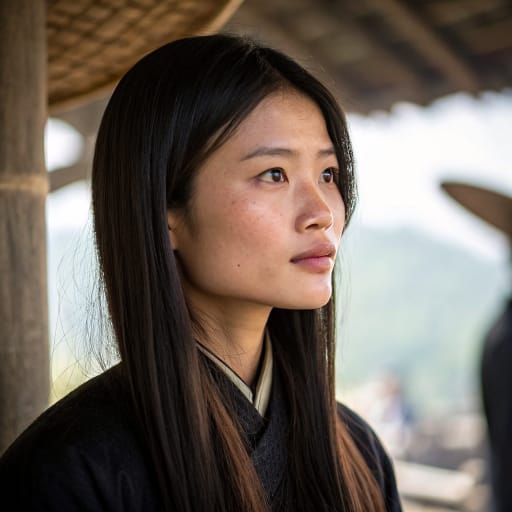
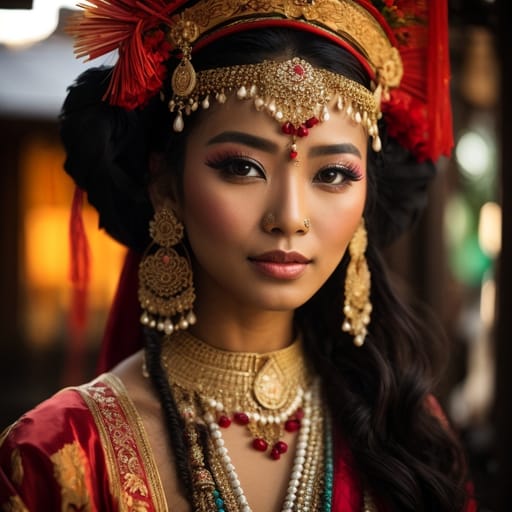
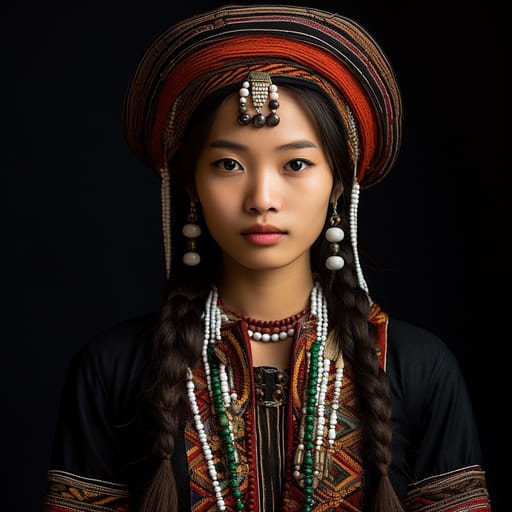
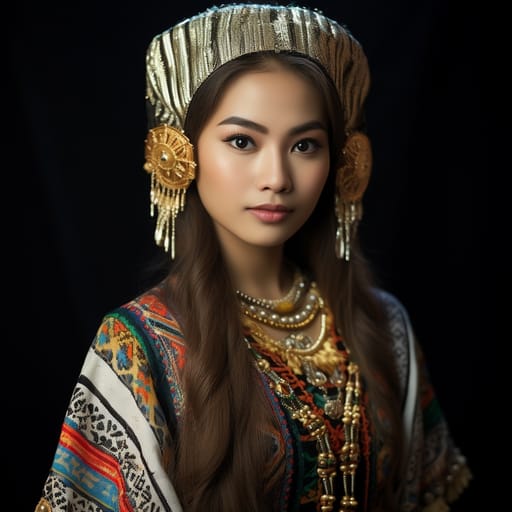
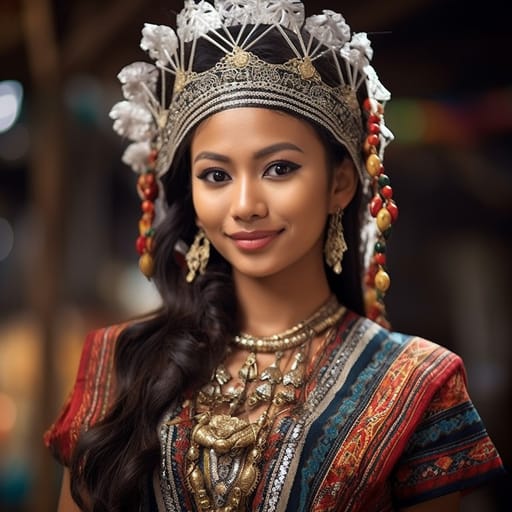
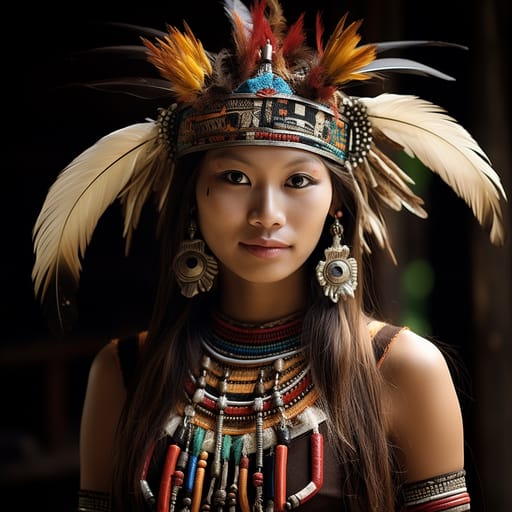
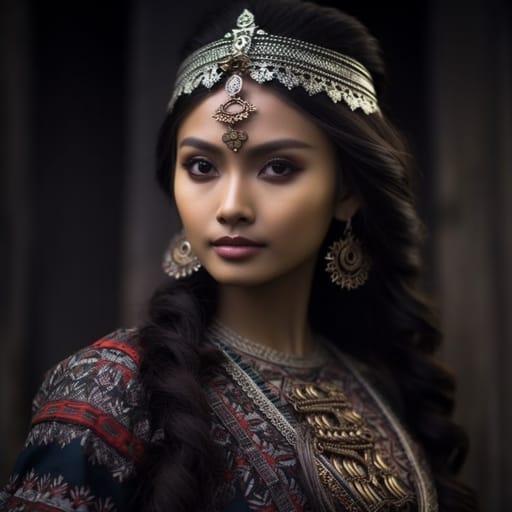
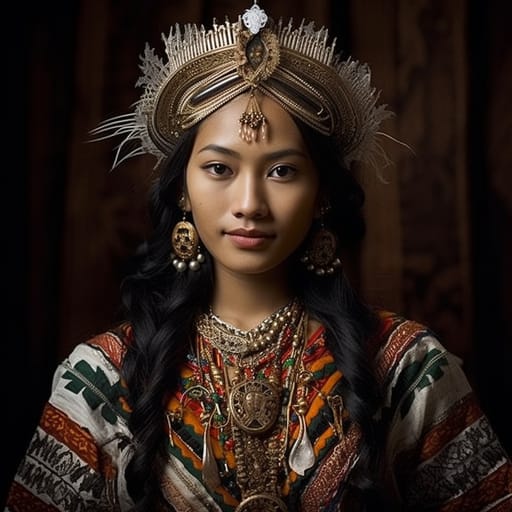
Typical Bru Phenotypes
Reference for AI generation: hair, eyes, skin, facial structure, build
The Bru are a Katuic-speaking Austroasiatic people of the Annamite foothills, and their phenotype sits squarely within mainland Southeast Asia's older Mon-Khmer substrate — closer in build and feature to neighboring Katu, Pacoh, and Khmu uplanders than to the lowland Lao or Kinh majorities they live among. The defining note is compactness: short stature, lean musculature, and a finely-boned facial structure that reads as more angular than the rounder lowland Tai-Kadai average.
Hair is uniformly black or near-black, straight to faintly wavy, with the coarse-medium texture typical of mainland Southeast Asia. Greying tends to come late. Eyes are dark brown to almost black; the epicanthic fold is present in most adults but is generally lighter and less pronounced than in northern East Asian populations, often producing a softer almond shape rather than a tightly-hooded lid. Truly monolid eyes are uncommon.
Skin tones cluster in the Fitzpatrick III–IV range, with warm olive and golden-brown undertones; field-working Bru in Savannakhet and Quảng Trị often weather to a deeper IV–V from sustained sun exposure, while sheltered faces stay noticeably lighter. The undertone is warm rather than the cooler sallow cast seen in some northern Vietnamese groups.
Facial structure leans toward a low-to-medium nasal bridge with a broader alar base than Sinitic populations — a Mon-Khmer signature shared with the Katu and Bahnar. Lips are medium-full, jaws relatively narrow, cheekbones present but not the dramatic high-and-wide projection of Tibeto-Burman or northern Tai phenotypes. Foreheads are typically modest, the overall facial outline oval to slightly heart-shaped.
Build is small-framed and wiry. Adult men commonly fall in the 1.55–1.65 m range and women 1.45–1.55 m, with low body-fat percentages tied to subsistence agriculture and forest foraging. The Vietnamese-side Vân Kiều and Trì subgroups and the Laotian-side So branch are phenotypically near-indistinguishable; differences between them are linguistic and cultural rather than visible.
Bru Body & Anatomy Reference
Southeast Asian Austronesian / Austroasiatic phenotype: anatomy reference for AI nude generation
Bru Boobs & Breasts
Bust reference for Bru women: small-to-medium cup, modest projection, which is typical of Southeast Asian Austronesian / Austroasiatic ancestry. Areolas measure about 26-38mm across, with medium-brown to dark-brown pigmentation. Body type (ectomorph, petite frame) shapes the bust as well, so Bru tits are usually firm, modest projection. In AI imagery, keep the forward-set shape rather than drifting toward the fuller South Asian or Polynesian bust.
Bru Ass & Hips
The Bru ass is typically small-to-medium, modest projection, narrower hip profile, which sets it apart from the fuller glutes of the Pacific Islander phenotype. Underneath, the pelvis shows narrow-to-medium iliac crests, part of the Southeast Asian Austronesian / Austroasiatic skeletal pattern. For Bru butt pics and AI renders, match that silhouette and the overall build (ectomorph, petite frame).
Bru Vagina & Pussy
Bru pussy and vulvar anatomy presents medium-brown to dark-brown labial pigmentation, consistent with the Southeast Asian Austronesian / Austroasiatic phenotype's pigmentation pattern. Bru pubic hair is typically straight-to-wavy fine-to-medium texture, in the inverted-triangle pattern. For anatomically accurate Bru pussy renders the labial coloration should match the surrounding tan to medium-brown skin tone with a continuous gradient, and the hair should keep its straight-to-wavy fine-to-medium texture.
Bru Dicks & Penis
Bru dicks follow the Southeast Asian Austronesian / Austroasiatic reference data: regional mean ~11cm erect; moderate girth; medium-brown shaft pigmentation. Shaft color should track the tan to medium-brown skin tone with a smooth change toward the glans, and Bru pubic hair keeps its straight-to-wavy fine-to-medium texture.
Bru Body, Curves & Build
Bru body type and overall build presents as ectomorph, petite frame, with mean adult female BMI 20-23: the characteristic Southeast Asian Austronesian / Austroasiatic habitus. Bru curves and proportions should keep the regional skeletal frame (height, shoulder-to-hip ratio, limb proportions) rather than a generic mesomorph default.
Bru Skin Tone & Hair Texture
Bru skin sits in the tan to medium-brown (Fitzpatrick III-V) band. Hair is typically straight-to-wavy 1A-2A, dark-brown to black, in keeping with the Southeast Asian Austronesian / Austroasiatic phenotype. In nude renders the skin should stay one even tone from face to body, and body, pubic and head hair should match.
Data depth
0/100Coverage of image-grounded phenotype observations · drives AI generation diversity
- Sample size
- 0/40· 0 images
- Image quality
- 0/30· 0% high
- Confidence
- 0/20
- Source diversity
- 0/10
- ·No image observations yet
Explore phenotype categories
Structured taxonomy with peer-reviewed scales · 22 anatomical categories
Erotic Poses & Sex Positions
From the pose catalog: 219 named positions with reference skeletons
Frequently asked questions about Bru people
Where is the Bru homeland?
The Bru homeland is Savannakhet Province (Laos), Vietnam (Quảng Bình and Quảng Trị Provinces) in Southeast Asia.
What language do Bru people speak?
Bru people primarily speak Austroasiatic / Katuic / Bru.
What religion do Bru people practice?
The predominant religion among Bru people is Animism.






Make your own Bru images
Five a day, free, no credits to buy. The studio starts from this group's phenotype data, so you can set body type, pose and style and keep the traits accurate.
Start with Bru