Help us get this right
Does this portrait look right for Bhumij?
Nobody has judged this one yet. You would be the first.
Bhumij Erotic
India (West Bengal, Odisha, Jharkhand)
Sarnaism
About Bhumij People
The Bhumij are one of the Munda-speaking peoples of eastern India, concentrated in the broken plateau country where West Bengal, Jharkhand, and Odisha meet — a landscape of laterite soil, sal forest, and small rivers cutting through low hills. The name itself comes from bhumi, "land," and the Bhumij have long pressed the claim that they belong to this earth in a way later arrivals do not. They are kin to the Munda and Ho proper, and their language sits inside the same Kherwarian branch of Austroasiatic, though centuries of proximity to Bengali and Odia speakers have left Bhumij heavily layered with Indo-Aryan vocabulary. In many villages today the household tongue has shifted entirely to Bengali or Odia, with Bhumij surviving in ritual phrases, song, and the older generation's speech.
Religiously they follow Sarnaism, the indigenous tradition shared across much of the Chota Nagpur belt. Worship centers on the sarna, a grove of preserved sal trees on the edge of the village, where the village priest — the laya or naeke — makes offerings to Sing Bonga, the sun deity, and to the local earth and ancestor spirits. The grove is not symbolic; it is the actual seat of the deities, and a village without one is considered religiously incomplete. Hindu observance overlaps in practice, particularly among Bhumij who have spent generations in closer contact with caste society, but the sarna calendar — sowing, first-fruits, hunting festivals — remains the spine of the year.
Historically the Bhumij occupied a complicated middle position. Under the late Mughal and early Company periods, many of their chiefs held tenure as ghatwals — frontier wardens responsible for the passes of the Jungle Mahals — and this quasi-feudal arrangement is what produced the Bhumij Revolt of 1832 under Ganga Narayan Singh, when the imposition of new revenue middlemen broke the older compact and the country rose for nearly a year. That episode still shapes how Bhumij remember themselves: not as a tribe peripheral to Indian history but as a people who held land on terms, lost those terms, and fought for them. Distinctive markers persist — clan-based exogamy organized around totemic killis, a strong tradition of communal hunting at Sendra, and a body of dance and drum music that travels with the agricultural calendar rather than the temple one.
Related ethnic groups
Groups that share Bhumij's homeland, region, language, or religious tradition. These are likely candidates for comparative phenotype reference.
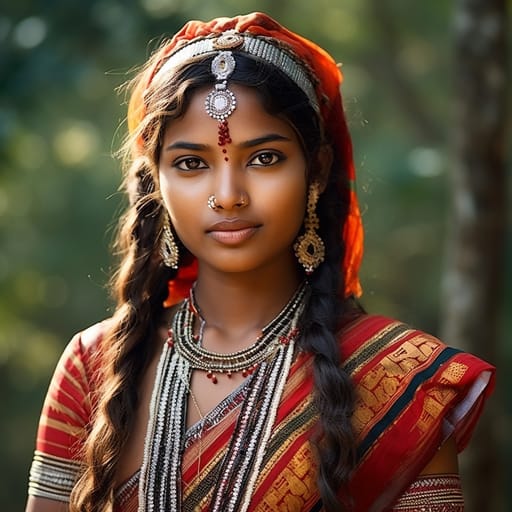
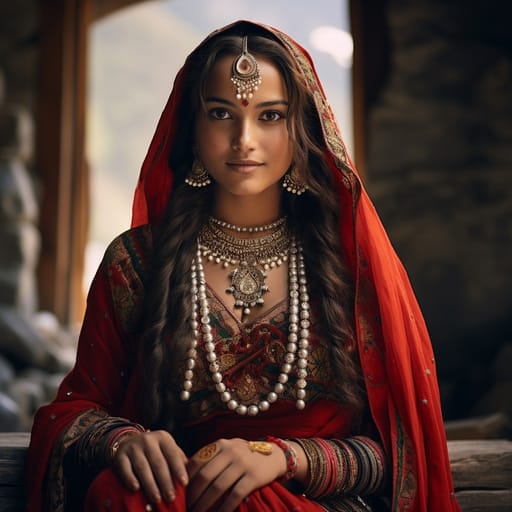
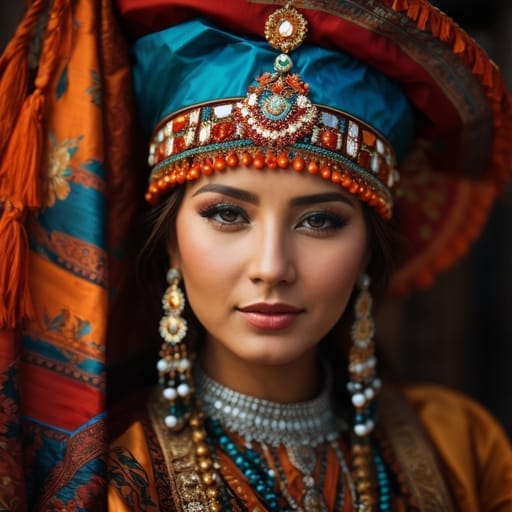
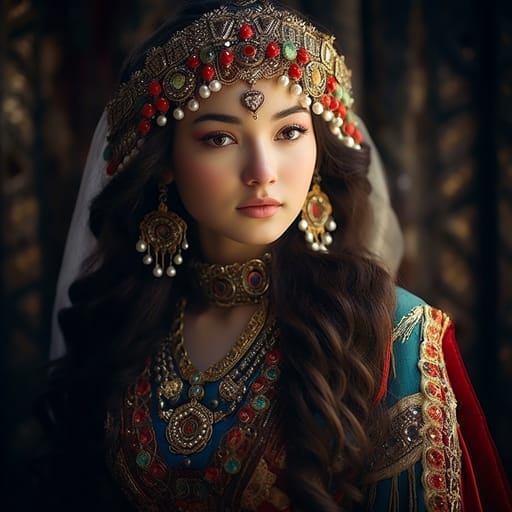
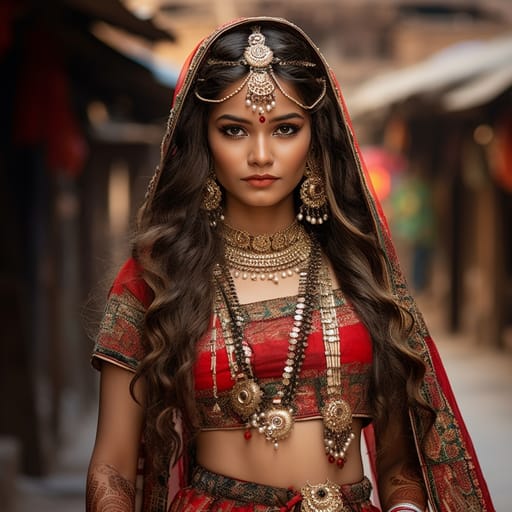
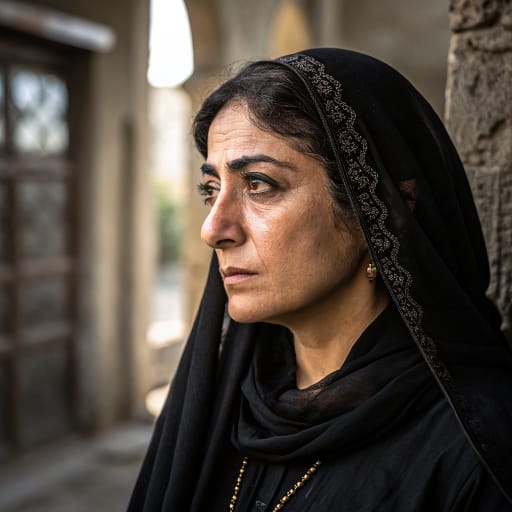
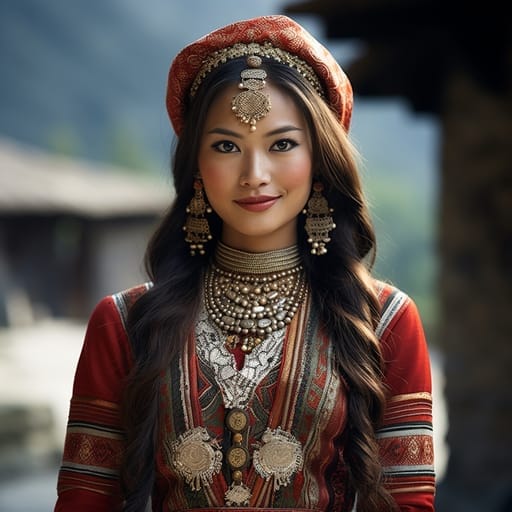
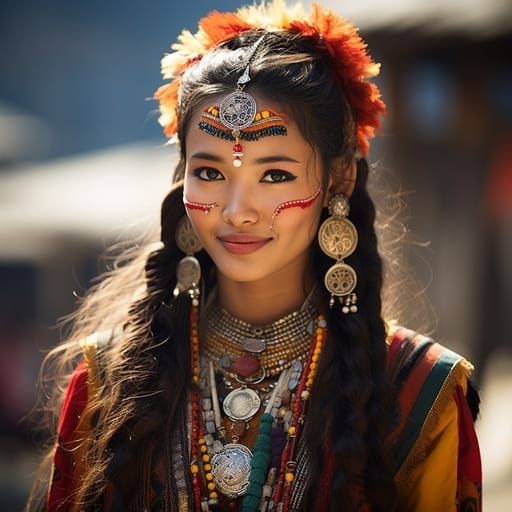
Typical Bhumij Phenotypes
Reference for AI generation: hair, eyes, skin, facial structure, build
The Bhumij are a Munda-speaking Austroasiatic tribal population of the Chota Nagpur plateau and its eastern fringes — Purulia, Singhbhum, Mayurbhanj, and the forested belts of West Bengal, Jharkhand, and Odisha. Their phenotype sits within the broader Austroasiatic-tribal cluster of eastern India: distinct from the Indo-Aryan and Dravidian populations that surround them, with closer morphological affinity to other Munda groups (Santal, Ho, Mundari) than to neighbouring Bengali or Odia castes.
Hair is uniformly black, straight to gently wavy, with coarse to medium texture. Greying tends to come late. Body and facial hair is sparse — beards thin, cheek and chest growth light — a common Austroasiatic-tribal pattern. Eyes are dark brown to near-black; a partial or incomplete epicanthic fold appears in a meaningful minority, especially in the Singhbhum and Mayurbhanj heartland, giving some faces a subtly East-Asian-leaning eye shape without the full Mongoloid morphology. Eye openings are typically narrow and almond-shaped rather than rounded.
Skin tone runs from medium brown through deep brown — Fitzpatrick IV through VI — with warm, reddish-bronze undertones distinct from the cooler olive of Bengali castes. Forest and field labour leaves the visible tone darker than the unexposed baseline. Facial structure is broad and flat-planed: low to medium nasal bridges, moderately wide alar bases, relatively wide malar bones, and squarish jaws. Lips are medium-full, often with a defined cupid's bow. Foreheads are typically broad rather than tall.
Build is short to medium-statured — men commonly 158–166 cm, women proportionally lower — with compact, wiry musculature shaped by generations of agricultural and forest work. Shoulders are squared, limbs proportionally short, hips narrow in men and moderate in women. Body fat distribution skews lean. Performers like the Chhau dancer Gambhir Singh Mura show the type clearly: low centre of gravity, dense small-frame musculature, the broad cheekbones and warm-brown skin that read as characteristically Bhumij rather than generically "Indian".
Bhumij Body & Anatomy Reference
Anatomy by feature, Indo-Aryan / Dravidian South Asian phenotype
Bhumij Boobs & Breasts
The typical Bhumij bust is medium-to-large cup, moderate-to-full projection, in line with the wider Indo-Aryan / Dravidian South Asian pattern. Areolas usually fall in the 32-46mm range, with medium-brown to dark-brown areolar pigmentation against the wheatish-to-brown skin tone. Compared with the smaller East Asian bust profile, Bhumij breasts sit forward and are generally full and soft, generally fuller than the East Asian norm. A faithful AI render of Bhumij tits keeps that shape and areola size.
Bhumij Ass & Hips
Butt shape among Bhumij women: medium-to-full, moderate-to-high projection, classic curvy hip profile, over medium-to-wide iliac crests, full gluteal-femoral fat distribution. This follows Indo-Aryan / Dravidian South Asian ancestry and looks quite unlike the slim hip profile of East Asian women. An accurate Bhumij ass in adult AI imagery keeps both the silhouette and the overall build (endomorph-to-mesomorph with fuller hip deposition) instead of a generic average.
Bhumij Vagina & Pussy
Vulvar anatomy among Bhumij women: medium-brown to dark-brown labial pigmentation, fuller labia minora projection. Pubic hair tends to be straight-to-wavy coarse texture, dense distribution, in the usual inverted-triangle pattern. Both follow Indo-Aryan / Dravidian South Asian pigmentation, which is why Bhumij pussy renders should not fall back on a pale, sparse Western template.
Bhumij Dicks & Penis
The Bhumij cock profile, from Indo-Aryan / Dravidian South Asian anthropometric data: regional mean ~13cm erect; moderate girth; medium-brown shaft pigmentation. Pubic hair has a straight-to-wavy coarse texture and forms the usual inverted-V pattern. Whether Bhumij men are circumcised follows religious and cultural practice rather than phenotype.
Bhumij Body, Curves & Build
Build and curves among Bhumij women follow the Indo-Aryan / Dravidian South Asian pattern: endomorph-to-mesomorph with fuller hip deposition, mean adult female BMI 22-25. Proportions matter as much as skin tone, so Bhumij figures should keep their regional height and limb ratios.
Bhumij Skin Tone & Hair Texture
The Bhumij skin range is wheatish to brown (Fitzpatrick III-V), and hair tends to be straight-to-wavy 1A-2B, dense, dark-brown to black. That combination marks the Indo-Aryan / Dravidian South Asian phenotype, and skin tone is the trait AI generators most often get wrong for Bhumij women.
Data depth
3/100Coverage of image-grounded phenotype observations · drives AI generation diversity
- Sample size
- 3/40· 1 image
- Image quality
- 0/30· 0% high
- Confidence
- 0/20· mean 0.10
- Source diversity
- 0/10· wikipedia
- ·No image observations yet
- ·Low overall confidence
- ·Wikipedia-only source, not population-representative
Explore phenotype categories
Structured taxonomy with peer-reviewed scales · 22 anatomical categories
Notable Bhumij People
15 reference figures, sourced from Wikipedia
- Durga Bhumij, politician
- Haren Bhumij, politician
- Jogeswar Bhumij, cricketer
- Pranjal Bhumij, footballer
- Gambhir Singh Mura, Padma Shri recipient and tribal Chhau dancer
- Amulya Sardar, politician
- Hari Ram Sardar, politician
- Maneka Sardar, politician
- Sanatan Sardar, tribal leader and politician
- Sanjib Sardar, politician
- Rani Shiromani, queen of Karnagarh and leader of Chuar rebellion
- Durjan Singh, leader of Chuar Rebellion
- Ganga Narayan Singh, leader of Bhumij rebellion and Chuar Rebellion
- Shyam Ganjam Singh, leader of Chuar Rebellion
- Subal Singh, leader of Chuar Rebellion
Erotic Poses & Sex Positions
From the pose catalog: 219 named positions with reference skeletons
Frequently asked questions about Bhumij people
Where is the Bhumij homeland?
The Bhumij homeland is India (West Bengal, Odisha, Jharkhand) in Southern Asia.
What language do Bhumij people speak?
Bhumij people primarily speak Austroasiatic / Munda / Bhumij.
What religion do Bhumij people practice?
The predominant religion among Bhumij people is Sarnaism.






Make your own Bhumij images
Five a day, free, no credits to buy. The studio starts from this group's phenotype data, so you can set body type, pose and style and keep the traits accurate.
Start with Bhumij