Help us get this right
Does this portrait look right for Bamun?
Nobody has judged this one yet. You would be the first.
Bamun Erotic
The Noun department of Cameroon's West Region, centered on the royal town of Foumban, with sizable communities in Douala and Yaoundé
Bamun, also called Shüpamom (Niger-Congo, Grassfields Bantu, Nun group); French widely used
Mostly Muslim, with Protestant and Catholic minorities and continuing ancestral and royal rites
A Grassfields people of western Cameroon; royal tradition traces the dynasty to the Tikar, and the kingdom absorbed many earlier local groups
About Bamun People
The Bamun, a name also written Bamum or Bamoun, are the people of an old kingdom in the western highlands of Cameroon, and the kingdom is still what holds them together. Foumban, the royal town, is the center of gravity: the sultan lives there, the palace stands there, and Bamun families settled in Douala or Yaoundé still trace a line back to it. Tradition dates the dynasty to the late fourteenth century, when Nchare Yen, a prince from the Tikar country, subdued the local chiefs and founded the kingdom. In the early nineteenth century King Mbuembue enlarged it, turned back raiders from the north and ringed the capital with a deep defensive trench. The two-headed serpent that became the royal emblem is read as his mark: a king who could fight on two fronts at once.
The figure most associated with the Bamun is Ibrahim Njoya, the seventeenth king, who reigned into the colonial era. Around 1896 he began devising a writing system for his language. Over many years he reworked it from pictographic signs into a compact syllabary and used it to record the kingdom's history, laws and medicine. He handled the German colonizers shrewdly, famously sending his beaded throne to Kaiser Wilhelm II. His religious life was restless: he converted to Islam, leaned toward Christianity once missionaries arrived, and even drafted a faith of his own. The French were less accommodating. They pushed him from power, and he died in exile in Yaoundé in 1933. His script fell out of everyday use, though it has since been encoded in Unicode and revival efforts keep it alive.
Most Bamun today are Muslim, which is why the ruler is styled sultan, and there is a sizable Christian minority dating from the mission era. Ancestral and palace rites carry on beside both. The language, Shüpamom, belongs to the Nun group of Grassfields Bantu. It is close to the speech of several neighboring chiefdoms and more distant from the Bamileke languages across the Noun River, while French is the language of school and government. Foumban's artisans' street is known for lost-wax brass casting, carved wood and beadwork. The most telling custom is Nguon, a royal festival brought back after a long lapse, in which the people, speaking through their notables, weigh the king's conduct in public. It is a reminder that Bamun kings were never meant to go unanswered.
Related ethnic groups
Groups that share Bamun's homeland, region, language, or religious tradition. These are likely candidates for comparative phenotype reference.
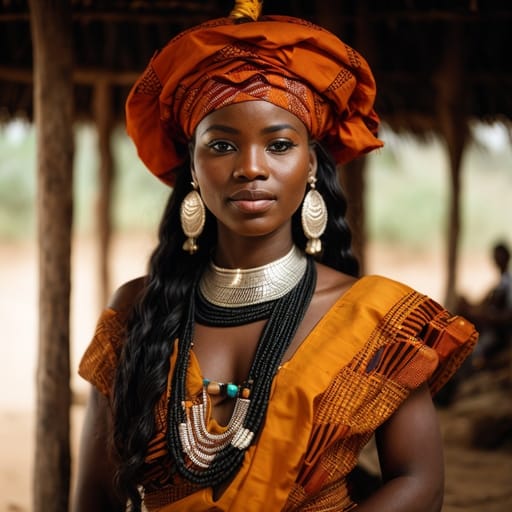
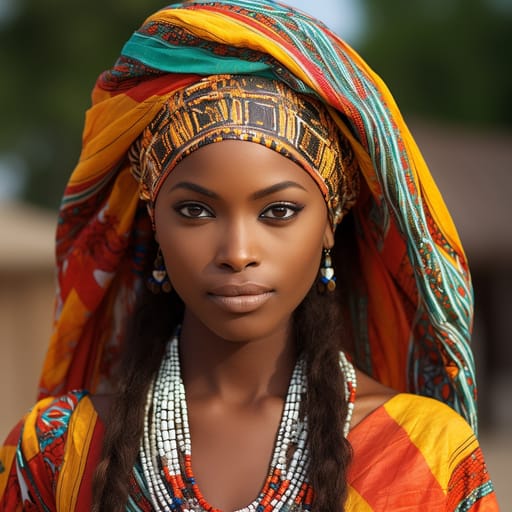
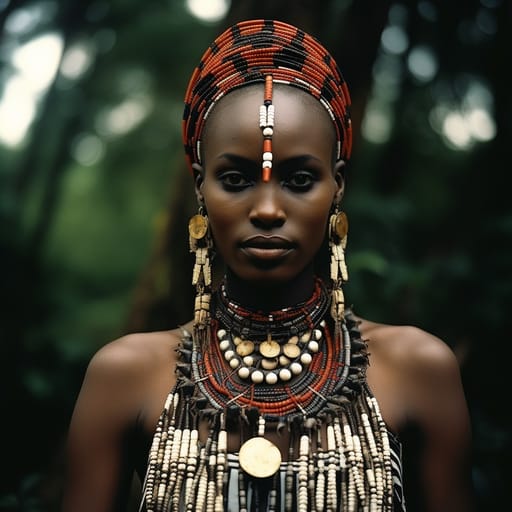
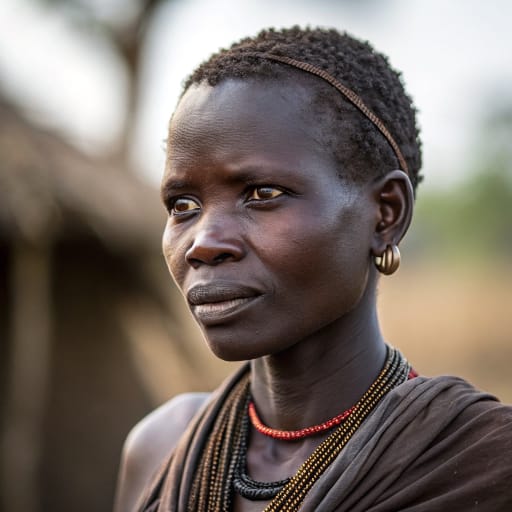
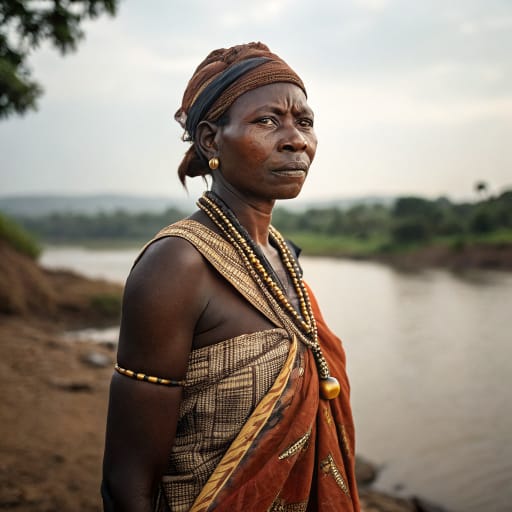
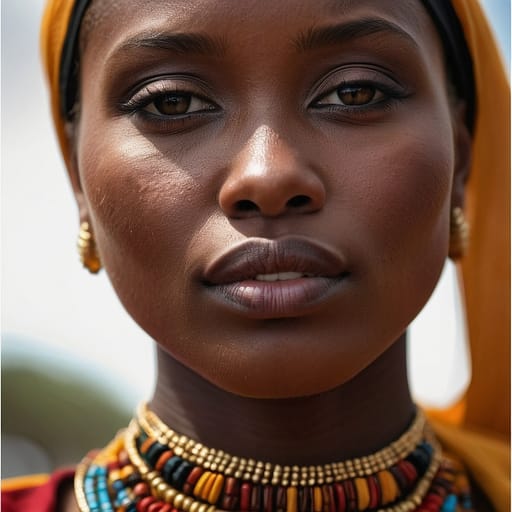
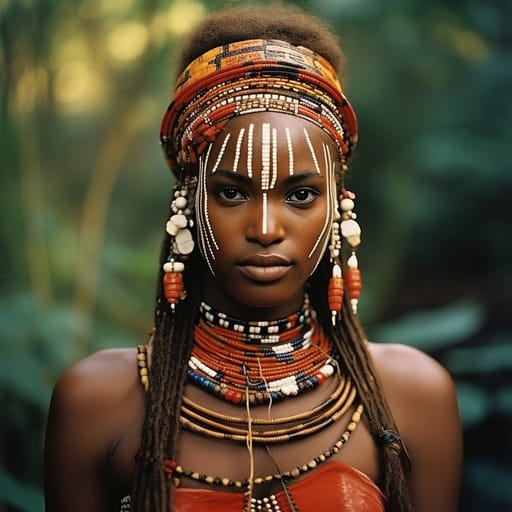
Typical Bamun Phenotypes
Reference for AI generation: hair, eyes, skin, facial structure, build
Bamun Body & Anatomy Reference
Bantu / Central African Niger-Congo phenotype: anatomy reference for AI nude generation
Bamun Boobs & Breasts
Bust reference for Bamun women: medium-to-large cup, full, projecting, which is typical of Bantu / Central African Niger-Congo ancestry. Areolas measure about 32-48mm across, with deep-brown pigmentation. Body type (mesomorph with strong gluteal-femoral fat deposition) shapes the bust as well, so Bamun tits are usually fuller projection than East African; comparable to West African norm. In AI imagery, keep the forward-set shape rather than drifting toward the smaller East African conical profile.
Bamun Ass & Hips
The Bamun ass is typically full, projected, wide-set glutes, which sets it apart from the slim narrow-hip Cushitic East African profile. Underneath, the pelvis shows broad iliac crests, gynoid pelvic pattern, part of the Bantu / Central African Niger-Congo skeletal pattern. For Bamun butt pics and AI renders, match that silhouette and the overall build (mesomorph with strong gluteal-femoral fat deposition).
Bamun Vagina & Pussy
Bamun pussy and vulvar anatomy presents deep-brown labial pigmentation, fuller labia minora, consistent with the Bantu / Central African Niger-Congo phenotype's pigmentation pattern. Bamun pubic hair is typically tightly-coiled coarse texture, dense distribution, in the inverted-triangle pattern. For anatomically accurate Bamun pussy renders the labial coloration should match the surrounding deep-brown skin tone with a continuous gradient, and the hair should keep its tightly-coiled coarse texture.
Bamun Dicks & Penis
Bamun dicks follow the Bantu / Central African Niger-Congo reference data: regional mean ~14cm erect; above-average girth; deep-brown shaft pigmentation. Shaft color should track the deep-brown skin tone with a smooth change toward the glans, and Bamun pubic hair keeps its tightly-coiled coarse texture.
Bamun Body, Curves & Build
Bamun body type and overall build presents as mesomorph with strong gluteal-femoral fat deposition, with mean adult female BMI 23-26: the characteristic Bantu / Central African Niger-Congo habitus. Bamun curves and proportions should keep the regional skeletal frame (height, shoulder-to-hip ratio, limb proportions) rather than a generic mesomorph default.
Bamun Skin Tone & Hair Texture
Bamun skin sits in the deep-brown (Fitzpatrick VI) band. Hair is typically tight 4A-4C coil, in keeping with the Bantu / Central African Niger-Congo phenotype. In nude renders the skin should stay one even tone from face to body, and body, pubic and head hair should match.
Explore phenotype categories
Structured taxonomy with peer-reviewed scales · 22 anatomical categories
Erotic Poses & Sex Positions
From the pose catalog: 219 named positions with reference skeletons
Frequently asked questions about Bamun people
Where is the Bamun homeland?
The Bamun homeland is The Noun department of Cameroon's West Region, centered on the royal town of Foumban, with sizable communities in Douala and Yaoundé in Central Africa.
What language do Bamun people speak?
Bamun people primarily speak Bamun, also called Shüpamom (Niger-Congo, Grassfields Bantu, Nun group); French widely used.
What religion do Bamun people practice?
The predominant religion among Bamun people is Mostly Muslim, with Protestant and Catholic minorities and continuing ancestral and royal rites.






Make your own Bamun images
Five a day, free, no credits to buy. The studio starts from this group's phenotype data, so you can set body type, pose and style and keep the traits accurate.
Start with Bamun