No portrait yet
Zoque Erotic
Northwestern and central Chiapas, the Chimalapas region of eastern Oaxaca, and Ayapa in Tabasco, Mexico
Zoque languages, including Chiapas Zoque, Chimalapa Zoque and Ayapa Zoque (Mixe-Zoquean)
Roman Catholicism fused with pre-Hispanic practice through household saints and mayordomia; a growing evangelical Protestant minority
Mixe-Zoquean family, sister to the Mixe and to the Zoquean Popoluca of southern Veracruz; divided regionally into Chiapas, Chimalapa and Ayapa Zoque
About Zoque People
The Zoque are the people whose ancestors' words ended up everywhere else. Specialists working on Mesoamerican languages keep running into an old layer of borrowed vocabulary, terms tied to cacao, to maize preparation, to the ritual calendar, that turns up in Mayan, in Nahuatl and in other unrelated tongues, and the likeliest single source for that layer is Mixe-Zoquean, the family Zoque belongs to. That finding put the Zoque and their Mixe cousins at the center of a long argument about who the Olmecs were, since the Olmec heartland sat just north of them on the Gulf plain. The argument is not settled and Zoque farmers have no stake in it, but it does establish something plain: this is an old presence in a region where a great many peoples arrived later. Zoque country today is three separated pieces. The largest is in Chiapas, in the Sierra Norte and the Mezcalapa river country and the hot central valley around Ocozocoautla and Copoya. A second sits in the Chimalapas forests of eastern Oaxaca, some of the least broken woodland left in Mexico and the subject of a land dispute that has run for generations. The third is a remnant in Ayapa, Tabasco, where the local variety is down to a very small number of elderly speakers. Zoque speakers overall are counted in the tens of thousands.
Catholicism arrived early and was absorbed rather than adopted. Saints belong to households and to mayordomos who take on a year of expense and obligation to feed a fiesta, and the calendar of those obligations is the real skeleton of village life. Ocozocoautla's Zoque carnival, with its masks and its ranked dance companies, is the best known public face of it. Evangelical churches have made real inroads in recent decades, which in Chiapas is rarely a quiet change. The defining modern event, though, was volcanic. In the spring of 1982 El Chichon, a mountain no one had ranked as a serious threat, erupted through the middle of Zoque territory, killed roughly two thousand people, buried villages outright and scattered survivors into resettlement towns hundreds of miles from the graves they were used to visiting. Tuxtla Gutierrez, the state capital, stands on a Zoque town, and Zoque identity there is now a city thing: a dance troupe, a fiesta, a surname, a grandmother who still has the language.
Related ethnic groups
Groups that share Zoque's homeland, region, language, or religious tradition. These are likely candidates for comparative phenotype reference.
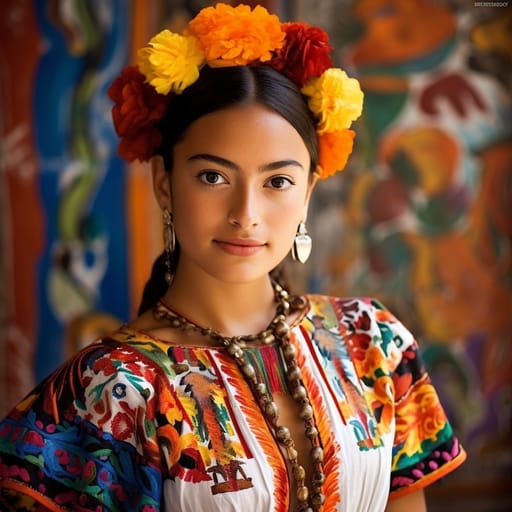
Otomi
same region (Central America)
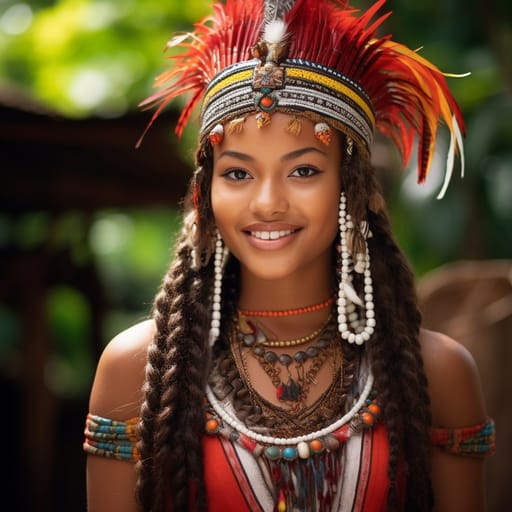
Kalinago
same region (Central America)
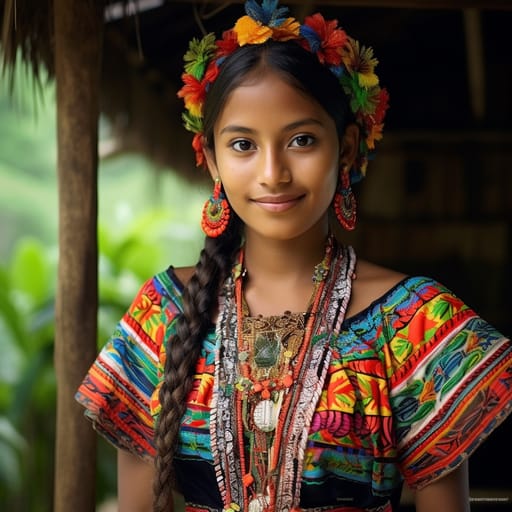
Miskito
same region (Central America)
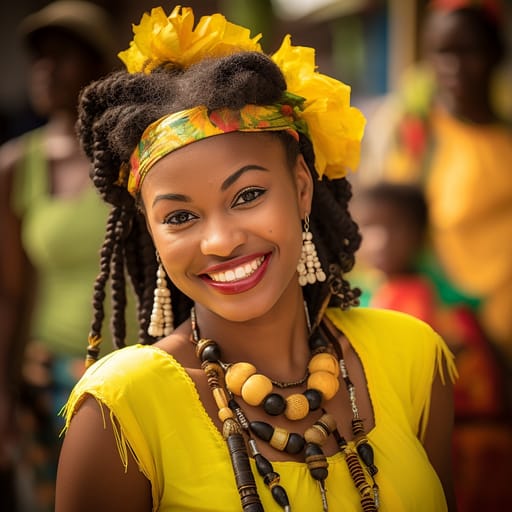
Garifuna
same region (Central America)
Lenca Salvadoran
same region (Central America)
Cabécar
same region (Central America)
Purépecha
same region (Central America)
Afro-Nicaraguan
same region (Central America)
Typical Zoque Phenotypes
Reference for AI generation: hair, eyes, skin, facial structure, build
Zoque Body & Anatomy Reference
Mesoamerican Indigenous / Mestizo phenotype: anatomy reference for AI nude generation
Zoque Boobs & Breasts
Zoque tits and boobs run medium-to-large cup, full, moderate-to-high projection, the classic Mesoamerican Indigenous / Mestizo bust profile. Zoque nipples and areolas show medium-brown to dark-brown areolar pigmentation against the tan-to-medium-brown skin tone, with areolar diameter typically in the 32-46mm range and forward-set positioning rather than the smaller East Asian bust. Zoque breasts trend full and projecting, classic Latina curvy bust profile, a function of the endomorph-to-mesomorph with strong hip-and-bust deposition body habitus and the mean adult female BMI 26-29. For anatomically accurate AI-generated Zoque nudes the render preserves the medium-to-large cup, full, moderate-to-high projection shape, 32-46mm areolas with medium-brown to dark-brown pigmentation, and the torso proportions of the Mesoamerican Indigenous / Mestizo phenotype.
Zoque Ass & Hips
Zoque hips and butt usually read as medium-to-full, high projection, classic Latina curvy hip profile. The skeletal base is wide iliac crests, full gluteal-femoral fat deposition, the Mesoamerican Indigenous / Mestizo pattern. Set against the slim narrow-hip East Asian profile, the difference is easy to see, and the hip-to-waist ratio is often what identifies Zoque women in photos.
Zoque Vagina & Pussy
Expect medium-brown to dark-brown labial pigmentation, fuller labia minora on Zoque women, in keeping with Mesoamerican Indigenous / Mestizo ancestry. The pubic hair is straight-to-wavy coarse dark texture, dense distribution. Coloring should run evenly from the tan to medium-brown skin of the thighs to the labia, and Zoque nude imagery should keep the hair's straight-to-wavy coarse dark texture.
Zoque Dicks & Penis
Zoque dick and penile anatomy in adult AI generation should anchor on the regional reference data: regional mean ~13cm erect, moderate girth, and medium-brown shaft pigmentation. The Zoque cock profile reflects the Mesoamerican Indigenous / Mestizo population's anthropometric measurements. The shaft pigmentation should track the surrounding tan to medium-brown skin tone, and the pubic hair should keep its straight-to-wavy coarse dark texture in the typical inverted-V escutcheon.
Zoque Body, Curves & Build
Zoque body type: endomorph-to-mesomorph with strong hip-and-bust deposition, with mean adult female BMI 26-29. This is the typical Mesoamerican Indigenous / Mestizo build. Height range, shoulder-to-hip ratio and fat distribution all follow from it, which is what an accurate Zoque nude body should show.
Zoque Skin Tone & Hair Texture
Zoque skin tone falls in the tan to medium-brown (Fitzpatrick III-V) band, the surface signal most often miscalibrated by generic AI nude generators. Zoque hair texture is typically straight-to-wavy 1A-2B, dense dark-brown to black, characteristic of the Mesoamerican Indigenous / Mestizo phenotype. In Zoque nude renders the skin should hold that band consistently across the body.
Explore phenotype categories
Structured taxonomy with peer-reviewed scales · 22 anatomical categories
Erotic Poses & Sex Positions
From the pose catalog: 219 named positions with reference skeletons
Frequently asked questions about Zoque people
Where is the Zoque homeland?
The Zoque homeland is Northwestern and central Chiapas, the Chimalapas region of eastern Oaxaca, and Ayapa in Tabasco, Mexico in Central America.
What language do Zoque people speak?
Zoque people primarily speak Zoque languages, including Chiapas Zoque, Chimalapa Zoque and Ayapa Zoque (Mixe-Zoquean).
What religion do Zoque people practice?
The predominant religion among Zoque people is Roman Catholicism fused with pre-Hispanic practice through household saints and mayordomia; a growing evangelical Protestant minority.






Make your own Zoque images
Five a day, free, no credits to buy. The studio starts from this group's phenotype data, so you can set body type, pose and style and keep the traits accurate.
Start with Zoque