Help us get this right
Does this portrait look right for Acaxee?
Nobody has judged this one yet. You would be the first.
Acaxee Erotic
Sierra Madre Occidental of eastern Sinaloa and northwestern Durango, Mexico, around the colonial mining centers of Topia and San Andrés
Acaxee, extinct (Uto-Aztecan, Taracahitic branch)
Indigenous religion centered on stone idols and war ritual; nominally Catholic after Jesuit missions from around 1600
Included the closely related Tebaca and Sabaibo; Taracahitic-speaking neighbors of the Xixime, Tepehuán and Tahue
About Acaxee People
The Acaxee were an Indigenous people of the Sierra Madre Occidental. They lived in the canyon country of eastern Sinaloa and northwestern Durango, Mexico, until Spanish mining, missionary rule and epidemic disease broke them apart in the late sixteenth and seventeenth centuries. Their descendants were absorbed into the mixed population of the region, and no Acaxee community exists today. What set them apart, in large part, was the ground they held. They lived in some of the most broken terrain in northern Mexico, with settlements scattered along ridges and steep barranca slopes, and they were surrounded by neighbors they often fought.
Their language belonged to the Taracahitic branch of Uto-Aztecan. That put them in the same broad family as the Tarahumara to the north and the Yaqui and Mayo of the lowlands toward the Gulf of California. Nearby lived the Xixime to the south, the Tepehuán to the east and the Tahue on the Sinaloa coastal plain. The closely related Tebaca and Sabaibo are generally counted within the Acaxee orbit. Daily life rested on small plots of maize, beans and squash, with hunting, fishing and wild plants gathered from the canyons making up the rest.
Religion and war were tightly bound. Spanish and Jesuit writers reported that the Acaxee feuded constantly with the Xixime, kept the bones of slain enemies as trophies and ate captives in ritual settings. Those accounts came from men with every reason to stress savagery, but the picture of fiercely independent mountain villages holds up. The Acaxee also kept stone idols, and Jesuit missionaries, among them Hernando de Santarén, set about destroying them.
Silver was the turning point. Spanish mines at Topia and San Andrés opened in the late sixteenth century, pulling the sierra into the colonial economy and putting Acaxee labor to work for it. In 1601 the Acaxee revolted under a religious leader the Spanish called Perico, who preached that the Spaniards should be driven out. The rebels burned churches and attacked mining settlements. Spanish forces under Francisco de Urdiñola then ended the revolt, with Jesuits acting as go-betweens. Epidemics did the rest, and within a few generations the Acaxee had faded as a distinct people. Their legacy lives on in colonial chronicles and mission records, and in the families of the Sinaloa and Durango highlands, who carry the ancestry without the name.
Related ethnic groups
Groups that share Acaxee's homeland, region, language, or religious tradition. These are likely candidates for comparative phenotype reference.
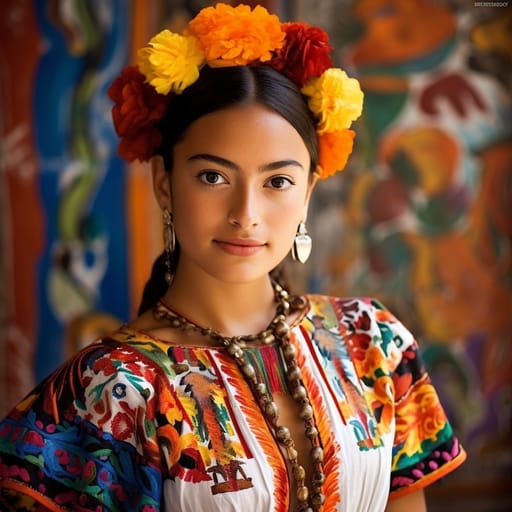
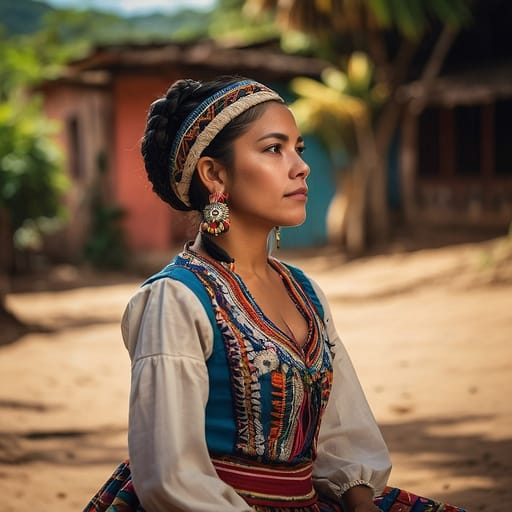
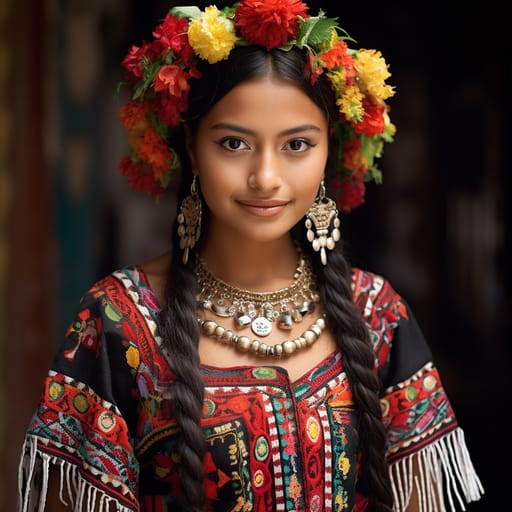
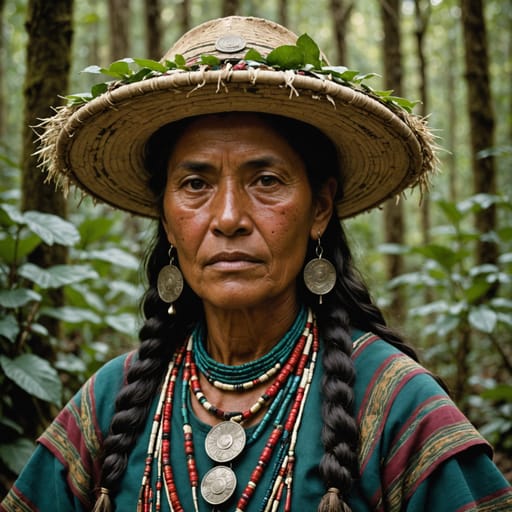
Typical Acaxee Phenotypes
Reference for AI generation: hair, eyes, skin, facial structure, build
Acaxee Body & Anatomy Reference
Anatomy by feature, Mesoamerican Indigenous / Mestizo phenotype
Acaxee Boobs & Breasts
The typical Acaxee bust is medium-to-large cup, full, moderate-to-high projection, in line with the wider Mesoamerican Indigenous / Mestizo pattern. Areolas usually fall in the 32-46mm range, with medium-brown to dark-brown areolar pigmentation against the tan-to-medium-brown skin tone. Compared with the smaller East Asian bust, Acaxee breasts sit forward and are generally full and projecting, classic Latina curvy bust profile. A faithful AI render of Acaxee tits keeps that shape and areola size.
Acaxee Ass & Hips
Butt shape among Acaxee women: medium-to-full, high projection, classic Latina curvy hip profile, over wide iliac crests, full gluteal-femoral fat deposition. This follows Mesoamerican Indigenous / Mestizo ancestry and looks quite unlike the slim narrow-hip East Asian profile. An accurate Acaxee ass in adult AI imagery keeps both the silhouette and the overall build (endomorph-to-mesomorph with strong hip-and-bust deposition) instead of a generic average.
Acaxee Vagina & Pussy
Vulvar anatomy among Acaxee women: medium-brown to dark-brown labial pigmentation, fuller labia minora. Pubic hair tends to be straight-to-wavy coarse dark texture, dense distribution, in the usual inverted-triangle pattern. Both follow Mesoamerican Indigenous / Mestizo pigmentation, which is why Acaxee pussy renders should not fall back on a pale, sparse Western template.
Acaxee Dicks & Penis
The Acaxee cock profile, from Mesoamerican Indigenous / Mestizo anthropometric data: regional mean ~13cm erect; moderate girth; medium-brown shaft pigmentation. Pubic hair has a straight-to-wavy coarse dark texture and forms the usual inverted-V pattern. Whether Acaxee men are circumcised follows religious and cultural practice rather than phenotype.
Acaxee Body, Curves & Build
Build and curves among Acaxee women follow the Mesoamerican Indigenous / Mestizo pattern: endomorph-to-mesomorph with strong hip-and-bust deposition, mean adult female BMI 26-29. Proportions matter as much as skin tone, so Acaxee figures should keep their regional height and limb ratios.
Acaxee Skin Tone & Hair Texture
The Acaxee skin range is tan to medium-brown (Fitzpatrick III-V), and hair tends to be straight-to-wavy 1A-2B, dense dark-brown to black. That combination marks the Mesoamerican Indigenous / Mestizo phenotype, and skin tone is the trait AI generators most often get wrong for Acaxee women.
Explore phenotype categories
Structured taxonomy with peer-reviewed scales · 22 anatomical categories
Erotic Poses & Sex Positions
From the pose catalog: 219 named positions with reference skeletons
Frequently asked questions about Acaxee people
Where is the Acaxee homeland?
The Acaxee homeland is Sierra Madre Occidental of eastern Sinaloa and northwestern Durango, Mexico, around the colonial mining centers of Topia and San Andrés in Central America.
What language do Acaxee people speak?
Acaxee people primarily speak Acaxee, extinct (Uto-Aztecan, Taracahitic branch).
What religion do Acaxee people practice?
The predominant religion among Acaxee people is Indigenous religion centered on stone idols and war ritual; nominally Catholic after Jesuit missions from around 1600.






Make your own Acaxee images
Five a day, free, no credits to buy. The studio starts from this group's phenotype data, so you can set body type, pose and style and keep the traits accurate.
Start with Acaxee